
How AI is transforming local marketing in Canada
Canadian customers are choosing local service businesses differently than they did even two years ago. Instead of scrolling through a list of blue links, they ask an AI tool a question and receive a single, confident recommendation. That shift changes everything for HVAC contractors, plumbers, dentists, lawyers, and every other local service provider trying to grow. This article explains exactly how AI-driven discovery works, what signals influence it, and the practical steps you can take right now to make sure your business is the one being recommended rather than the one being skipped.
Table of Contents
- How AI is reshaping local search and discovery
- What influences AI recommendations for local businesses
- Practical steps to improve your visibility with AI
- How AI interprets reviews and content: creating a better first impression
- Why AI marketing demands a new mindset for Canadian local owners
- Canadian AI visibility solutions for your local business
- Frequently asked questions
Key Takeaways
| Point | Details |
|---|---|
| AI shifts search experience | Customers often see AI-generated summaries first, so your business must stand out in those recommendations. |
| Reviews and profile completeness matter | AI chooses featured businesses based mainly on review volume and accurate Google Business Profile data. |
| Descriptive reviews are vital | Encouraging detailed, specific reviews helps AI emphasize your services and strengths. |
| Update your information | Regularly maintain accurate business details across listings to prevent errors that reduce AI visibility. |
| Mindset shift required | Competing for AI-driven discovery means focusing on reputation and relevance, not just traditional SEO. |
How AI is reshaping local search and discovery
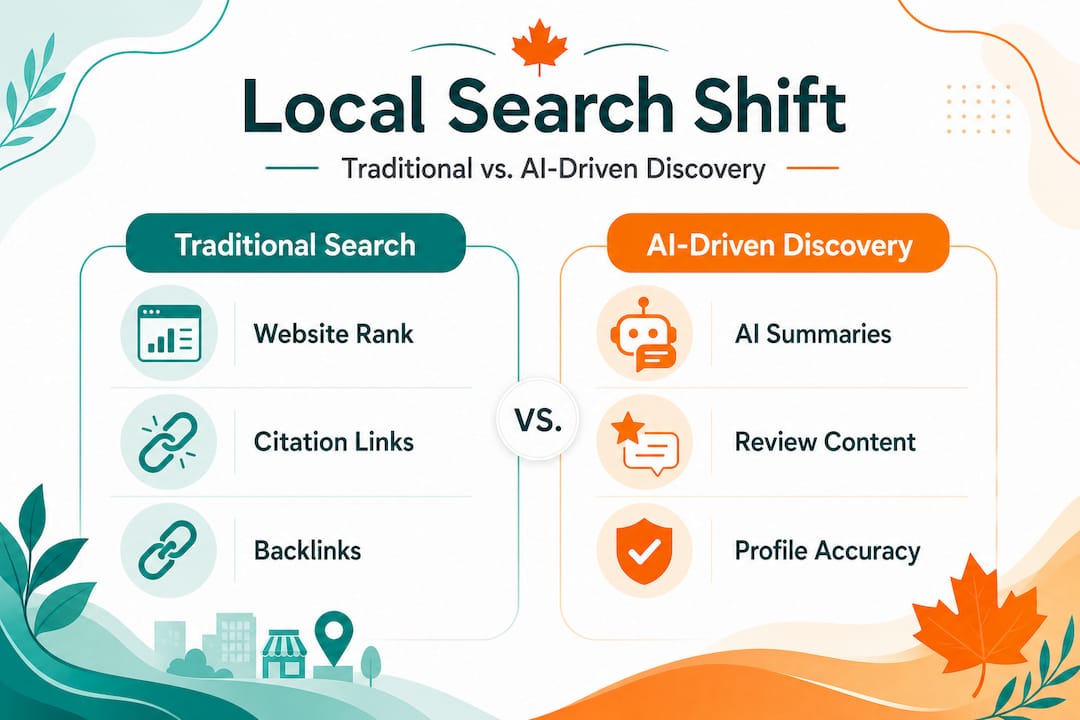
Traditional local search was a ranking game. You optimised your website, built citations, earned backlinks, and hoped to land on page one. The reward was a click. That model is giving way to something fundamentally different.
AI is changing local marketing by shifting discovery from “rank-and-click” results to AI-generated answers and summaries that synthesise information from listings, reviews, and websites. When someone types “best plumber in Calgary” into an AI-enabled search tool, the AI does not hand them ten options and leave. It reads your reviews, scans your website, checks your business profile, and then writes a paragraph recommending one or two businesses by name. That paragraph is what the customer reads. Your ranking position barely factors in.
Google has accelerated this change considerably. The platform now provides AI-powered review summaries generated directly from user reviews, meaning the actual words your customers write become a direct input into what future customers see. A shopper looking at your Google Maps listing no longer reads a dozen individual reviews. They see a two-sentence AI summary that condenses the themes from hundreds of reviews into a single impression.
| Traditional local search | AI-driven discovery |
|---|---|
| Ranks websites by authority and relevance | Recommends businesses by synthesis of profile, reviews, and content |
| Customer clicks a link and reads independently | AI writes the summary the customer reads |
| Star rating is the primary trust signal | Review themes and descriptive language shape the narrative |
| Technical SEO drives visibility | Reputation, accuracy, and content quality drive visibility |
| Multiple results shown equally | One or two businesses featured confidently |
This shift is not a distant prediction. It is happening in Canadian searches right now. If you want to understand it more deeply, our guides on AI SEO for Canadian businesses and AI-powered search provide a strong foundation.
Now that we have set the stage, let us look at exactly what factors influence how AI chooses which local businesses to feature.
What influences AI recommendations for local businesses
Here is where things get genuinely surprising for most business owners. You might assume that AI tools favour businesses with the fastest websites, the cleanest schema markup, or the most backlinks. The data says otherwise.
A study of 10,000 local businesses found that review volume, Google Business Profile completeness, and local pack presence correlate more strongly with AI recommendations than technical SEO factors. Core Web Vitals, page speed, and structured data were the weakest correlations. That finding should change how you spend your marketing time.
The three signals that matter most:
- Review volume: The more reviews you have, the more material AI has to draw from. A business with 12 reviews and a 5-star average loses to a business with 180 reviews and a 4.6-star average in most AI evaluations. Volume signals legitimacy.
- Google Business Profile completeness: AI tools pull from your profile to populate recommendations. Missing hours, no service descriptions, absent photos, and incomplete category selections all create gaps that AI tools interpret as uncertainty.
- Local Pack presence: Appearing in the Google Local Pack (the map with three business listings) dramatically increases the likelihood of being featured in AI-generated answers. Local Pack presence is partly a function of the two signals above.
Statistic worth noting: The same study found that technical SEO factors were the least meaningful correlations for AI-driven recommendations. If you are spending your entire marketing budget on page speed optimisation while neglecting your Google Business Profile and review programme, you are optimising for the wrong era.
The gap between awareness and accuracy is equally striking. According to the same research, 93% of businesses are known by AI tools, but only 55% have accurate details. Your business is probably already in the AI’s awareness. The question is whether what the AI knows about you is correct.
We go deeper on how these signals intersect in our articles on AI and reputation in local search and our reputation management guide.
Let us take these data-backed criteria and see how you can practically optimise your business for AI-driven marketing.
Practical steps to improve your visibility with AI
AI visibility is more like being cited or recommended than being ranked, so your marketing approach should combine reputation operations, Google Business Profile accuracy, and question-based content. Here is what that looks like in practice.
-
Complete your Google Business Profile without shortcuts. Fill in every field: services offered, service areas, business hours (including holiday hours), photos, business description, and attributes. If you run an HVAC company, list every service you provide. Do not leave any section blank. AI tools treat incomplete profiles as less trustworthy.
-
Create a simple review generation system. After every job, send a follow-up message to your customer asking them to leave a Google review. The message does not need to be long. Something like “Hi, thanks for choosing us today. If you have a moment, a Google review helps us a lot” works well. Consistency matters more than volume in the short term. Ten new reviews a month beats zero.
-
Respond to every review, especially negative ones. Your response becomes part of the data AI reads. When you respond to a critical review by explaining what went wrong and how you resolved it, you give AI tools additional context. That context shapes the summary customers see. A business with 40 responded reviews outperforms a business with 200 silent reviews in AI summary quality.
-
Ensure business detail accuracy across all platforms. Check your name, address, and phone number on Google, Yelp, Apple Maps, Facebook, and any industry directories. A 93% to 55% accuracy gap is enormous. Wrong hours or a mismatched address tells AI tools your business data cannot be trusted, which reduces recommendation confidence.
-
Create content that answers real customer questions. If homeowners in your city ask “how long does furnace replacement take?” or “do I need a permit for a new hot water tank?”, write a page or blog post that answers that question directly. AI tools look for locally relevant, question-answering content when forming recommendations.
Pro Tip: Ask a few trusted customers to be specific in their reviews. Instead of “Great service!”, coach them toward something like “They fixed my burst pipe in two hours on a Sunday afternoon. Excellent work.” That descriptive language feeds directly into the AI summary your future customers will read.
For more on creating content that aligns with how AI tools evaluate local businesses, visit our guides on AI content creation tips and content visibility strategies.
Owners often overlook the subtle ways reviews contribute to AI summaries, so next we will change focus to what makes review text, not just ratings, so influential.
How AI interprets reviews and content: creating a better first impression
Star ratings are a blunt instrument. A 4.8-star average tells a potential customer almost nothing about whether your business is fast, friendly, reliable, or good with emergencies. AI tools read further than the stars.

AI summaries extract themes and attributes from the descriptive language inside reviews rather than simply averaging star scores. If fifteen of your customers mention that you arrived on time, the AI summary will likely note your punctuality. If twelve customers mention your technicians explained things clearly, the summary will reflect clear communication as a business strength. These attributes are what move customers from curious to committed.
What this means for your business:
- Descriptive reviews build richer AI summaries. Customers who say “professional, on time, and explained everything clearly” give AI far more to work with than customers who say “great!”
- Recurring keywords create themes. If you want to be known for emergency availability, you need reviews that mention emergency availability. The AI learns what customers value about your business from what they write, not from what you say about yourself.
- Responses add depth to the record. When you thank a customer and reiterate a specific service or detail (“glad we could get your furnace running before the cold snap”), you reinforce a theme in the data AI reads.
- Your website content works alongside reviews. Pages that use the same language your customers use (“same-day drain cleaning in Vancouver” rather than “expedient plumbing remediation services”) help AI tools match your business to natural-language queries.
“Review content becomes a direct input to what customers see.” That is not a future possibility. It is happening on every Google Maps listing in Canada today.
Pro Tip: After responding to reviews, scan the language your happiest customers use. Those phrases, words like “fast,” “honest,” “no hidden fees,” or “explained everything” are the exact terms to weave into your service page copy and your business description.
To stay current on how AI evaluates businesses, browse our AI SEO blog for ongoing insights, and revisit our review management article for a full reputation framework.
With a clear understanding of how AI impacts visibility, let us consider some deeper truths about why owners must adjust their approach beyond technical SEO.
Why AI marketing demands a new mindset for Canadian local owners
We talk to a lot of local business owners across Canada, and we see the same pattern repeatedly. They know SEO matters, so they spend money on it. They fix their page speed, add schema markup, chase backlinks. None of that is wasted. But it is increasingly the wrong investment if their Google Business Profile is half-empty and their last review was eight months ago.
The honest truth is that AI tools behave more like a trusted friend giving a recommendation than like a search engine returning a ranked list. When your friend recommends a plumber, they say “call Dave, he is reliable, shows up on time, and his prices are fair.” They are synthesising their experience. That is precisely what AI tools do, and the inputs they use are your reviews, your profile data, and your content.
The businesses winning in AI-driven discovery are not the ones with the cleverest technical setups. They are the ones with consistent, detailed review programmes and accurate listings. A roofing company in Hamilton with 210 reviews, full profile data, and question-answering blog posts will outperform a company with a technically superior website and 18 thin reviews in almost every AI recommendation scenario.
Our AI reputation strategy guide unpacks this in detail, but the short version is this: the flywheel is reputation, not ranking. More reviews generate better AI summaries, better summaries attract more customers, more customers generate more reviews. Getting that flywheel spinning is the single most valuable marketing action you can take in 2026.
Stop optimising for the old game. Optimise to be recommended.
Canadian AI visibility solutions for your local business
If this article has made one thing clear, it is that AI-driven local marketing is not a distant trend but a real, measurable shift affecting Canadian service businesses right now.
At Locally Visible, we build done-for-you AI search visibility for Canadian local service businesses, from HVAC and plumbing to dental and legal. Our work is designed to get you cited by ChatGPT and other AI tools within 90 days, or we work free until you are. Whether you need to strengthen your reputation programme, complete your profile data, or create content that answers real customer questions, we have industry-specific AI solutions built for your market. Explore the full range of AI SEO for service industries and take the first step toward being recommended, not just ranked.
Frequently asked questions
How does AI choose which local businesses to feature in search results?
AI uses review volume, profile completeness, and Local Pack presence rather than technical SEO to select which businesses to highlight. These three signals carry far more weight than page speed or structured data.
Do Google review responses impact AI-generated summaries?
Yes, your responses add context and service details that shape what AI summarises. Review content is a direct input into the summaries customers see, and your replies become part of that content record.
What’s the biggest mistake local business owners make with AI-driven marketing?
Focusing exclusively on technical SEO while neglecting reputation and profile completeness is the most common oversight. Technical SEO factors were the least meaningful correlations found in a study of 10,000 local businesses.
How can I make sure my business details are accurate for AI?
Keep your Google Business Profile and all directory listings complete, consistent, and updated regularly. Only 55% of businesses have accurate details according to AI tools, even though 93% are already known, making accuracy a major competitive advantage.
Recommended
- How AI transforms content for Canadian local businesses — Locally Visible
- How AI transforms content for Canadian local businesses — Locally Visible
- What is AI SEO? Boost local visibility for Canadian businesses — Locally Visible
- What is AI-powered search? Guide for Canadian service businesses — Locally Visible