Blog / What Is Ai-Powered Search
What is AI-powered search? Guide for Canadian service businesses

The short answer
AI-powered search means engines like ChatGPT, Perplexity, and Google AI Overviews synthesize a single answer from multiple sources rather than returning a list of blue links. For Canadian service businesses, this changes the goal from ranking to citation — getting your business named inside the answer. Engines weight Reddit mentions, schema markup, and topical depth above traditional ranking signals.
Traditional SEO is no longer the whole game. If you run a local service business in Canada, the way potential customers find you is changing faster than most business owners realise. AI-powered search platforms like ChatGPT, Google’s AI Overview, and Microsoft’s AI-assisted results are reshaping local discovery in real time. Some businesses will ride this wave and win more customers. Others will keep optimising for yesterday’s algorithm while their competitors get recommended by AI tools their customers are already using every day. Understanding what AI-powered search actually is, and what it means for your business, is one of the most important things you can do right now.
Table of Contents
- What AI-powered search means for local businesses
- How AI-powered search changes customer discovery
- What AI-powered search means for your opportunity and risk
- Steps to boost your AI-powered search visibility in 2026
- Why most Canadian local businesses are missing the AI search revolution
- Partner with AI search experts for real results
- Questions we often hear
Key Takeaways
| Point | Details |
|---|---|
| AI search changes the game | AI-powered search redefines how local Canadians find and choose service providers. |
| Act now to stay visible | Businesses that delay adopting AI search fall behind in customer acquisition and online presence. |
| Get found by new customers | Optimising for AI search drives more qualified leads to your local business. |
| Balance opportunity and risk | Leveraging AI search brings big rewards but demands vigilance against misinformation and bias. |
| Simple steps make a difference | Practical changes, such as updating profiles and adding schema markup, quickly boost AI visibility. |
What AI-powered search means for local businesses
Now that you understand that search habits are shifting, let’s define exactly what AI-powered search means and how it’s different from the SEO strategies you know.
AI-powered search refers to search experiences driven by large language models (LLMs) and generative AI. Instead of showing a list of blue links, these platforms read your query, interpret the intent behind it, and synthesise an answer often including a recommended business, service, or solution. Think of it as the difference between a filing cabinet (traditional search) and a knowledgeable colleague (AI search) who gives you a direct answer based on everything they know.

Traditional search engines rank pages using signals like keywords, backlinks, and on-page SEO. AI-powered search goes further. It processes natural language queries, understands context, and delivers summarised recommendations rather than ranked lists. When someone types “who’s the best electrician near me” into ChatGPT, they don’t get ten links. They get a name, possibly yours, or possibly your competitor’s.
| Factor | Traditional search | AI-powered search |
|---|---|---|
| Results format | List of ranked links | Natural language summary + recommendations |
| Query style | Keywords (“electrician Toronto”) | Full sentences (“Who can fix my panel tonight?”) |
| Citations | Website rankings | Brand mentions, reviews, structured data |
| Business control | On-page SEO, backlinks | Authority signals, citation consistency, GEO |
| Trust signals | Domain authority | Review volume, schema, verified listings |
Core features of AI-powered search local businesses should know:
- Results are generated from synthesised data, not just ranked pages
- Natural language queries produce direct answers, not link lists
- AI models favour businesses with consistent, accurate, and well-structured information
- Review quality and volume directly influence AI recommendations
- AI search visibility basics depend on structured data and trustworthy citation sources
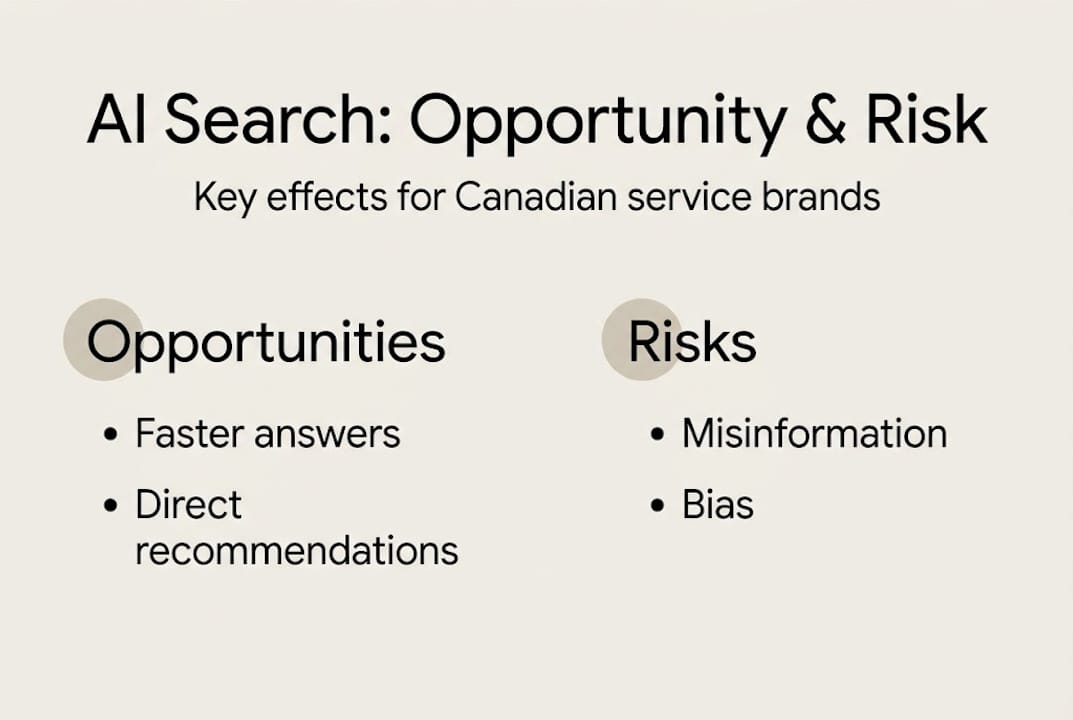
Here’s something worth noting. Research has found that AI can introduce risks of misinformation and bias compared to traditional search results, meaning the information AI surfaces about your business may not always be accurate if your online data is inconsistent or outdated. For a plumber in Calgary, that could mean AI confidently recommending the wrong phone number or a competitor who invested in better data hygiene.
How AI-powered search changes customer discovery
With a clear definition in mind, let’s look at how AI-powered search is actively changing the local discovery journey for your potential customers.
Picture someone in Ottawa asking ChatGPT: “What’s the best plumber near me for a burst pipe?” That query doesn’t trigger a Google Maps pack or a list of websites. The AI model pulls from its training data, live web sources, and structured information to recommend a specific business. If your business isn’t visible in the sources AI models trust, you simply don’t exist in that answer.
| Stage | Classic local SEO funnel | AI search recommendation funnel |
|---|---|---|
| Discovery | Customer googles keyword, clicks listing | Customer asks AI, receives a direct recommendation |
| Trust-building | Reviews on Google, website browsing | AI summarises reputation signals, cites sources |
| Contact | Customer clicks through to website | Customer contacts business directly from AI response |
| Decision | Customer compares multiple results | AI pre-filters to 1-3 trusted options |
Steps a customer takes from query to booking in the AI model:
- Customer asks AI a conversational question about a local service need
- AI model retrieves trusted sources: review platforms, business listings, news mentions, schema data
- AI synthesises a recommendation with 1 to 3 business options
- Customer contacts the recommended business directly, often skipping the website entirely
- Business converts the lead without the customer ever comparing competitors
That last point is significant. Let it sit for a second. AI search compresses the decision funnel dramatically. The businesses that get recommended win the lead before the customer even considers shopping around.
Research shows that brands can lag 20 to 50% behind in AI-powered visibility compared to traditional SEO. This means your current SEO ranking may give you false confidence. You could be ranking well on Google while being invisible to AI platforms your customers are increasingly using.
Review our AI SEO field notes to see real examples of how Canadian businesses are showing up in AI queries, and understand how AI tools pick business recommendations in practice.
Pro tip: Make sure your business name, address, and phone number are identical across every directory, review site, and social profile. AI models cross-reference these sources. Any inconsistency reduces their confidence in recommending you.
What AI-powered search means for your opportunity and risk
Understanding these shifts reveals openings, and new risks, for your business in a world dominated by AI-powered search.
New opportunities for businesses that act now:
- Early adopters gain AI recommendation slots before competitors even realise the game has changed
- AI search can amplify your reputation faster than traditional SEO if your signals are strong
- Being cited by AI tools positions you as the default trusted option in your trade category
- AI-optimised businesses often get recommended without the customer needing to visit your website at all
- AI SEO for trades is still an open field in Canada, meaning the barrier to leading is lower right now than it will be in 18 months
But the risks are real too. Research confirms that AI search is less reliable in critical information domains and can introduce bias or errors into its recommendations. If your business has outdated listings, poor review quality, or conflicting information online, AI models may either ignore you or worse, recommend inaccurate details to potential customers.
“AI-generated results risk amplifying misinformation where data quality is inconsistent, making proactive reputation management a necessity, not an option.” Source: PMC Research, 2024.
There’s also the control problem. With traditional SEO, you can adjust your page, build links, and see measurable ranking shifts. With AI search, the algorithm is opaque. You can’t simply optimise a single page and expect results. Your entire digital footprint, from schema for AI citations to review platforms to third-party mentions, becomes the ranking signal.
AI is also reshaping other industries at speed. Look at AI’s impact in security industries as a parallel: early movers built substantial competitive advantages that late adopters now struggle to close.
Pro tip: Google your business regularly and audit what AI tools say about you. Ask ChatGPT directly: “Who are the best [your trade] in [your city]?” If you’re not mentioned, that’s your gap.
Steps to boost your AI-powered search visibility in 2026
Once you know what’s at stake, here’s how you can ensure your business stands out in both classic and AI-powered search in 2026.
Research is clear that GEO optimisation is now essential as businesses consistently lag behind in AI search visibility compared to traditional SEO performance. GEO, or generative engine optimisation, is the practice of making your business information more accessible and trustworthy to AI models.
Your 2026 AI search playbook:
- Claims your Google Business Profile and all major listings. Keep your name, address, and phone number consistent everywhere.
- Add structured schema markup to your website. Schema is machine-readable code that tells AI models exactly what your business does, where you operate, and what customers say about you.
- Build local citations on Canadian directories such as YellowPages.ca, HomeStars, and local chamber sites. Volume and consistency matter.
- Generate a steady stream of new reviews. AI models weight recent, high-volume reviews heavily. Review velocity is a real signal.
- Update your service area descriptions clearly on your website and all profiles. AI models need geographic clarity to recommend you for local queries.
Quick wins for 2026 AI search visibility:
- Update your website content to answer full-sentence questions customers actually ask
- Add FAQ sections to your service pages using natural conversational language
- Check for and fix any outdated or conflicting business information across all platforms
- Build mentions on trusted local news sites and trade associations
- Ask satisfied customers to mention your specific services and city in their reviews
Pro tip: Schema markup is one of the highest-leverage actions you can take right now. It essentially translates your business information into a language AI models read fluently. If you haven’t implemented it yet, explore the AI SEO process we use for Canadian trades to see how we handle it done-for-you.
Why most Canadian local businesses are missing the AI search revolution
Stepping beyond strategy for a moment, let’s talk about why so many businesses fail to benefit from this shift and what separates the ones that do.
The uncomfortable truth is that most local business owners are waiting. They’re watching. They assume AI search is still experimental or too complicated to engage with. That inertia is expensive. The businesses we see gaining real momentum in AI-generated recommendations aren’t the biggest or the most tech-savvy. They’re the ones who started treating their digital reputation as infrastructure, not an afterthought.
The common mistake we observe is doubling down on old SEO tactics while AI platforms are being trained on entirely different signals. Authority, trust, and citation consistency matter far more to AI models than keyword density ever did.
Here’s what we’ve seen consistently: proactive businesses that align their listings, reviews, and schema early capture AI recommendation slots that competitors then find very difficult to displace. It’s a flywheel. Once AI tools learn to trust you, they keep recommending you. Browse our real-world AI SEO examples to see this in action across Canadian trades.
Don’t wait for your competitors to figure this out first. AI search is the new front line for winning local customers.
Partner with AI search experts for real results
Ready to win in your local market? Here’s how we at locallyvisible.ca can help you turn AI-powered search into measurable growth.
We built our entire process around one goal: getting Canadian local service businesses cited by ChatGPT and other AI platforms, starting with a free visibility check. No vague promises, no mystery pricing. Our AI SEO system handles your listings, schema, citation building, and review strategy for you. Check our transparent AI SEO pricing to see exactly what’s included, and review how the process works to understand what we stand behind. Your competitors are not waiting. Neither should you.
Questions we often hear
What makes AI-powered search different from traditional SEO?
AI-powered search uses language models and context to recommend local services directly, while traditional SEO focuses on ranking websites through keywords and backlinks. Research confirms that AI systems process information in fundamentally different ways than classic search algorithms do.
Are there risks to relying only on AI-driven search results?
Yes. AI results can present misinformation or biased recommendations, so businesses need to maintain accurate, high-quality information across all platforms. Studies show that AI introduces risks of misinformation or bias compared to traditional search results.
How soon should local service businesses adopt AI-powered search strategies?
Now, not later. AI platforms are already influencing customer choices across Canada in 2026, and brands currently lag 20 to 50% in AI-powered visibility compared to their SEO performance.
What is the first step to improve AI search visibility for a local business?
Start by updating all business profiles for accuracy, add structured schema markup to your website, and encourage a consistent flow of new customer reviews. GEO optimisation is now essential as businesses lag in AI search compared to SEO results.