
One bad review at the wrong moment can cost a local service business in Canada a week’s worth of new customers. That’s not a hypothetical. It’s the reality for plumbers, electricians, landscapers, and dozens of other trades watching potential clients scroll past their listing toward a competitor with a cleaner reputation. The good news? Reputation is manageable. In this guide, we walk you through the legal landscape, practical tools, and proven strategies Canadian service businesses need to attract more customers and build lasting trust online.
Table of Contents
- Understanding business reputation management in Canada
- Essential tools and resources for managing your reputation
- How to generate, respond to, and leverage reviews
- Avoiding common mistakes and staying compliant
- Measuring success and adapting your strategy
- Why reputation is built on action, not just words
- Supercharge your reputation with AI-powered solutions
- Frequently asked questions
Key Takeaways
| Point | Details |
|---|---|
| Authentic reviews matter | Canadian business reputation grows best with real, organic reviews—never incentivize or fake them. |
| Respond to shape perception | Personal, thoughtful owner responses not only address concerns but encourage better future reviews. |
| Use the right tools | Combining automated alerts with mixed-mode follow-ups makes review management easier and more effective. |
| Track and adapt | Consistently measure your review metrics and iterate your business practices to drive lasting results. |
Understanding business reputation management in Canada
Reputation management is the ongoing practice of shaping how your business appears online and in your community. For Canadian local service businesses, this means monitoring reviews, responding to feedback, maintaining consistent information across directories, and actively building goodwill with every customer interaction.
Let that sit for a second: every customer interaction. Not just the five-star ones.
Why it matters for local businesses specifically
Local service businesses depend on trust more than almost any other category. When someone hires a plumber or a roofer, they’re letting a stranger into their home. Reviews are the modern word-of-mouth, and they carry enormous weight in that decision. Check out industry-specific reputation tips to see how different trades approach this differently.

Here’s a quick snapshot of what’s at stake:
| Factor | Impact on local business |
|---|---|
| Star rating below 4.0 | Significant drop in click-through rates |
| No response to negative reviews | Signals poor customer service |
| Inconsistent business info online | Hurts local search rankings |
| High review volume | Builds trust and search visibility |
What Canadian law says about reviews
This is where many business owners get tripped up. Canada’s Competition Bureau is clear: incentivized or fake reviews are considered deceptive marketing practices and are prohibited. That means no gift cards for reviews, no discounts in exchange for feedback, and definitely no paid review services.
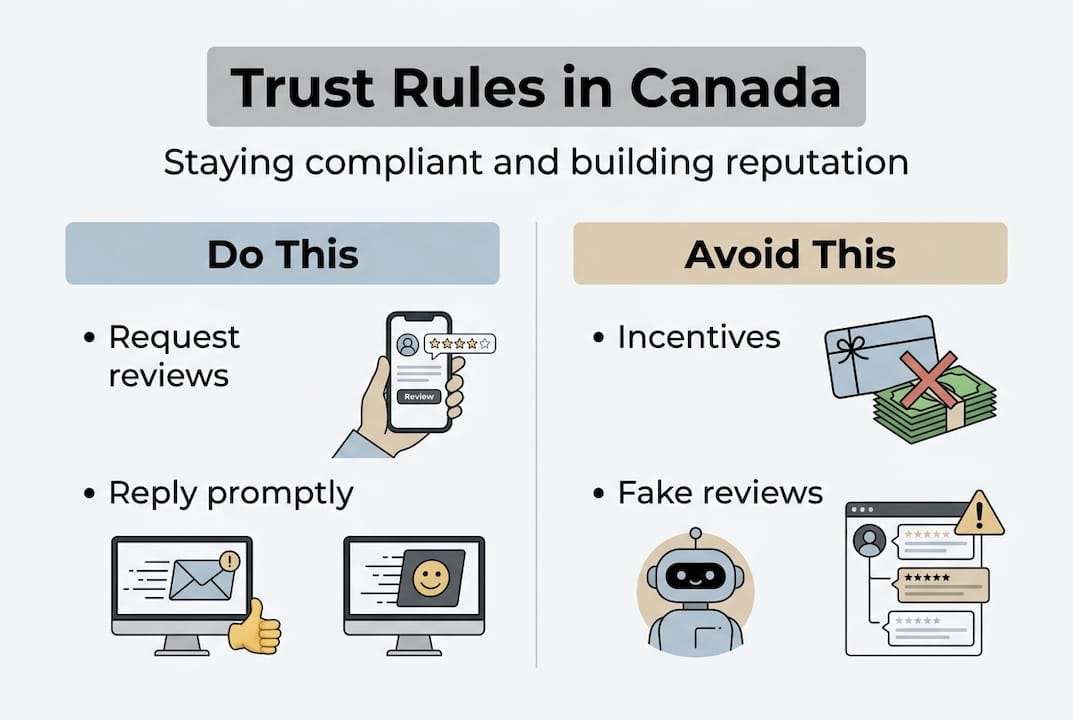
The rules exist to protect consumers, but they also protect honest businesses from being undercut by competitors gaming the system.
Common misconceptions to drop right now
- “I just need more five-star reviews.” Volume matters, but so does recency, diversity, and how you respond.
- “Negative reviews will ruin me.” A thoughtful response to a bad review often impresses potential customers more than the review itself.
- “Reputation management is a one-time fix.” It’s a flywheel. You keep it spinning or it slows down.
“Your reputation is what people say about you when you’re not in the room. Online, that room never closes.”
Essential tools and resources for managing your reputation
Knowing what reputation management involves is step one. Having the right tools to actually do it is step two.
Platforms you must monitor
- Google Business Profile (the most critical for local search)
- Facebook Business Page
- Yelp (especially relevant for restaurants, contractors, and home services)
- HomeStars (popular in Canada for home service trades)
- Better Business Bureau Canada
Tool comparison: reputation monitoring options
| Tool | Best for | Price range | Key feature |
|---|---|---|---|
| Google Alerts | Basic monitoring | Free | Email alerts for brand mentions |
| Birdeye | Multi-location businesses | Paid | Centralized review dashboard |
| Podium | Service businesses | Paid | Text-based review requests |
| Grade.us | Agencies and trades | Paid | Review funnel automation |
| Mention | Social listening | Freemium | Real-time brand tracking |
For most small service businesses, starting with Google Alerts plus your Google Business Profile dashboard costs nothing and covers the most important ground.
AI and personalization: a careful balance
AI tools can help you draft responses faster, flag sentiment trends, and schedule follow-up requests. But AI tools for reputation work best when they assist your judgment, not replace it. A response that reads like a template does more damage than no response at all.
Research shows that mixed follow-up methods including telephone outreach boost review response rates by 13%. That’s a meaningful lift from simply picking up the phone alongside your digital follow-ups.
Pro Tip: After completing a job, send a text or email with a direct link to your Google review page. Then follow up with a quick call two days later. This two-touch approach consistently outperforms either method alone.
For deeper frameworks on this, explore our review management strategies to see what’s working across different Canadian trades.
How to generate, respond to, and leverage reviews
With your monitoring tools set up, here’s the practical playbook for building review velocity and making those reviews work for your business.
Step-by-step: earning authentic reviews
- Complete the job well. This sounds obvious, but it’s the foundation. No review strategy fixes a poor service experience.
- Ask at the right moment. The best time is right after the customer expresses satisfaction, not days later when the moment has passed.
- Make it frictionless. Send a direct link. Don’t ask them to search for you.
- Use a two-touch follow-up. Text or email first, then a brief phone call if no response within 48 hours.
- Thank every reviewer. Publicly. Even if it’s just two sentences.
How your responses shape future reviews
Here’s something most guides skip: owner responses influence the length and quality of future reviews. When you respond thoughtfully, subsequent reviewers write more detailed, more cognitive content. That’s a signal to Google and to potential customers that your business is engaged and trustworthy.
This is especially relevant for mechanics, HVAC technicians, and other service businesses where trust is the core product. Understanding who gets recommended online helps clarify why your response behavior matters as much as your star rating.
Negative reviews: treat them as diagnostics
- Read the complaint carefully before responding.
- Acknowledge the issue without assigning blame.
- Offer to resolve it offline when appropriate.
- Never argue publicly.
A negative review handled well is visible proof that you take customer care seriously. For more on building client trust through transparency, the principle is simple: own your mistakes faster than your competitors do.
Pro Tip: Screenshot your best reviews and add them to your website’s testimonials page. Real words from real customers outperform any marketing copy you could write.
Avoiding common mistakes and staying compliant
Even businesses with good intentions make avoidable errors. Here are the most common ones we see across Canadian service trades.
Mistakes that hurt your reputation (and sometimes your legal standing)
- Buying reviews. It violates Canadian law and platforms detect it. The short-term boost isn’t worth the long-term risk.
- Ignoring negative reviews. Silence reads as guilt or indifference to prospective customers.
- Copy-paste responses. Customers notice when every reply sounds identical. It signals automation without care.
- Responding defensively. Arguing with a reviewer publicly almost always backfires.
- Letting your listing go stale. Outdated hours, wrong phone numbers, or missing photos erode trust before a customer even contacts you.
The legal line in Canada
As noted earlier, incentivized or fake reviews are prohibited under Canadian deceptive marketing practice rules. This applies to every business, regardless of size. Review your review compliance policy to make sure your current practices are above board.
Statistic callout: Using mixed follow-up methods (phone plus digital) boosts response rates by 13% compared to single-channel outreach. That’s a significant gain from a simple process change.
Why ethical practices win long-term
Shortcuts in reputation management tend to collapse at the worst possible time, right when you’re trying to grow. Transparent, customer-first practices build compounding trust. Every genuine review, every honest response, every resolved complaint adds to a foundation that’s very hard for competitors to replicate.
Measuring success and adapting your strategy
You can’t improve what you don’t measure. Here’s how to track your reputation efforts and adjust based on real signals.
Key metrics to monitor
| Metric | What it tells you | How often to check |
|---|---|---|
| Average star rating | Overall perception | Weekly |
| Review volume (monthly) | Momentum and engagement | Monthly |
| Response rate | How proactive you are | Weekly |
| Review content themes | Recurring service issues | Monthly |
| Review recency | How fresh your credibility is | Weekly |
Step-by-step: adapting your strategy from data
- Identify recurring complaints. If three reviews mention slow response times, that’s an operational issue, not a PR problem.
- Track which review request methods perform best. Text vs. email vs. phone follow-up. Double down on what works.
- Monitor your rating trend over 90 days. A slow decline is often more dangerous than a single bad review.
- Adjust your response style based on feedback quality. Research confirms that detailed owner responses stimulate longer, more thoughtful future reviews from customers.
- Set a monthly review target. Aim for at least four to six new reviews per month to maintain review velocity.
Use a simple spreadsheet or track your reputation with a dedicated tool to log these numbers monthly. Consistency in measurement is what separates businesses that grow from those that plateau.
Why reputation is built on action, not just words
We’ve worked with enough Canadian service businesses to say this plainly: most reputation problems are operations problems in disguise. A plumber who shows up on time, explains the work clearly, and leaves the space clean will accumulate five-star reviews almost automatically. The business that struggles with reviews is often struggling with something upstream, whether it’s scheduling, communication, or follow-through.
Polished online responses matter. Good review request timing matters. But none of it moves the needle if the service itself is inconsistent.
AI and automation are genuinely useful. We use them. But they amplify what’s already there. If your service is excellent, automation helps you capture and broadcast that excellence faster. If your service has gaps, no amount of AI-generated responses will paper over the pattern.
Sometimes a single in-person gesture, a handwritten note, a follow-up call to check on a repair, has more lasting impact than a hundred polished online replies. Fostering long-term trust is a daily practice, not a campaign.
The businesses we see winning in local search are the ones treating reputation as a reflection of their operations, not a separate marketing activity.
Supercharge your reputation with AI-powered solutions
Proactive reputation management directly feeds stronger local search visibility and more customer inquiries. When your reviews are fresh, your responses are consistent, and your business information is accurate everywhere online, you become the obvious choice in your market.
At Locally Visible, we offer done-for-you AI search visibility built specifically for Canadian local service businesses. From review strategy to citation consistency to getting your business cited by AI tools like ChatGPT, we handle the technical heavy lifting. See how AI SEO works for your trade, explore industry-specific solutions tailored to your field, or check out transparent pricing to find the right fit. We guarantee results in 90 days or we work free until you get them.
Frequently asked questions
What is the fastest way to improve my business’s online reputation?
Respond to all reviews promptly and authentically, especially negative ones, and consistently ask satisfied customers for feedback right after each service. Owner responses shape the quality and frequency of future reviews, so every reply counts.
Is it legal to reward customers for reviews in Canada?
No. Canada’s Competition Bureau classifies incentivized reviews as deceptive marketing practices, which means offering discounts, gifts, or any reward in exchange for a review is prohibited under Canadian law.
How can I get more customers to leave positive reviews?
Deliver excellent service, make reviewing easy with a direct link, and follow up by both email and phone without applying pressure. Mixed-mode follow-ups boost response rates by 13% compared to single-channel outreach.
What should I do about negative reviews?
Treat them as diagnostic feedback rather than personal attacks, respond calmly without assigning blame, and show publicly that you’re committed to improvement. Thoughtful responses often impress prospective customers more than the negative review itself.
Which review platforms should I focus on for my Canadian service business?
Prioritize Google Business Profile first, then Facebook and HomeStars. Focus your energy on the platforms where your specific local customers are most likely to search before hiring.