Blog / Role Of Ai In Reputation
How AI shapes local reputation and search visibility

How AI shapes local reputation and search visibility
Your online reputation is no longer just what your customers say about you. It is what AI systems can find, read, and confidently repeat to someone searching for services like yours. For local service businesses, AI-driven reputation work is largely about scaling signals from review text, brand data, and response behaviour so AI systems can cite or recommend your business. If those signals are weak, incomplete, or contradictory, you simply will not show up, no matter how good your work actually is. This guide breaks down exactly how that works and what you can do about it.
Table of Contents
- How AI actually assesses your business reputation
- Why consistency and data quality are reputation essentials
- How to leverage AI for review monitoring and rapid response
- Optimising your business for AI-driven search visibility
- Why reputation and visibility tactics must change in the AI era
- Boost your AI-driven local reputation with expert help
- Frequently asked questions
Key Takeaways
| Point | Details |
|---|---|
| AI reads signals | Your business reputation is shaped more by external reviews and data signals than by your own advertising or website. |
| Data consistency is critical | Errors or mismatches in business listings can cause AI to ignore or misrepresent your company. |
| Review engagement boosts results | Replying to more reviews can dramatically increase conversions and AI search visibility. |
| Content must be AI-friendly | Webpages should be structured for AI extraction—think FAQs, timelines, and detailed service descriptions. |
How AI actually assesses your business reputation
Let us start with a question most business owners have never thought to ask: what does an AI system actually see when it looks at your business?
The honest answer is that it does not see your polished website copy, your logo, or your carefully worded “About Us” page. It scans what third parties have said about you, across multiple platforms, and uses those signals to form a picture of who you are and whether you are worth recommending.
“In an AI-answers world, reputation is influenced by the evidence and third-party signals that are accessible for AI systems to retrieve and summarize.”
That quote should give you pause. Third-party evidence. Not your own words.
Here is what AI systems are actually reading and weighing:
- Review text and sentiment: Not just star ratings, but the actual language customers use. Words like “fast,” “licensed,” “professional,” or “cleaned up after themselves” create patterns that AI picks up.
- Review volume and recency: A business with 200 reviews over the last 18 months looks more active and trusted than one with 50 reviews from four years ago.
- Response behaviour: Do you reply to reviews? How quickly? How professionally? AI reads those replies too.
- Profile completeness and consistency: Your Google Business Profile, your website, your Yelp listing, and your social accounts should all tell the same story.
- Third-party citations: Mentions in local news, community forums, and directories carry weight precisely because they are not self-generated.
Understanding how ChatGPT picks which businesses to recommend reveals a fundamental shift: AI does not rank in the traditional sense. It cites. It summarises. And it draws almost entirely from publicly accessible, third-party evidence.
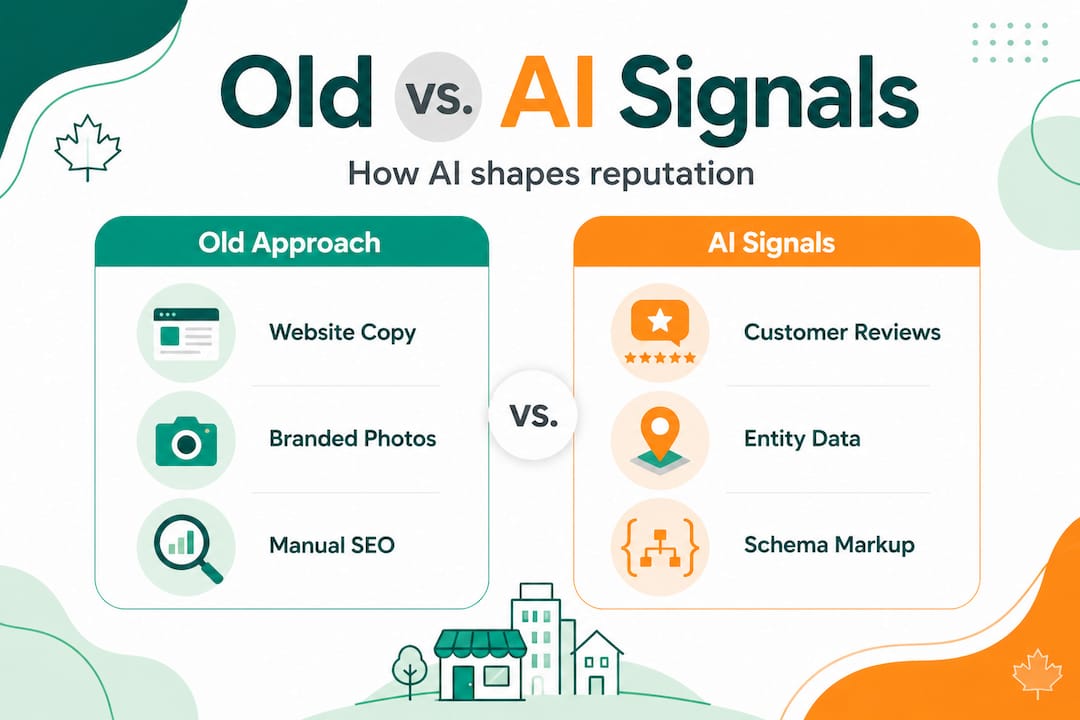
Here is a quick comparison of old-school reputation tactics versus what actually works in an AI-signals environment:
| Old approach | AI-signals approach |
|---|---|
| Polished marketing copy on your website | Review text from real customers |
| Keyword stuffing in service descriptions | Consistent, accurate business data across platforms |
| One-time profile setup | Ongoing profile maintenance and updates |
| Focusing only on Google | Building presence across multiple directories |
| Responding only to negative reviews | Responding broadly to build a pattern of engagement |
The gap between these two columns is where most local service businesses in Canada are losing visibility right now. They are still playing the old game while AI has already changed the rules. You can explore more on this through our AI SEO blog, where we break down platform-specific tactics in detail.
Why consistency and data quality are reputation essentials
Here is something that surprises many business owners when we first explain it: a single mismatch in your business name, address, or phone number across platforms can cause AI systems to distrust your data entirely.

That is not an exaggeration. Reliable data quality and accessibility are a shared condition for accurate AI outputs, as empirical research on AI in local contexts consistently shows. When AI pulls your business information and finds conflicts, it either averages the data incorrectly or, in many cases, skips your business altogether in favour of one with cleaner signals.
Consider this scenario: your Google Business Profile lists your phone number with the area code separated by a hyphen, but your Yelp listing spells out your street address differently. Your website uses an old suite number you forgot to update. To a human, these look like minor inconsistencies. To an AI system mapping entities across the web, they look like three potentially different businesses.
The critical data points to lock down are:
- Business name: Use the exact same format everywhere. No abbreviations on one platform and full names on another.
- Address: Match the format exactly, including whether you write “Street” or “St.” or “Avenue” vs “Ave.”
- Phone number: One format, consistently applied across every listing.
- Hours of operation: Keep these updated, especially around holidays and seasonal changes.
- Business category: Use the most specific and accurate category available on each platform.
Here is a quick look at what data mismatches cost you:
| Data issue | Impact on AI systems |
|---|---|
| Inconsistent phone number | AI may treat listings as separate businesses |
| Outdated hours | AI may cite incorrect hours, causing distrust |
| Wrong business category | AI may recommend you for wrong service type |
| Missing service descriptions | AI has less text to extract for answers |
| Incomplete address | AI citation confidence drops significantly |
Pro Tip: Create a single source of truth document for your business data. Every time you update anything, your address, your hours, your service area, update that document first and then push the changes simultaneously to all platforms. This one habit prevents months of citation drift.
Using tools like JSON-LD schema markup on your website also signals your entity data directly to AI systems in a format they read easily and trust. And if you want to build additional citation depth, platforms like Reddit for AI visibility have emerged as surprisingly powerful supplementary sources that AI systems actively pull from.
How to leverage AI for review monitoring and rapid response
Reviews are not just social proof anymore. They are data points that feed directly into how AI systems describe and recommend your business. The quantity, recency, and actual language of your reviews all shape what an AI says about you when someone asks for a recommendation.
AI reputation management for local businesses has evolved into automated, brand-safe review monitoring and response workflows, with human-in-the-loop editing to ensure accuracy and tone. In practical terms, that means you do not need to monitor five review platforms manually every day, because AI tools can flag new reviews, suggest responses, and escalate urgent ones.
Here is a straightforward workflow to implement:
- Set up monitoring across all review platforms. Google, Yelp, HomeStars, and any industry-specific directories relevant to your trade. Use a centralised tool to surface all new reviews in one place.
- Draft responses using AI assistance. Let an AI tool generate a first draft of each reply, then have a team member review and personalise it before publishing.
- Respond within 48 hours. Speed signals activity. An AI system scanning your profile sees response dates. A business that replies consistently looks more trustworthy than one with months-old unanswered reviews.
- Respond to positive reviews, not just negative ones. Most businesses only bother with damage control. Responding to praise builds the response pattern that AI reads as genuine engagement.
- Track your response rate monthly. Set a target of at least 30% of all reviews receiving a response, because responding to reviews is directly associated with higher conversion performance in local marketing benchmarks.
Pro Tip: When responding to positive reviews, incorporate a relevant service keyword naturally. For example, if someone praises your pipe repair speed, thank them by name and mention your emergency plumbing response time. This adds keyword-rich, human-sounding content that AI can extract.
Statistic to note: Responding to a greater share of reviews is associated with up to 80% higher conversion rates in local marketing benchmarks. That is not a small margin.
One more thing worth flagging: how cleanliness is described in reviews is a strong trust signal for service businesses like cleaning companies and contractors. Coaching your team to consistently deliver on the details customers actually write about, tidying up after the job, wearing shoe covers, and so on, directly improves the language in your reviews, which directly improves what AI says about you.
To see how this approach applies to your specific trade, our AI SEO by industry pages cover tailored strategies, and our AI SEO process explains how we put it all together.
Optimising your business for AI-driven search visibility
By this point, you understand the signals. Now let us talk about structuring your business presence to make those signals as readable as possible for AI systems.
AI search visibility tactics for local service businesses converge on three things: entity and data consistency (your NAP and Google Business Profile), review ecosystem quality (volume, recency, and text depth), and content designed to be extracted as direct answers. These three pillars work together.
Here is your action checklist:
- Complete every field on your Google Business Profile. Services, descriptions, photos, Q&A, and posts. Every empty field is a missed signal.
- Build reviews across multiple platforms, not just Google. AI pulls from across the web. HomeStars, Yelp, Facebook, and industry-specific directories all contribute to your entity’s reputation picture.
- Ask customers to be specific in their reviews. A review that mentions your service type, your city, and a specific outcome is worth ten times more as an AI signal than “great service.”
- Write your website content in extractable formats. FAQ sections, numbered process steps, and short definitional paragraphs are easier for AI to pull as direct answers.
- Use entity signals and structured data on your website. Schema markup tells AI systems exactly what your business is, where it operates, and what it does.
- Refresh your content regularly. AI systems favour businesses that show signals of ongoing activity. Updated blog posts, new service pages, and recent photos all contribute.
Pro Tip: Structure your service pages to answer specific questions directly. Instead of a vague service description, write: “We provide licensed electrical panel upgrades in Calgary, typically completed within one business day.” That sentence is specific, geographically anchored, and extractable as an AI answer. This is the kind of content that gets cited.
The AI search visibility guide at Locally Visible walks through how all of these components connect in a done-for-you context. If you want to understand the full architecture before acting, that is a solid starting point.
Why reputation and visibility tactics must change in the AI era
Here is our honest, perhaps uncomfortable take: most local service businesses in Canada are optimising for a search landscape that no longer exists.
They are chasing page-one rankings on Google while their potential customers are getting direct answers from ChatGPT, Gemini, and AI-enhanced search features that never send the user to a results page at all. Tactics that only try to “rank” in traditional SEO are incomplete in an AI-answers environment. Reputation strategy must also be optimised for extractability and citation in AI responses, what is sometimes called GEO (generative engine optimisation) or AEO (answer engine optimisation) thinking.
Let that sit for a second. Zero-click answers mean your business either gets cited directly, or it does not show up at all. There is no second page to fall back on.
What most businesses are missing is this: AI citation is not random. It follows evidence. A business with consistent NAP data, a rich review ecosystem, schema-structured web content, and broad third-party mentions is a business that AI can describe with confidence. And confident AI descriptions become recommendations.
The businesses outpacing their competitors right now are not necessarily doing more marketing. They are doing the right kind of evidence-building. They are thinking like an AI citation strategist, not a traditional marketer. They are asking: “What would an AI need to see to confidently recommend me?” and then building that evidence systematically.
Local schema markup and a clear understanding of how ChatGPT picks local businesses are two of the highest-leverage starting points we consistently see underutilised. They require relatively low effort and produce outsized results in AI citation frequency.
If you do one thing this week, audit your business data across every platform it appears on. Fix the mismatches. Then look at your review response rate and your website’s FAQ structure. Those three moves alone will put you ahead of most of your local competitors in the AI visibility race.
Boost your AI-driven local reputation with expert help
Building the kind of AI-ready reputation we have described takes more than a checklist. It takes consistent execution across data management, review strategy, schema implementation, and content structure, often over several months before the citations start flowing.
That is exactly what we do at Locally Visible. Our AI SEO process is built specifically for Canadian local service businesses who want to be cited by ChatGPT and AI-driven search without spending months figuring it out alone. We handle the signals, the data, the content structure, and the ongoing optimisation. If you want to see what the numbers could look like for your business before committing, our AI ROI calculator gives you a real picture of the opportunity. And when you are ready to look at what full-service visibility support looks like, our AI SEO pricing is designed to be straightforward and results-accountable. Start with a free visibility check, then a website build, then the SEO and AI visibility program.
Frequently asked questions
What is the most important data for AI to trust my business reputation?
Reliable, consistent business information (NAP: name, address, phone) and up-to-date reviews are essential, because AI relies on entity and data consistency alongside review ecosystem quality and structured, extractable content.
How does responding to reviews impact my visibility in AI search?
Businesses that respond to a greater share of reviews see significantly higher conversions, and responding to reviews is directly tied to stronger performance in local marketing benchmarks used by AI and local search systems.
Can AI-generated replies to reviews cause problems for my business?
Yes, because automated replies need human review and customisation to protect your brand voice. Automating for speed while preserving brand safety with customisable guardrails is the recommended approach.
How can I make my business show up in AI-driven search answers?
Keep your profiles consistent across all platforms, generate fresh high-quality reviews regularly, and structure your website with extractable formats like FAQs and numbered process steps, since pages designed for entity clarity and extractability are most likely to be cited by AI systems.