
The idea that only big brands can dominate local search is a myth worth busting right now. Canadian local service businesses — plumbers, dentists, HVAC contractors, landscapers — are using AI content tools to punch well above their weight online. AI tools help generate hyper-local content like neighborhood-specific service pages, social posts, and FAQs 50% faster while keeping quality high through human review. The result? Better Google rankings, more visibility in local map packs, and more calls from the right neighborhoods. This guide breaks down exactly how AI works for local content creation, what types of content to build, and how to measure what’s actually moving the needle.
Table of Contents
- Why AI matters in local content creation
- Types of content AI can create for local businesses
- When (and when not) to use AI: Hybrid human + AI models
- AI’s impact on local SEO and measuring success
- Our perspective: What most guides miss about using AI for local content
- Boost your local business with AI-powered content
- Frequently asked questions
Key Takeaways
| Point | Details |
|---|---|
| AI accelerates content | Small businesses generate local content up to 50% faster using AI tools with human review. |
| Hybrid approach works best | Combining AI efficiency with human oversight boosts trust, quality, and local relevance. |
| Local SEO results improve | AI-driven content increases Google Business Profile visibility and drives more leads. |
| Track ROI metrics | Measure success by monitoring traffic, leads, and online visibility, not just keyword rankings. |
Why AI matters in local content creation
Let’s be direct: most local service businesses are under-publishing. One blog post a month, a stale Google Business Profile, and service pages that haven’t been touched in years. That’s not a content strategy. It’s a gap your competitors are quietly filling.
AI changes the math. Tools like Jasper, Copy.ai, and ChatGPT can produce first drafts of service area pages, FAQs, and social posts in minutes rather than days. The AI content creation market is projected to grow from $2.5 billion in 2025 to $9.2 billion by 2033 at a 17.58% CAGR. That’s not a trend. That’s a structural shift in how content gets made.
For Canadian local service providers, the most valuable output isn’t generic blog content. It’s hyper-local content — material that speaks directly to a specific city, neighborhood, or service corridor. Think of it this way: a roofing company in Mississauga needs content that mentions local weather patterns, permit requirements, and the specific postal codes they serve. AI can scaffold that content quickly, and a human can sharpen it.
Here’s what AI can generate for local businesses:
- Neighborhood-specific service landing pages
- Google Business Profile posts and updates
- FAQs tailored to local customer questions
- Seasonal offer pages (e.g., winter furnace tune-up specials)
- Review response templates
- Blog posts targeting local search queries
- Social media captions for community-focused platforms
The adoption curve is accelerating. Small and medium-sized businesses (SMBs) that invest in AI-powered content now are building a compounding advantage over competitors who wait. You can explore how AI SEO works in practice to see what that looks like for a local service provider.
| Metric | 2023 | 2025 | 2033 (projected) |
|---|---|---|---|
| Global AI content market size | $1.4B | $2.5B | $9.2B |
| SMB adoption rate (North America) | ~18% | ~34% | ~65% |
| Avg. content output increase with AI | 2x | 3x | 5x+ |
“AI helps SMBs maintain content consistency and personalize messaging at scale — two things that were previously only achievable with large marketing teams.”
Consistency and scale. That’s the core value proposition for local businesses.
Types of content AI can create for local businesses
Knowing AI is useful is one thing. Knowing exactly what to build with it is another. Here’s a numbered breakdown of the content types that drive the most impact for Canadian local service businesses.
- Service area pages — Dedicated pages for each city or neighborhood you serve, with locally relevant copy and search terms.
- Google Business Profile posts — Short, timely updates that keep your profile active and improve local pack visibility.
- FAQs — Answers to the questions your customers actually type into Google, written in plain language.
- Neighborhood landing pages — Hyper-targeted pages that mention local landmarks, streets, or community events.
- Seasonal campaign pages — Time-sensitive offers tied to local weather, holidays, or community events.
- Blog posts — Educational content that builds authority and captures long-tail search traffic.
- Review response templates — Professional, personalized responses to Google reviews that reinforce trust.
Now, not all AI content is created equal. The table below shows the key differences between purely AI-written content and a hybrid approach where a human reviews and refines the AI draft.
| Factor | AI-only content | Human + AI hybrid |
|---|---|---|
| Speed | Very fast | Fast with review time |
| Cost | Low | Moderate |
| Quality | Variable | Consistently high |
| E-E-A-T compliance | Weak | Strong |
| Local accuracy | Often generic | Highly specific |
| Regulatory awareness | None | Human-verified |
E-E-A-T stands for Experience, Expertise, Authoritativeness, and Trustworthiness. It’s Google’s framework for evaluating content quality, and it matters a lot for local businesses in regulated industries like healthcare, legal services, and financial advice.
Consider a concrete example: a plumber in Calgary uses AI to draft a service page for emergency pipe repair in the Beltline neighborhood. The AI produces a solid draft in four minutes. A human then adds the local permit office contact, references the Calgary Building Code, and injects a customer story. That’s hyper-local content built 50% faster with the quality that earns rankings.

Understanding how ChatGPT ranks content helps you build pages that get cited by AI search engines, not just indexed by Google. If you want to see what this looks like for your industry, we’ve mapped it out by service category.
Pro Tip: Always have a local expert review AI drafts before publishing. AI doesn’t know about your city’s noise bylaws, provincial licensing requirements, or the local slang your customers actually use. That human layer is what separates content that ranks from content that sits.
When (and when not) to use AI: Hybrid human + AI models
AI is not a replacement for human judgment. It’s a force multiplier. The businesses that get this right treat AI like a very fast junior copywriter: capable, efficient, but in need of direction and review.
Here’s a practical breakdown of when to use each approach:
AI-only content works well for:
- Initial drafts of templated service pages
- Bulk FAQ generation for common questions
- Social media caption variations
- Review response templates
Hybrid content (AI draft + human edit) works best for:
- Neighborhood landing pages requiring local specifics
- Blog posts that need real experience or case studies
- Any content in regulated industries (healthcare, legal, financial)
- Google Business Profile posts that reference local events or promotions
Human-only content is essential for:
- Testimonials and customer stories
- Owner bio and “About Us” pages
- Content requiring professional liability awareness
- Crisis communications or sensitive community topics
The data on this is clear. Hybrid content outperforms pure AI by generating 40% more backlinks and driving better engagement across competitive queries. Pure AI content can cut costs by 35 to 99%, but it consistently underperforms in local markets where E-E-A-T signals matter most.
“Hybrid wins. AI scales the output, humans add the experience layer that search engines and real customers actually trust.”
This isn’t just an SEO consideration. It’s a reputation consideration. A purely automated content pipeline for a local business risks publishing inaccurate service details, outdated pricing, or content that misses local regulatory nuances. That erodes trust fast.
For AI content tailored by industry, the hybrid model is the standard we recommend across every service category.
Pro Tip: Use AI to draft, then localize. Add the street name, the local landmark, the provincial regulation, the seasonal context. That’s the layer AI can’t invent. You can.
AI’s impact on local SEO and measuring success
Content creation is only valuable if it drives real business outcomes. Let’s connect AI content directly to the SEO and revenue metrics that matter for local service businesses.
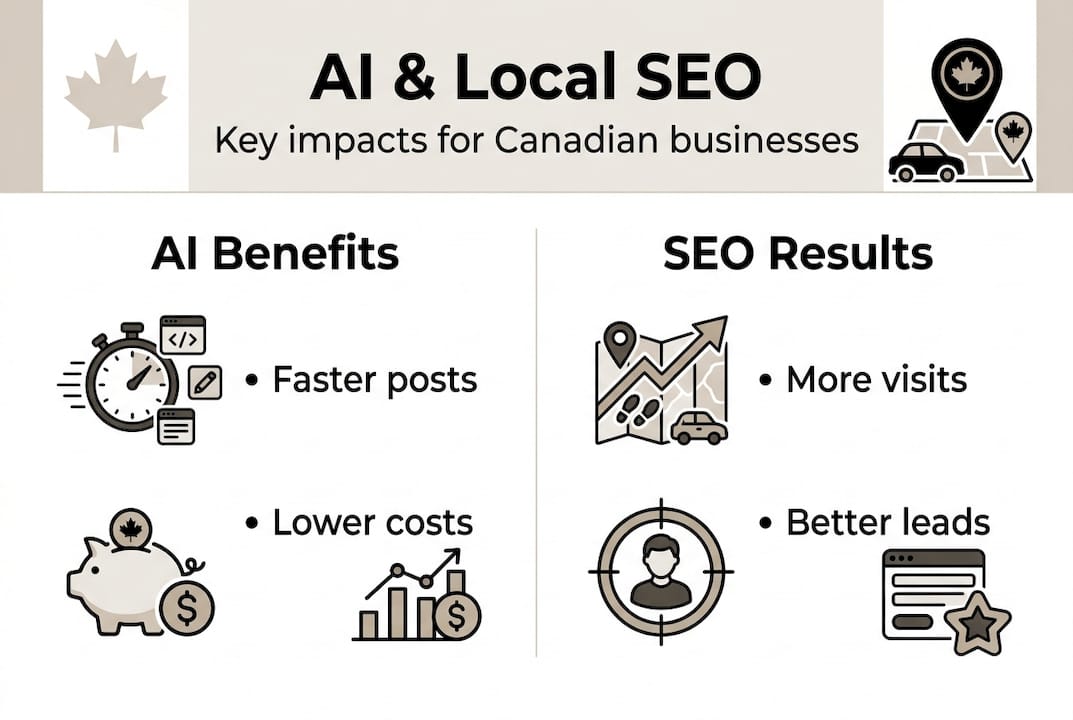
First, the mechanism: AI tools boost local SEO by enabling consistent publishing across Google Business Profiles, service pages, and blogs. Consistency signals relevance to Google. Relevance drives rankings. Rankings drive calls.
Consider that 46% of all Google searches have local intent. That’s nearly half of all queries. If you’re not publishing content that targets local search terms, you’re invisible to almost half your potential customers.
Here are the key metrics to track:
- Website traffic — Are more people finding your site through organic search?
- Google Business Profile actions — Calls, direction requests, and website clicks from your GBP listing
- Local keyword rankings — Are you appearing in the top 3 map pack results for your core services?
- Lead volume — Phone calls, form fills, and email inquiries tied to organic traffic
- Review velocity — Are new reviews coming in consistently, signaling active customer engagement?
| Metric | Before AI content | After 90 days of AI content |
|---|---|---|
| Monthly organic visits | 180 | 410 |
| GBP profile views | 620 | 1,340 |
| Inbound leads (organic) | 8 | 21 |
| Local keyword rankings (top 5) | 4 terms | 14 terms |
These aren’t hypothetical numbers. They reflect the kind of trajectory we see when local businesses publish consistently with a hybrid AI content model. The AI search visibility impact compounds over time, much like a flywheel that gets easier to spin the longer you push it.
Don’t just track rankings. Track leads. Rankings are a leading indicator. Revenue is the outcome. If you want to understand the AI SEO ROI before committing, we’ve made our pricing transparent so you can run the math yourself.
Our perspective: What most guides miss about using AI for local content
Here’s what we’ve seen that most guides won’t say out loud: the businesses that fail with AI content treat it like a vending machine. They feed in a prompt, publish the output, and wonder why nothing changes.
AI is a helper. A fast, tireless, capable helper. But local trust is built on authentic details that only you can provide. Your customer’s name. The specific problem you solved at 11pm on a Tuesday. The fact that you know the difference between a Brampton permit and a Mississauga one. AI can’t invent that. You can share it.
We’ve also seen agencies sell “auto-pilot” AI content packages that churn out generic pages with no local proofing. That approach can actually hurt your rankings and your reputation. Insist on a review step. Insist on local context. And check your field notes on AI content regularly to stay ahead of what’s working.
The businesses winning with AI aren’t the ones automating the most. They’re the ones using AI to do more of what they’re already good at, faster.
Boost your local business with AI-powered content
If this guide gave you a clearer picture of how AI fits into your content strategy, the next step is seeing it applied to your specific business and market.
At Locally Visible, we build done-for-you AI search visibility for Canadian local service businesses. That means hyper-local content, consistent publishing, and a hybrid model that keeps humans in the loop where it counts. We back it with a simple promise: cited by ChatGPT in 90 days, or we work free until you are. Explore our 3-step AI SEO process, review transparent AI SEO pricing, or find solutions tailored to your industry to get started.
Frequently asked questions
How can AI improve my local business’s Google ranking?
AI enables faster creation of relevant, hyper-local content that directly boosts Google Business Profile visibility and local search rankings. Neighborhood-specific pages and FAQs built 50% faster with AI give Google more locally relevant signals to rank your business.
What types of content should local businesses create with AI?
Focus on service area pages, blog posts, Google Business Profile updates, and community-specific FAQs. These content types target the local search queries your customers are already using to find businesses like yours.
Is AI-generated content safe for local SEO in Canada?
Yes, when reviewed by a human for accuracy, local relevance, and regulatory compliance. Pure AI content underperforms in competitive queries because it lacks the E-E-A-T experience layer that Google rewards.
How do I know if AI content is working for my business?
Track website traffic, phone and email inquiries, Google Business Profile actions, and new leads from organic search. Monitor ROI via traffic and leads, not just keyword rankings, to see the real business impact.