How AI transforms local search for Canadian service businesses
Proximity used to be your biggest advantage. If someone in Toronto searched for a plumber or an electrician, the businesses closest to them appeared at the top. That era is ending. AI-driven recommendations now factor in semantic relevance, meaning Google’s AI Overviews and tools like ChatGPT rank businesses based on how well your content, reviews, and profile match what the searcher actually needs. For Canadian local service businesses, this is both a warning and a real opportunity to get ahead.
Table of Contents
- How AI is reshaping local search: What’s changed and why it matters
- What local AI looks for: Key signals and local business relevance
- Tactics to boost AI visibility: Practical steps for local service success
- The payoffs and pitfalls: What Canadian service businesses can expect
- Why clinging to old SEO is a recipe for invisibility
- Grow your local business with AI-optimised search
- Frequently asked questions
Key Takeaways
| Point | Details |
|---|---|
| Semantic relevance wins | AI ranks businesses for local search based on how well your details match search intent, not just technical SEO. |
| Review and profile accuracy | Google Business Profile completeness and review volume are the top drivers of AI recommendations in 2026. |
| Tactics for visibility | Regularly update your profiles, create relevant FAQ content, and track brand mentions to stay visible. |
| AI-era SEO differs | Adopting an AI-first strategy beats traditional SEO alone for Canadian service providers. |
How AI is reshaping local search: What’s changed and why it matters
The shift didn’t happen overnight, but in 2026 it’s impossible to ignore. Google’s AI Overviews, which appear at the very top of search results before any traditional listings, now synthesise information from multiple sources to recommend businesses. ChatGPT and other large language models do the same. Both rely on semantic relevance over proximity, meaning the quality, depth, and consistency of your business information matters far more than your postcode.
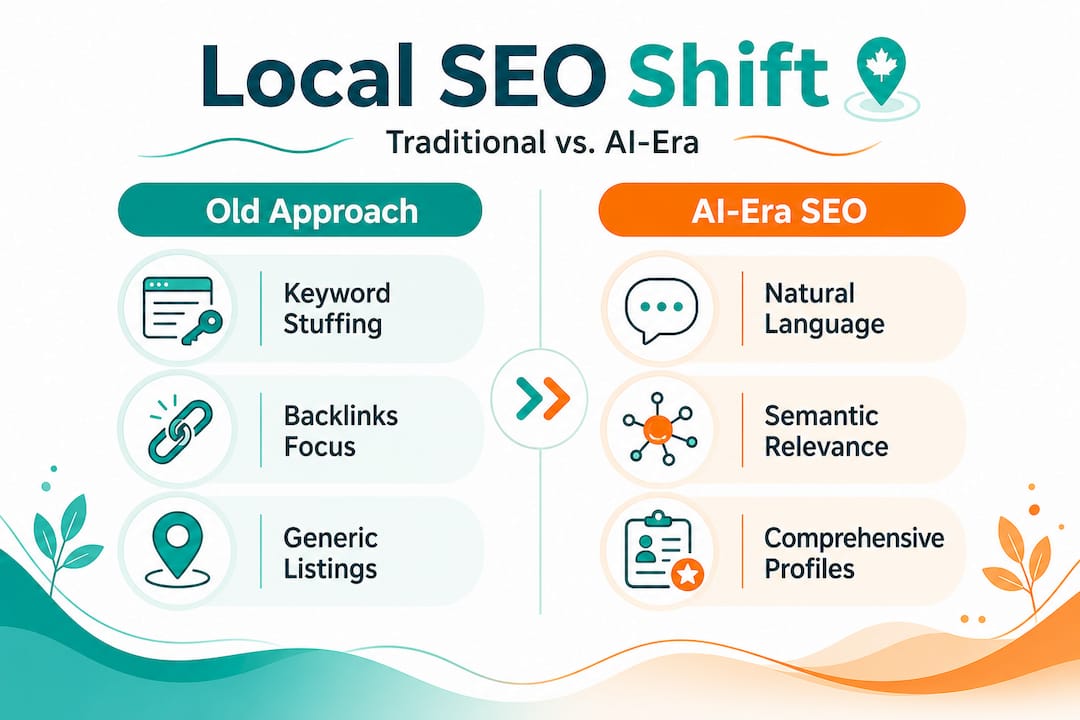
Here’s what the old model looked like:
- Proximity: Be close to the searcher
- Technical SEO: Keyword stuffing, backlinks, meta tags
- Citations: Getting listed on as many directories as possible
Here’s what the new AI model values:
- Semantic fit: Does your business description match what someone is actually looking for?
- Review depth and volume: Are your reviews detailed and recent?
- Google Business Profile (GBP) completeness: Is every field filled in accurately?
- Earned media and brand mentions: Do credible sources reference your business by name?
- Structured data (schema): Does your website tell AI what your business does in machine-readable terms?
The gap between awareness and accuracy tells a sobering story. A study of 10,000 local businesses found that 93% of businesses were known to AI systems, but only 55% of the information AI held about them was accurate. That means nearly half of businesses are either being misrepresented or described in ways that hurt their chances of being recommended.
“AI doesn’t just ask ‘who is nearby?’ It asks ‘who is the most credible, relevant, and well-documented answer to this person’s specific need?’ That distinction changes everything for local businesses.”
To understand AI-powered search in Canada and why it affects your visibility, you need to accept one hard truth: having a website and a Google listing is no longer enough. The businesses that win AI recommendations are the ones that have invested in the depth and accuracy of their digital presence.
What local AI looks for: Key signals and local business relevance

Knowing that the rules have changed is one thing. Knowing exactly what AI rewards is another. The good news is that the most important signals are within reach of any local service business owner who takes the time to act on them.
A large-scale analysis of AI recommendation data confirms that review volume and GBP completeness outperform traditional technical SEO signals when it comes to AI-driven local recommendations. Let’s break down the key signals and why each one matters.
| Ranking signal | Why AI values it | Priority level |
|---|---|---|
| Review volume and recency | Signals active, trusted business | Very high |
| GBP accuracy and completeness | Provides reliable data for AI to reference | Very high |
| Website schema and FAQ content | Helps AI parse what you do and for whom | High |
| Earned media and brand mentions | Builds semantic authority across the web | High |
| Local citation consistency | Prevents conflicting information in AI training data | Medium |
| Traditional backlinks | Still useful but no longer the dominant factor | Low to medium |
Schema markup (structured data added to your website’s code) is worth explaining simply. It’s a way of telling AI exactly what your business is, what services you offer, what areas you serve, and what customers say about you. Without schema, AI has to guess. With it, you’re speaking AI’s language directly.
Semantic relevance takes some thinking to apply practically. Imagine a customer searching “best licenced electrician for panel upgrades in Calgary.” A business that mentions panel upgrades in their GBP description, has five reviews specifically referencing panel work, and has a FAQ on their website answering “what’s involved in an electrical panel upgrade” will beat a competitor who simply lists “electrician” and nothing else, even if that competitor is physically closer.
Here’s what a smart content audit for AI visibility looks like:
- Check every field in your Google Business Profile and fill in any gaps
- Read your ten most recent reviews and note whether they mention specific services
- Look at your website’s FAQ page (if you don’t have one, create it)
- Search your business name in ChatGPT and see what it says. Is it accurate?
- Check your business listings on major directories for consistency
Pro Tip: Use Google’s free Structured Data Testing Tool to see whether your website’s schema is correctly implemented. Broken or missing schema is one of the fastest things to fix for an immediate improvement in AI readability.
Investing in AI SEO for visibility means treating your business information as a living asset that needs regular attention. The businesses winning the most AI recommendations in Canada right now are not necessarily the biggest. They’re the most thorough. You can also explore broader business visibility strategies to layer AI tactics with established local marketing approaches.
Tactics to boost AI visibility: Practical steps for local service success
Now let’s get practical. These are the steps that translate the theory above into real gains in AI-driven local search visibility. Think of this as your checklist, and consider each one a lever you can pull starting today.
-
Complete and verify your Google Business Profile. This means every category, every service listed, your hours, your service area, photos, and your business description written in plain language that matches how customers actually search for you. A plumber in Vancouver who describes their services as “emergency drain clearing, hot water tank installation, and bathroom fixture repair” will outperform one whose description just says “plumbing services.”
-
Build a review flywheel. Send a review request to every satisfied customer within 24 hours of completing a job. The flywheel metaphor is apt here: once you get momentum, reviews compound. Aim for reviews that mention specific services and locations, because those specific details are exactly what AI uses when matching your business to a search query.
-
Write a proper FAQ section on your website. Address the ten most common questions customers ask before hiring someone in your trade. Use natural language. “How long does a furnace installation take?” is a much better FAQ header than “furnace installation duration,” because AI is trained on how humans talk and search.
-
Add schema markup to your website. Specifically, use LocalBusiness schema, Service schema, and Review schema. If you’re not technical, ask your web developer to implement it, or use a plugin if you’re on WordPress. This alone can meaningfully improve how accurately AI describes your business.
-
Earn media mentions and local coverage. A mention in a local news article, a community blog, or a local business association directory adds what AI researchers call “corroborating signals.” These tell AI that your business is real, active, and trusted by sources beyond your own website.
-
Monitor your AI visibility regularly. Search for your business in ChatGPT, Perplexity, and Google’s AI Overview responses. Check whether the information is accurate and whether you’re being cited at all. If you find errors, update your GBP and website to correct them.
| Old local SEO approach | AI-era local SEO approach |
|---|---|
| Keyword stuffing in titles | Natural language in business description and FAQs |
| Building as many backlinks as possible | Earning brand mentions in local media and directories |
| Listing on every possible directory | Maintaining accurate, consistent listings on key directories |
| Optimising for proximity | Optimising for semantic relevance and service specificity |
| Generic customer reviews | Detailed reviews mentioning specific services and locations |
Local service owners across Canada who have prioritised GBP optimisation, detailed local reviews, schema content, and earned media monitoring are seeing measurable results. One HVAC company in Ottawa that implemented these tactics over three months reported a 40% increase in inbound calls traced directly to Google’s AI-generated responses. The investment was mostly time and attention, not a large advertising budget.
Pro Tip: Use a tool like Google Alerts to track mentions of your business name online. When you find a mention on a local news site or community page, make sure the information is accurate and consider reaching out to have your website linked. These mentions feed directly into AI’s understanding of who you are.
For more on how content fits into this picture, see our guide on AI-powered content for local business.
The payoffs and pitfalls: What Canadian service businesses can expect
Let’s be straightforward about what happens when you align your strategy with AI-era signals.
What you gain:
- More direct leads. When AI recommends your business by name in an Overview or a ChatGPT response, the person asking is already looking to hire. These leads convert at a higher rate than cold traffic.
- Zero-click visibility. Your business gets seen even when the user doesn’t click through to your website, because AI surfaces your name, rating, and key details directly in the response.
- Long-term trust signals. Reviews, schema, and earned media compound over time. The effort you put in today keeps paying off months from now.
The pitfalls to avoid:
- Chasing technical SEO improvements while ignoring reviews and GBP completeness. This is the most common mistake we see.
- Buying fake or generic reviews. AI systems are increasingly good at detecting inauthentic patterns, and these can actually hurt your recommendation rate.
- Setting up your GBP once and forgetting it. Outdated information is worse than no information.
- Assuming that being cited in AI means you’ll always be cited accurately. The accuracy gap between AI awareness and correct information is real.
“AI Overviews reduce traditional clicks, with some studies showing drops from 15% to 8%, but businesses whose content is cited in those Overviews see increases in direct conversions because the customer arrives pre-qualified.”
This is the counter-intuitive insight most business owners miss. Fewer clicks on your website link can actually mean more phone calls and booked appointments, because the person who calls after seeing your business recommended by AI already trusts you. They didn’t need to visit your website to be convinced.
The caveat is that this only works if AI is recommending you accurately. If ChatGPT says you serve an area you don’t, or lists a service you no longer offer, that pre-qualified trust becomes a frustrated potential client. See our insights on AI content detection for tips on staying ahead of inaccuracies.
Why clinging to old SEO is a recipe for invisibility
Here’s our honest, experience-backed take: most local service businesses in Canada are still optimising for a search landscape that no longer exists. They’re building backlinks, stuffing service pages with keywords, and wondering why newer competitors are getting more calls despite having less established websites.
The uncomfortable truth is that semantic relevance now commands AI results more than almost anything else in the traditional playbook. Brand authority, the depth of your business information, and the specificity of your customer reviews are the real currency of AI-driven local search.
We’ve seen it repeatedly. A roofing company with 200 backlinks but thin reviews and a skeletal GBP loses recommendation share to a competitor with 30 backlinks, 85 detailed reviews, and a fully built-out GBP with service-specific FAQs. The second business has built semantic authority, and AI can clearly parse what they do, where they do it, and why customers trust them.
The businesses that adapt early don’t just survive this shift. They capture a disproportionate share of local leads because AI tends to default to the same well-documented, credible businesses repeatedly once they’re established as reliable sources. It becomes a compounding advantage.
Resisting a semantic-first SEO approach in 2026 isn’t neutral. It’s actively falling behind. The gap between businesses that have adapted and those that haven’t will only widen as AI search becomes more deeply embedded in how Canadians find and hire local service providers.
Grow your local business with AI-optimised search
If this article has made one thing clear, it’s that AI visibility requires a different kind of effort than traditional SEO. It’s not about tricks. It’s about building a thorough, accurate, and credible digital presence that AI can confidently reference when recommending businesses to your next customer.
At Locally Visible, we specialise in done-for-you AI search visibility for Canadian local service businesses. We work with your specific industry, your service area, and the exact ranking signals AI rewards. Our industry-specific AI SEO services are built around what actually works in 2026, not what worked five years ago. We’ll get your business cited by ChatGPT in 90 days, or we work free until you are. Explore our AI SEO pricing to see a straightforward path to more leads from AI-driven search.
Frequently asked questions
How do I make sure my business is found by AI tools like ChatGPT and Google’s AI Overviews?
Complete your Google Business Profile thoroughly and build a steady flow of detailed customer reviews, while adding FAQ pages and schema markup to your website. AI recommendations rely heavily on GBP completeness and review volume over technical SEO factors.
What is semantic relevance and why does it matter for local search?
Semantic relevance means your business content closely matches the specific intent behind a customer’s search, which AI prioritises over keyword proximity or backlink counts. Semantic relevance now outperforms traditional SEO signals in AI-driven local recommendations.
Will optimising for AI decrease the clicks I get from Google?
AI Overviews do reduce raw click-through rates, but businesses cited within those Overviews often see more direct customer actions like phone calls because the lead arrives already informed. Click rates can drop from 15% to 8%, yet zero-click conversions rise for businesses with cited content.
Is it still worth doing traditional local SEO work?
Foundational work like accurate directory listings and a well-structured website still matters, but the weight of results has shifted. Review volume, profile accuracy, and semantic fit now drive far more AI-sourced visibility than classic citation-building or proximity alone.
What tools help Canadian service businesses monitor their AI search visibility?
Search your business name directly in ChatGPT, Perplexity, and Google’s AI Overviews regularly, and use Google Alerts to track brand mentions. Monitoring AI visibility tools combined with consistent GBP audits is the most reliable way to stay accurately represented in AI-driven search results.
Recommended
- What is AI-powered search? Guide for Canadian service businesses — Locally Visible
- What is AI-powered search? Guide for Canadian service businesses — Locally Visible
- What is AI SEO? Boost local visibility for Canadian businesses — Locally Visible
- How AI transforms content for Canadian local businesses — Locally Visible