Blog / What Is Business Visibility
Business visibility strategies for Canadian local services

The short answer
Canadian local-service visibility in 2026 stacks five weakly-correlated signals: organic SEO (your own optimized site with depth content), AI citation footprint (Reddit, forum, and editorial mentions naming your business), schema markup (so engines can verify your hours, services, prices), review velocity (recent reviews matter more than lifetime count), and directory consistency. No single channel wins alone — the businesses being recommended by ChatGPT in 2026 are the ones who stack four or five.
If you think business visibility is just about ranking on page one of Google, you’re already behind. Canadian consumers are increasingly turning to AI-powered search tools, ChatGPT, and voice assistants to find local services. These platforms don’t simply pull up a list of websites; they recommend businesses they recognise and trust. That shift changes everything for local plumbers, electricians, cleaners, and contractors. The businesses that adapt now will capture customers before competitors even realise the game has changed. This article covers what visibility really means in 2026, how AI-driven tools are reshaping local search, and the practical steps you can take starting today.
Table of Contents
- Understanding business visibility: Definition and importance
- Traditional and AI-driven visibility: What’s different?
- AI-driven solutions: Tools and tactics for boosting visibility
- Measuring visibility success: Metrics and next steps
- Why visibility for local businesses demands a new mindset
- Transform your local visibility with expert AI solutions
- Frequently asked questions
Key Takeaways
| Point | Details |
|---|---|
| Visibility redefined | Business visibility now means being recognized and recommended by AI-driven platforms, not just ranking in search engines. |
| AI tools matter | Using structured data, GEO strategies, and consistent local details helps your business gain trust from AI search engines. |
| Human touch wins | Human-edited, trustworthy content outperforms generic automation and secures more recommendations. |
| Measurement shift | Focus on Google Business Profile insights, calls, reviews, and AI citations to track your business’s real visibility. |
| Take action today | Applying these strategies can make your local business stand out and attract customers across Canada. |
Understanding business visibility: Definition and importance
With the stakes clear, let’s break down what visibility actually means and how it has changed.
Business visibility, in the traditional sense, referred to how prominently a company appeared in search engine results pages. You optimised for keywords, built backlinks, and hoped Google noticed. That model still has value, but it’s no longer the whole picture. Today, local online discoverability has shifted toward something more nuanced: being recognised as a trusted entity by AI-powered platforms and local search engines alike.
Think of it this way. When someone asks ChatGPT, “Who’s the best plumber in Mississauga?” the AI doesn’t scroll through search rankings. It recalls businesses it has encountered repeatedly across reliable, consistent sources. If your business isn’t part of that knowledge base, you’re invisible, no matter how well your website ranks. Let that sit for a second.
For Canadian local service businesses, this evolution matters enormously. The AI visibility overview landscape is clear: businesses that build structured, verifiable online presences are the ones getting recommended. Those that rely solely on traditional SEO are leaving significant customer acquisition opportunities on the table.
What visibility looks like now
Here’s a quick snapshot of how business visibility has evolved:
| Visibility factor | Traditional approach | AI-driven approach |
|---|---|---|
| Primary signal | Keyword rankings | Entity recognition |
| Discovery method | Search engine results | AI citations and recommendations |
| Trust indicator | Backlinks and domain authority | Consistent local references and reviews |
| Content priority | Keyword-dense pages | Structured, FAQ-style, human-edited content |
| Platform focus | Google Search | Google, ChatGPT, Bing AI, voice assistants |
What makes this shift significant is that AI platforms are not looking for the business with the most backlinks. They’re looking for the business they can verify. They want to know you exist, that you are who you say you are, and that real customers can confirm it.
Here are the core reasons visibility has become critical for Canadian local services:
- Customer discovery: Most Canadians now use digital tools before making a service call. If you’re not findable on these platforms, that call goes to a competitor.
- Trust by association: Appearing in AI recommendations signals credibility, even before a customer visits your website.
- Compound growth: The more consistently you appear across platforms, the more AI systems treat you as a reliable source, which creates a visibility flywheel that builds over time.
- Local market advantage: Many Canadian small businesses haven’t adapted yet. Early movers gain disproportionate visibility in their communities.
The practical upshot is straightforward. Visibility is no longer about gaming an algorithm. It’s about being genuinely findable, trustworthy, and consistent across every platform your potential customers use.
Traditional and AI-driven visibility: What’s different?
Now that we’ve defined visibility, it’s helpful to compare the old and new methods side-by-side.
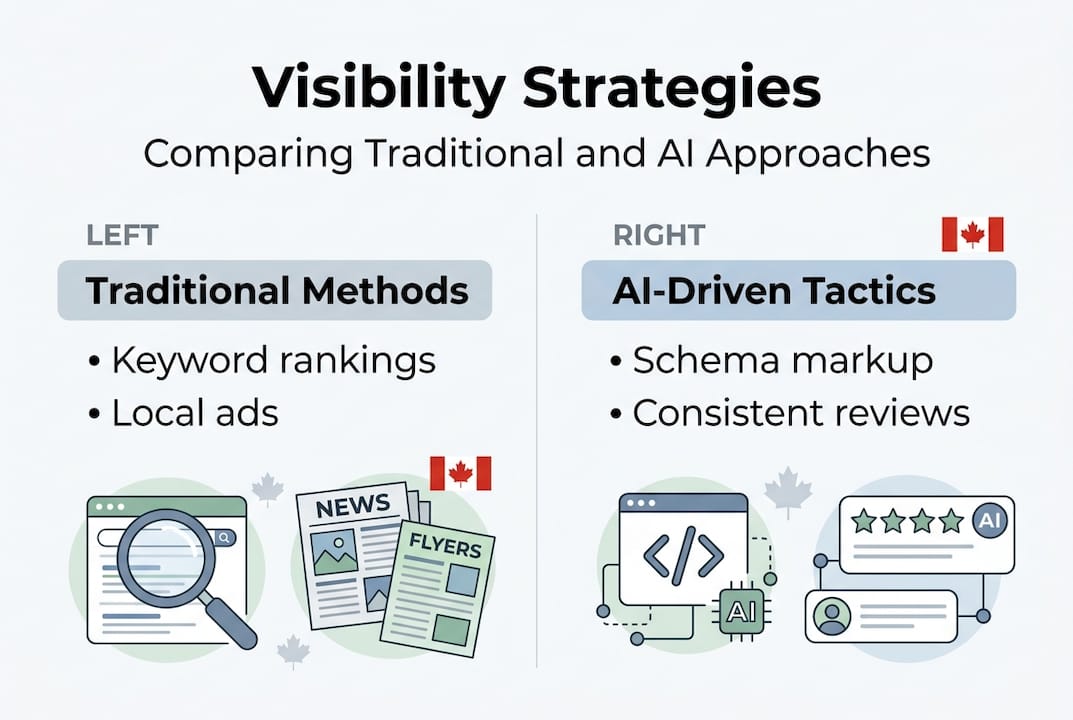
The traditional playbook for local visibility was relatively predictable. You built a website, stuffed it with location-based keywords like “emergency plumber Toronto,” set up a Google Business Profile, and maybe ran some Google Ads. That approach drove traffic. In many cases, it still does. But it was built around a fundamentally passive model: you optimise, then you wait for Google to surface you.
AI-driven visibility operates on a completely different logic. Google’s local algorithm uses Relevance, Proximity, and Prominence as its three core factors. AI systems layer on top of that by prioritising entities that are verifiable and low-risk. In other words, the AI wants to recommend businesses it knows won’t embarrass it. That means your business needs to present consistent, structured, and trustworthy information everywhere it appears online.
Side-by-side comparison
| Approach | Traditional SEO | AI-driven visibility |
|---|---|---|
| Core tactic | Keyword optimisation | Schema markup and entity signals |
| Key asset | Backlink profile | Citation consistency and trust signals |
| Review strategy | Accumulate reviews | Review velocity and sentiment patterns |
| Content format | Long-form keyword articles | FAQ-style, structured, locally relevant content |
| Success metric | Page ranking | AI citation frequency and GBP engagement |
Here’s how to think about building AI-driven visibility in practical terms:
- Establish entity clarity: Make sure your business name, address, phone number, and category are identical across Google, Yelp, Facebook, and every directory. Inconsistency creates doubt for AI systems.
- Build prominence through reviews: The impact of customer reviews on local trust signals is substantial. Volume matters, but so does recency and response patterns.
- Create locally relevant content: Write blog posts and service pages that specifically mention your city, neighbourhood, and the problems your customers face. This signals local relevance to AI platforms.
- Earn mentions from credible sources: Local news coverage, community websites, and industry directories all contribute to the prominence signals that AI systems value.
- Use structured data: Schema markup tells AI engines exactly what your business does, where it operates, and how to contact you. It’s the digital equivalent of introducing yourself clearly.
Understanding how ChatGPT picks businesses to recommend reveals an important insight: the process relies heavily on pattern recognition across consistent, credible mentions. That’s not SEO as we once knew it. That’s reputation management at a structural level.
You might also be surprised to learn that Reddit visibility has become a meaningful input for AI engines. When real users on Reddit mention a local business positively, that authentic signal carries weight. It’s one reason why encouraging satisfied customers to share experiences across platforms, not just Google, moves the needle.
Pro Tip: Resist the temptation to publish AI-generated content without editing it. Human-edited AI content consistently outperforms generic, unedited output in AI citation systems because it reads as more credible and contextually accurate.
AI-driven solutions: Tools and tactics for boosting visibility
With these differences highlighted, let’s dive into tactical steps you can actually apply.
The good news is that most of the tactics for building AI-driven visibility are within reach for any Canadian local service business, regardless of budget. You don’t need a massive marketing team. You need consistency, structure, and a willingness to invest in the right signals.
Schema markup is the single highest-leverage technical move you can make. Schema is a type of structured data that you add to your website’s code to help AI systems understand your business clearly. For a local plumber, that means tagging your business type, service areas, hours, reviews, and contact details in a format search engines and AI platforms can read without ambiguity. Schema markup templates are available for most common service categories and can often be implemented without a developer.
The impact of structured data on business recognition by AI platforms is well-documented. Businesses that implement schema correctly are far more likely to be surfaced as recommended entities in AI-generated responses.
Here’s a practical visibility-boosting checklist you can start working through this week:
- Audit your citations: Search your business name across Google, Yelp, Yellow Pages, and local Canadian directories. Fix any inconsistencies in name, address, or phone number immediately.
- Add schema to your website: Use LocalBusiness schema at minimum. Add ServiceArea and Review schema for additional clarity.
- Publish FAQ-style content: Write short, direct answers to the questions your customers actually ask, like “How much does a furnace inspection cost in Calgary?” These formats align well with how AI systems generate answers.
- Optimise your Google Business Profile (GBP): Fill in every field, including services, business description, photos, and hours. Post updates regularly.
- Encourage review velocity: Consistent new reviews signal an active, trustworthy business to AI platforms. Five reviews per month beats fifty reviews once a year.
- Build local references: Get your business mentioned on community websites, local news sites, and neighbourhood Facebook groups.
Statistic callout: According to Search Engine Land, businesses with complete structured data and consistent local references are significantly more likely to appear in AI Overviews and AI-generated local recommendations. The gap between businesses that implement this and those that don’t is widening rapidly.
Generative Engine Optimisation, or GEO, is an emerging approach that focuses specifically on making your content useful for AI-generated answers rather than traditional search rankings. It involves writing content that directly addresses common local questions, attributes claims clearly, and structures information in ways AI engines can easily parse and repeat.
Pro Tip: Start with your most frequently asked customer questions. Turn each one into a 100 to 150 word answer on your website or blog. These FAQ-style entries are exactly the kind of content AI platforms draw from when generating local recommendations. Check out the full breakdown of AI SEO steps to see how this fits into a complete visibility strategy.
Measuring visibility success: Metrics and next steps
Now, to ensure your efforts are working, here’s how to track and measure visibility.
One of the biggest mistakes local service businesses make is measuring visibility success the wrong way. If you’re still judging your progress purely by keyword rankings, you’re using an outdated ruler. As organic visibility shrinks and AI-generated results take up more screen real estate, traditional ranking positions tell only part of the story. You need to diversify with ads and Local Services Ads (LSAs), and track metrics that reflect how customers actually find and engage with your business.
Here’s what to track instead:
- Google Business Profile insights: Monitor how many people viewed your profile, requested directions, visited your website, and called you directly from GBP. These are direct signals of visibility translating into interest.
- Call volume: Track inbound calls week over week. A spike in calls often follows improvements in local visibility, whether from GBP, AI citations, or directory updates.
- Review growth and sentiment: Are you gaining new reviews consistently? Are the sentiments positive and specific? Specific reviews, mentioning services and locations, strengthen AI entity signals.
- AI citation tracking: Search for your business name in ChatGPT, Perplexity, and Bing Copilot. Note whether you appear in responses to local service queries. This is a direct measure of AI-driven visibility.
- Website traffic from local sources: Look at your Google Analytics (or equivalent) for increases in traffic from your city or region. Local organic traffic growth often reflects improved entity recognition.
| Metric | What it tells you | How often to check |
|---|---|---|
| GBP profile views | Overall discoverability | Weekly |
| GBP calls and direction requests | Local intent engagement | Weekly |
| New reviews received | Trust signal momentum | Monthly |
| AI citation mentions | AI-driven recognition | Monthly |
| Local organic traffic | Entity signal effectiveness | Monthly |
Key insight: The businesses gaining the most ground in AI-driven local search aren’t necessarily the biggest or most established. They’re the ones with the most consistent and structured online presence. Consistency is the new competitive advantage.
The benefits of strong local visibility go beyond just getting found. Businesses that appear prominently in AI recommendations and local search tend to convert at higher rates because the recommendation itself functions as a pre-qualification. A customer who found you through a ChatGPT suggestion already trusts you more than one who simply clicked a banner ad.
For a clear breakdown of what the ChatGPT citation process looks like and how to track it, we’d recommend starting there if you’re new to AI-driven visibility tracking.
Why visibility for local businesses demands a new mindset
Having covered measurement and tactics, let’s examine what savvy business owners should really focus on.
Here’s the uncomfortable truth most SEO advice won’t tell you: chasing rankings is a rearguard action. The front of the battlefield has moved. AI systems are now the primary recommendation layer for millions of Canadian consumers, and they operate by entirely different rules than Google’s ten blue links.
We’ve worked with enough local service businesses to know that the ones who thrive are not the ones with the flashiest websites or the biggest ad budgets. They’re the ones who build genuine trust signals: consistent citations, real customer reviews, structured content, and a presence that AI engines can verify confidently.
The evidence is clear. Human-edited AI content outperforms generic automation, and diversifying beyond organic rankings with LSAs and structured data is no longer optional. It’s foundational. Canadian small businesses that embrace this shift now will have a measurable head start over competitors who are still optimising for yesterday’s search landscape.
If you do one thing this week, audit your citation consistency. It’s the single fastest move you can make, and it’s free. Then build from there using the AI-first visibility framework that actually reflects how customers discover services today.
Transform your local visibility with expert AI solutions
For those ready to take their local visibility to the next level, here’s where to turn for help.
Understanding the tactics is one thing. Implementing them consistently while running a busy service business is another challenge entirely. That’s exactly the gap we built Locally Visible to bridge.
Our local AI SEO process is designed specifically for Canadian service businesses, covering everything from schema markup to citation audits to GEO content strategies. We also offer industry-specific AI SEO solutions tailored to plumbers, electricians, HVAC technicians, cleaners, and more. Every business is different, and your visibility strategy should reflect that. Explore our AI audit pricing to find a plan that fits your goals. We start with a free visibility check, then a website build, then the SEO and AI visibility program to keep it climbing.
Frequently asked questions
What does business visibility mean for local Canadian services?
It means being easily found and trusted by customers online, especially through AI-driven search platforms and local directories, where trust signals and consistent citations determine who gets recommended.
How can my business improve visibility in AI search results?
Use schema markup, FAQ-style content, consistent local business details, and human-edited information to build the trust signals AI platforms rely on when making local recommendations.
Why are Google rankings less important than before?
AI-driven engines favour verifiable entities with consistent local details and trust signals, surfacing them in generated recommendations rather than relying purely on traditional ranking positions.
What metrics should I use to measure visibility success?
Monitor Google Business Profile insights, call volume, review growth, and AI citation frequency rather than relying on keyword rankings alone, which capture a shrinking share of how customers find local services today.