Blog / Why Seo Matters For Service Businesses
Why SEO matters for service businesses: boost local visibility

The short answer
SEO matters more than ever for service businesses because 76% of "near me" searches result in a same-day store visit, and the citation footprint that ranks you on Google is the same footprint AI engines now use to decide who to recommend. Unlike paid ads, SEO compounds — every article and backlink keeps working long after it ships.
Many local service business owners assume that paid ads are the only reliable way to attract customers online. Spend money, get clicks. Stop spending, go dark. That cycle is exhausting and expensive. The truth is, search engine optimisation (SEO) offers a fundamentally different model, one where your visibility compounds over time instead of evaporating the moment your budget runs out. In this guide, we break down exactly why SEO matters, how it drives real bookings for Canadian service businesses, and what you need to know about the shift toward AI-powered search results.
Table of Contents
- What is SEO, and why does it matter for service businesses?
- How effective SEO drives long-term bookings and growth
- SEO vs. paid ads: Cost, control, and credibility
- Adapting to AI search: Why aligning your SEO with new search experiences is critical
- What most guides miss: The real reason SEO matters now for service businesses
- Take your next step: Easy local SEO with expert support
- Frequently asked questions
Key Takeaways
| Point | Details |
|---|---|
| SEO offers lasting results | SEO can produce ongoing customer leads without the recurring cost of ads. |
| Trust and visibility grow together | Users prefer trusted, organic search results for choosing service providers. |
| Adapting to AI is key | Optimizing for AI-generated answers and local intent helps secure visibility in modern search. |
| Paid ads stop, SEO stays | SEO provides ongoing benefit even when spending pauses, unlike paid advertising. |
What is SEO, and why does it matter for service businesses?
SEO stands for search engine optimisation. At its core, it means improving your website and online presence so that search engines like Google show your business when local customers are actively looking for services you provide. Think of it as making sure your name is at the top of the list when someone in your city types “emergency plumber near me” or “best house cleaner in Ottawa.”
For service businesses specifically, this matters enormously. You are not selling a product that ships across the country. You are selling your time, your skill, and your availability to people within a defined geographic area. Every day, thousands of Canadians search for electricians, HVAC technicians, landscapers, roofers, and dozens of other local professionals. If your business does not appear in those results, a competitor’s does.
Here is what strong SEO does for a local service business:
- Increases discoverability when customers are actively searching with intent to hire
- Builds credibility because organic listings are perceived as more trustworthy than ads
- Drives consistent traffic without requiring a daily ad budget
- Compounds in value as your domain authority and local citations grow over time
- Supports review velocity, meaning more visibility leads to more reviews, which leads to even more visibility
“The goal of SEO is not just to rank. It is to be found by the right person, at the right moment, when they are ready to call.”
SEO can be more cost-effective than paid search for small businesses, while still producing customer acquisition outcomes over time. That means you can attract leads and bookings without paying for every single click.
Pro Tip: Start by searching for your own service category in your city. If you do not appear on the first page, that is your gap. Every business that ranks above you is capturing customers who would otherwise call you.
SEO is not magic. It requires consistent effort, good content, accurate business information, and a well-structured website. But unlike ads, the work you put in today keeps paying off for months and years ahead. For a local plumber or cleaning company operating on tight margins, that distinction is the difference between a marketing strategy that drains cash and one that builds long-term business value.
With the basics outlined, we can explore how local SEO fuels growth in real-world scenarios.
How effective SEO drives long-term bookings and growth
Let us walk through what actually happens when a local customer needs a service and turns to Google. This is not hypothetical. It is the buying journey playing out thousands of times a day across Canada.
- The trigger: A homeowner in Calgary notices their furnace is making a strange noise in November.
- The search: They type “furnace repair Calgary” into Google on their phone.
- The scan: They glance at the top three results. Two are ads. One is an organic listing with 47 reviews and a 4.8-star rating.
- The click: They tap the organic listing because it looks established and trustworthy.
- The call: Within 90 seconds of landing on the website, they book an appointment.
That is SEO working exactly as it should. The business owner did not pay for that click. They earned it through consistent optimisation, a well-maintained Google Business Profile, and a steady stream of positive reviews.

Now compare that to the paid ad model. The moment that business owner pauses their Google Ads campaign, they vanish from the results entirely. Their competitor, who invested in SEO instead, keeps showing up. SEO can be more cost-effective than paid search for small businesses, producing ongoing traffic that leads to real clicks and leads over time.
Here is a straightforward comparison of what local service businesses typically experience:
| Factor | SEO | Paid ads |
|---|---|---|
| Average cost per lead | Lower over time | Higher, ongoing |
| Visibility when budget stops | Remains | Disappears immediately |
| Trust level with customers | Higher (organic) | Lower (labelled “Ad”) |
| Time to results | Weeks to months | Immediate |
| Long-term ROI | Compounds over time | Flat or declining |
Statistic callout: Studies consistently show that organic search results receive significantly more clicks than paid ads for most local service queries. Customers searching with intent to hire tend to scroll past ads and click the first credible organic result they find.
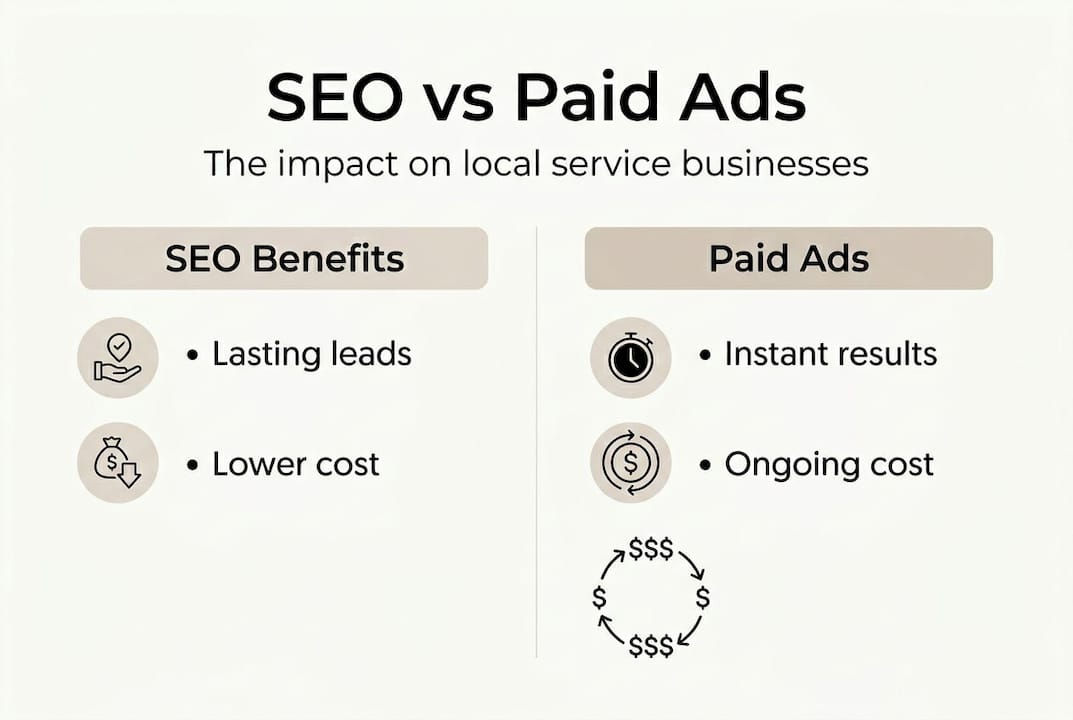
The compounding nature of SEO is what makes it so powerful for service businesses. Every blog post you publish answering a common customer question, every citation you build on local directories, every review you earn on Google, these all add to a growing foundation of authority. Six months in, your SEO is stronger than it was at month one. Twelve months in, it is stronger still. That flywheel effect is simply not available with paid advertising.
Now that you see why showing up for search matters, let us compare SEO to other ways service businesses get found.
SEO vs. paid ads: Cost, control, and credibility
We hear this question constantly from local service business owners: “Should I just run Google Ads instead?” It is a fair question. Ads are fast, measurable, and relatively easy to set up. But the comparison deserves an honest look.
SEO can be cheaper than paid search ads depending on keywords and competition, and it does not cost money beyond the resources needed to build it, though it does take time. That time investment is the trade-off. Here is how the two approaches stack up across the factors that matter most to service business owners:
| Factor | SEO | Paid ads |
|---|---|---|
| Upfront cost | Moderate (time and setup) | Low to moderate |
| Ongoing cost | Low (maintenance) | High (continuous spend) |
| Flexibility | Moderate | High |
| Customer trust | High (organic) | Lower (ad label) |
| Visibility lifespan | Long-term | Only while spending |
| Effort required | Consistent, ongoing | Ongoing budget management |
The trust factor is worth pausing on. Local customers, especially those searching for someone to enter their home or business, are cautious. They pay attention to signals of credibility. An organic listing with strong reviews and a complete profile reads as established and reliable. A paid ad, clearly labelled as such, raises questions: “Why do they need to pay to show up?”
That perception gap translates directly into click-through rates and, ultimately, bookings.
Here are the key advantages of prioritising SEO for your service business:
- Sustained visibility that does not require a monthly cheque to maintain
- Stronger conversion rates because organic visitors arrive with higher intent and trust
- Compounding returns as your domain authority builds over months and years
- Reduced dependency on a single platform’s pricing or algorithm changes
- Better brand positioning as a recognised, established local provider
That said, SEO and paid ads are not mutually exclusive. Many successful service businesses use both, running ads for immediate lead generation while building their organic presence for long-term stability. The point is that SEO should not be ignored in favour of ads, because the moment you stop paying, everything you built through ads disappears.
Pro Tip: If you are currently spending more than $500 per month on paid ads without a parallel SEO strategy, you are essentially renting your visibility. Redirect even a portion of that budget toward SEO and you begin building an asset rather than just buying access.
Beyond basic comparisons, there is an important shift impacting all local business visibility online: AI-driven answers.
Adapting to AI search: Why aligning your SEO with new search experiences is critical
Here is something that many SEO guides still are not talking about clearly enough. Search is changing. Fast.
AI-powered search tools, including Google’s AI Overviews and platforms like ChatGPT, are increasingly answering user questions directly on the results page. A customer asks “who is the best electrician in Vancouver?” and instead of seeing a list of ten blue links, they see a generated summary that names two or three businesses. If your business is not in that summary, you simply do not exist in that moment.
SEO visibility may not translate to clicks as AI answers increasingly satisfy queries without requiring a visit to your website. This is a fundamental shift. Ranking on page one is no longer enough if AI is summarising the answer before anyone clicks.
So what do you do? You adapt your SEO strategy to serve both traditional search engines and AI systems. Here is how:
- Optimise for featured snippets: Structure your content with clear questions and direct answers so AI systems can pull from your pages easily
- Reinforce local intent signals: Use your city, neighbourhood, and service area consistently across your website, Google Business Profile, and directory listings
- Build citation consistency: Ensure your business name, address, and phone number are identical everywhere they appear online
- Create answer-focused content: Write blog posts and FAQ pages that directly address the questions your customers are asking
- Earn authoritative mentions: When trusted local sources and directories reference your business, AI systems are more likely to include you in generated recommendations
Understanding how ChatGPT chooses recommendations is genuinely useful here. It is not random. AI systems favour businesses that are well-documented, consistently cited, and clearly associated with a specific location and service category.
Our AI search visibility guide walks through exactly how to position your business to appear in these AI-generated answers, which is quickly becoming as important as traditional search rankings.
Pro Tip: Add a dedicated FAQ section to your website that answers the ten most common questions your customers ask before hiring you. Write each answer in plain language, with your city and service type included naturally. This is one of the most effective ways to appear in both featured snippets and AI-generated summaries.
The businesses that thrive in this new environment are not just the ones with the best website. They are the ones whose digital presence is structured in a way that both humans and AI systems can easily read, trust, and recommend. Your AI SEO process should account for this from the very beginning.
With these changes in mind, let us consider a practical, opinionated take on what actually works when moving your local service business forward.
What most guides miss: The real reason SEO matters now for service businesses
Most SEO guides talk about rankings and traffic. They tell you to get backlinks, publish blog posts, and optimise your title tags. That advice is not wrong, but it misses the deeper point entirely.
SEO is not about showing up. It is about being chosen. There is a meaningful difference.
You can rank on page one and still lose the booking to a competitor who has more reviews, a clearer service description, or a stronger local reputation. The moment of selection, when a customer decides to call you instead of the next result, is where the real game is played.
We see this constantly. A service business invests in SEO, climbs the rankings, and then wonders why their bookings did not increase proportionally. The issue is almost never the ranking. It is the profile, the reviews, the trust signals, and the clarity of what they offer and where they serve.
Effective SEO today means shaping how your business appears across every touchpoint: your Google Business Profile, your website, your directory listings, and increasingly, AI-driven selection in generated summaries. It means continuously checking not just where you rank, but how you appear and whether what customers see makes them want to call you.
That is the real opportunity. And most guides never get there.
Take your next step: Easy local SEO with expert support
If this guide has made one thing clear, it is that SEO is not optional for Canadian service businesses that want steady, sustainable growth. The question is not whether to invest in it. It is how to do it efficiently without taking time away from running your business.
That is exactly what we built Locally Visible to do. We handle the done-for-you AI SEO process so your business gets found in both traditional search and AI-generated recommendations, without you having to become an SEO expert overnight. Whether you are a plumber, landscaper, cleaner, or contractor, we have tailored solutions available by SEO by industry. And if you want to understand what it costs before committing, our AI SEO pricing page lays it all out clearly. Start with a free visibility check, then a website build, then the SEO and AI visibility program.
Frequently asked questions
How long does it take for SEO to work for a local service business?
Most local service businesses see noticeable improvements in web visibility and bookings after several months of consistent SEO efforts, since SEO takes time to build momentum and improve rankings.
Is SEO really cheaper than running paid ads for service businesses?
Yes. SEO can be more cost-effective over time, producing ongoing traffic and leads without paying for every individual click.
Does showing up in search results always mean more bookings?
Not always. SEO visibility may not translate to clicks as AI answers increasingly satisfy queries directly, so optimising for local intent and AI visibility is now essential.
What is an easy first step for better SEO if I am just getting started?
Claim and fully update your Google Business Profile, making sure your business name, address, phone number, and service categories are accurate and consistent everywhere they appear online.