
Boost your local service visibility across Canada
Running a local service business in Canada means competing against dozens of neighbours and, increasingly, national brands with massive advertising budgets. You show up, do great work, and still find yourself buried on page two of Google while a chain with mediocre reviews sits at the top. That gap isn’t about quality. It’s about visibility strategy. This guide walks you through every practical step, from foundational setup to paid advertising and reputation management, so you can attract more customers in your city and build an online presence that compounds over time.
Table of Contents
- What you need to succeed in local marketing
- Step-by-step: Optimising your Google Business Profile
- Implementing local SEO: Website and citation essentials
- Pay-per-lead and digital advertising: Local Services Ads
- Building trust: Reputation and reviews for local service success
- Why local marketing is a marathon, not a sprint
- Next steps: Take your local marketing further
- Frequently asked questions
Key Takeaways
| Point | Details |
|---|---|
| Google Business Profile is critical | Ongoing GBP optimisation is the single most effective way to improve local visibility and win leads. |
| Foundational SEO steps matter | Schema, NAP consistency, and linking to GBP are marketing basics most competitors still miss. |
| Pay-per-lead ads accelerate results | Google Local Services Ads drive quality leads for eligible home service businesses with clear ROI. |
| Reviews and trust drive growth | Building reputation through reviews creates sustainable results that algorithms and customers reward. |
What you need to succeed in local marketing
Before you dive into advanced tactics, let’s make sure you’re set up for local marketing success. Most Canadian service businesses jump straight to advertising or social media, skipping the basics that make everything else work. Think of these foundations as the infrastructure beneath your marketing. Without them, even a generous ad budget delivers disappointing returns.
Here’s an overview of what every local service business needs before launching any marketing effort:
| Asset | Why it matters | Common mistake |
|---|---|---|
| Professional website | Your credibility hub for every channel | Outdated design, no service pages |
| Google Business Profile | Primary lead driver for local searches | Set up once, never touched again |
| Consistent NAP | Name, Address, Phone must match everywhere | Different formats on different directories |
| Reviews platform | Builds trust and improves rankings | No process for collecting reviews |
| Service-specific landing pages | Captures high-intent search traffic | One generic “Services” page |
| Social profiles | Reinforces brand presence and NAP | Abandoned or incomplete profiles |
Must-have checklist for local service businesses:
- Claimed and verified Google Business Profile
- Website with contact info matching your GBP exactly
- At least one landing page per core service
- Listed on key Canadian directories (Yellow Pages, Yelp, Bing Places)
- A simple process for requesting reviews after each job
- LocalBusiness schema (structured data) installed on your website
That last item trips up a lot of owners. LocalBusiness schema is code added to your website that tells search engines exactly who you are, where you operate, and what you do. It’s one of the most underused tools in local SEO. According to local SEO benchmarks from audits of small business websites, adoption of LocalBusiness schema remains remarkably low among Canadian SMBs, alongside weak linking between websites and Google Business Profile. That’s actually good news for you: fixing these basics now puts you ahead of most competitors with minimal effort.
Pro Tip: Your Google Business Profile is not a one-time launch. Treat GBP as an ongoing task, not a box to tick. Businesses that update their profiles regularly, add photos, respond to reviews, and post updates consistently outperform those that set it up and forget it.
Step-by-step: Optimising your Google Business Profile
With the basics in place, it’s time to focus on the main tool driving leads for local service businesses. Google Business Profile (GBP) is where most customers find you first, and it’s where the decision to call you, or call your competitor, often gets made. Treating it as a living asset rather than a static listing is one of the highest-leverage moves you can make.
Follow this checklist to optimise your GBP properly:
- Verify your business information. Confirm your business name, address, and phone number are accurate and formatted identically to your website.
- Select the right primary category. Your primary category tells Google what you do. Choose the most specific category that fits your main service (e.g., “Plumber” not “Contractor”).
- Add secondary categories. If you offer HVAC and plumbing, list both. Secondary categories capture additional search queries.
- Match your NAP to your website exactly. Even small differences, like “St.” vs. “Street,” can dilute your local ranking signals.
- Set accurate hours and service areas. Include all neighbourhoods and cities you genuinely serve. Misleading service areas can trigger penalties.
- Write compelling service descriptions. Use natural language your customers actually search for. Mention specific problems you solve, not just generic service names.
- Upload fresh photos regularly. Before-and-after shots, team photos, and job site images build confidence and make your listing stand out visually.
- Actively encourage reviews. Ask every satisfied customer directly and make it easy by sharing your GBP review link via text or email.
- Link your GBP services to matching landing pages. Each service listed on your GBP should link to a dedicated page on your website.
- Post monthly updates. Share seasonal offers, completed projects, or tips relevant to your trade.
Only 4.4% of small business websites link back to their own Google Business Profile. That’s a massive missed opportunity. A simple linked button on your homepage and contact page costs nothing and strengthens your local search signals significantly.
As a primary lead driver for Canadian local service businesses, your GBP deserves at least 20 minutes of attention every month. Set a recurring calendar reminder and treat it like a maintenance task, because that’s exactly what it is.
Pro Tip: Even minor changes to your GBP, like updating a photo or tweaking a service description, signal activity to Google. Consistent engagement with your listing can meaningfully improve how often it appears in local map results.
Implementing local SEO: Website and citation essentials
Once your Google Business Profile is robust, the next step is reinforcing your presence through your website and business directories. Your website and your GBP should work together like two halves of the same signal. When they align, search engines gain confidence in your business and rank you higher for local searches.

Here’s how a standard website compares to a properly optimised local SEO site:
| Feature | Standard website | Optimised local SEO site |
|---|---|---|
| LocalBusiness schema | Missing | Fully implemented |
| NAP consistency | Inconsistent across pages | Identical on every page and directory |
| GBP link | None | Linked from homepage and contact page |
| Embedded Google Map | Rarely included | On contact and location pages |
| Customer reviews | Not displayed | Embedded or highlighted prominently |
| Service area pages | Generic “service area” blurb | Dedicated pages per city or neighbourhood |
According to current SMB website audits, the most commonly missed items among Canadian service businesses include:
- No LocalBusiness schema markup on the homepage or contact page
- NAP inconsistencies between the website, GBP, and directory listings
- No visible link from the website to the Google Business Profile
- Missing embedded maps on contact or location pages
- Reviews not displayed anywhere on the site
Fixing these is straightforward. For schema best practices, add a JSON-LD block to your homepage that includes your business name, address, phone number, service area, and hours. There are free schema markup templates available that you can adapt without needing to be a developer. Most modern website platforms let you paste this into the page header directly.
For NAP consistency, audit every directory listing you appear in and bring them all into alignment with your GBP. This includes Yelp, Yellow Pages, Bing Places, Facebook, and any trade-specific directories relevant to your industry. Even a slightly different address format across listings dilutes your local authority.
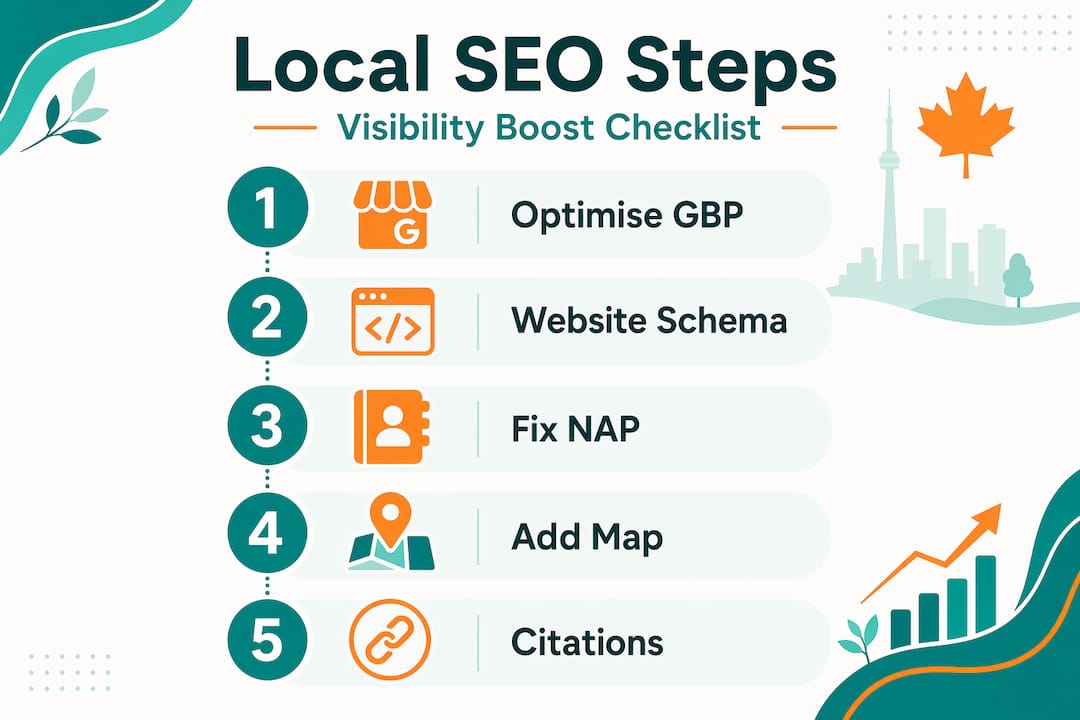
Embedded Google Maps on your contact page serve two purposes: they confirm to search engines that your physical location is real and well-documented, and they make it easier for customers to find you. Reviews displayed on your site, whether through a widget or manually curated, build trust the moment someone lands on your page.
Pay-per-lead and digital advertising: Local Services Ads
Even with great organic groundwork, advertising can jump-start growth in competitive markets. Google Local Services Ads (LSA) are a particularly effective option for Canadian home and trade service businesses because they operate on a pay-per-lead model rather than pay-per-click.
With LSA, you only pay when a customer contacts you directly through the ad. Not for impressions. Not for accidental clicks from someone who wasn’t looking for your service. Just for actual leads. Ads also display a “Google Verified” badge, which instantly boosts trust for potential customers who are comparing providers.
Businesses eligible for Local Services Ads in Canada typically include:
- Plumbers
- HVAC technicians
- Electricians
- Locksmiths
- Roofers
- Garage door specialists
- House cleaners
- Pest control services
- Lawyers and financial planners (in select markets)
For businesses in home service industries, LSA can be especially powerful when you’re entering a new service area or trying to grow faster than organic rankings alone allow. Because you only pay for genuine leads, it’s easier to calculate a real return on investment compared to traditional display or search ads.
One important note: your LSA ranking is partly driven by your reviews and response rate. That means the reputation work you do for organic SEO directly improves your paid performance too. It’s a genuine flywheel. Better reviews feed better LSA placement, which generates more leads, which gives you more opportunities to collect more reviews.
Building trust: Reputation and reviews for local service success
With paid and organic tactics in play, the make-or-break factor for local businesses often comes down to trust. A potential customer who finds you through a Google search, a Local Services Ad, or a social profile still needs one more thing before they pick up the phone: confidence that you’ll do what you say you’ll do.
Reviews are the most visible trust signal you have. Here are practical ways to generate them consistently:
- Ask directly after completing a job, in person or by text
- Send an automated follow-up email 24 hours after service with a direct link to your GBP review page
- Add a “Leave us a review” link to your email signature
- Respond to every review, positive or negative, within 48 hours
- Display a QR code on your invoice or business card that links to your review page
Pro Tip: When a negative review appears, respond publicly with empathy and a real offer to make it right. Prospective customers read how you handle complaints just as closely as they read the complaints themselves. A thoughtful response to a one-star review can actually increase conversions.
Reputation building for local trust also means creating clarity about what you offer. High-intent customers, the ones ready to hire today, need to see specific services mapped to specific locations. “Plumber in Oakville” is more persuasive than “Plumber serving the GTA.” As local marketing guidance for trade service businesses consistently shows, a trust and clarity foundation underpins every effective local marketing strategy. Niche service landing pages, honest descriptions, and clear pricing signals all contribute to that foundation.
Trust compounds. A business with 80 genuine reviews, prompt responses, and clear service pages will outperform a technically superior competitor who neglects reputation management every single time.
Why local marketing is a marathon, not a sprint
So what does it all add up to? Here’s what most “quick fix” guides miss about local business marketing.
We’ve worked with Canadian service businesses that tried every new platform, every trending tactic, and every shortcut promising first-page results in 30 days. Some of those tactics delivered a short burst of traffic. Almost none of them built anything lasting. What actually moves the needle over 12, 24, or 36 months is something far less exciting: consistency.
Every month you update your GBP, collect three more reviews, and fine-tune a service page, you’re adding another layer to a structure that compounds in your favour. Reviews from six months ago still build credibility today. A well-written service page you published last year still captures leads this year. Schema you installed once keeps signalling your relevance to Google every day. That’s the compounding effect that most local marketing advice ignores because it doesn’t make for a catchy headline.
The businesses we see dominate local search in their markets aren’t necessarily the ones with the biggest budgets. They’re the ones who showed up consistently over time. They responded to reviews when others didn’t. They updated their GBP when others treated it as a relic. They built local backlinks and directory listings gradually rather than in one frantic afternoon.
We also notice that the best-performing businesses stop trying to out-game the system and instead focus on local growth strategies that reflect how they actually serve customers. Real trust, clearly communicated, backed by genuine reviews, wins in local search. Not clever manipulation of ranking signals.
The practical takeaway: schedule a monthly 30-minute marketing review. Update your GBP, check your reviews, review your NAP consistency, and look at which service pages are generating calls. That rhythm, maintained over a year, will outperform any one-time SEO overhaul almost every time.
Next steps: Take your local marketing further
If you’re ready for more traffic, leads, and trust, here’s how you can get hands-on help.
The steps in this guide work. But we also know that between running jobs, managing staff, and handling customers, most service business owners don’t have time to audit their schema, chase directory listings, and monitor reviews every single month. That’s exactly why we built what we built.
At Locally Visible, we offer done-for-you AI SEO services tailored specifically for Canadian home and trade service businesses, covering HVAC, plumbing, electrical, dental, legal, and more. We handle your GBP optimisation, schema implementation, citation cleanup, and review system setup so your business gets cited in local search and AI responses. Explore services by industry or visit Locally Visible to learn how we help Canadian businesses get found and chosen online. We guarantee you’ll be cited by ChatGPT in 90 days, or we keep working until you are.
Frequently asked questions
How often should I update my Google Business Profile?
You should review and update your GBP at least once per month, adjusting hours, uploading photos, and posting updates to maintain visibility. Ongoing GBP optimisation is consistently recommended as a best practice for local service businesses.
What is the most common mistake local service businesses make with online marketing?
Most Canadian service businesses overlook foundational website elements like consistent NAP, LocalBusiness schema, and a clear link to their Google Business Profile. Low adoption of these basics is confirmed across SMB website audits and represents the single biggest gap in local SEO performance.
Am I eligible for Google Local Services Ads in Canada?
If you offer home or professional services like plumbing, HVAC, or electrical work, you are very likely eligible for Local Services Ads in Canada. Eligibility depends on your service category and location.
How does reputation affect my local Google rankings?
Positive reviews, steady review volume, and regular owner responses are important signals for local search rankings and consumer trust. Trust and reviews form the foundation of effective local service business marketing across every channel.