
Growing a local service business in Canada takes more than a great reputation and reliable service. Too many business owners watch their calendars stay half-empty while competitors with similar offerings attract a steady stream of customers. The gap isn’t quality. It’s visibility and relevance. Canadian customers have specific expectations, prefer businesses that feel local and trustworthy, and increasingly turn to search engines and AI tools before making a phone call. This guide gives you a step-by-step framework to attract more Canadian customers, improve your online presence, and build a targeting strategy that actually moves the needle.
Table of Contents
- Understand Canadian customer preferences
- Optimise your web presence for Canadian search
- Leverage Canadian advertising channels
- Measure and refine your targeting strategy
- A fresh look: Why targeting Canadian customers isn’t ‘one-size-fits-all’
- Boost your local visibility with proven solutions
- Frequently asked questions
Key Takeaways
| Point | Details |
|---|---|
| Know customer expectations | Canadian customers value personalised service and bilingual options, especially in Quebec. |
| Optimise for local search | Use location-specific keywords and service area pages for strong regional visibility. |
| Use targeted ads | Leverage Google Ads, Local Services Ads, and directories to reach the right local customers. |
| Track and refine strategies | Measure campaign performance and adjust for maximum ROI and customer engagement. |
| Regional nuances matter | Always adapt tactics for Canadian market and language diversity for best results. |
Understand Canadian customer preferences
Now that we’ve previewed actionable strategies, let’s dig into what truly matters to Canadian customers. The first thing to understand is that Canada isn’t a monolith. What works for a plumber in Vancouver may fall flat for an electrician in Montreal. Regional differences in language, culture, and consumer behaviour shape how customers find and trust local businesses.
Canadian customers consistently favour businesses that feel personal, responsive, and community-oriented. They’re more likely to trust a business with genuine reviews, a clear service area, and a consistent online presence. According to a 2026 report, marketing contributes $130.9B to Canada’s GDP, and personalised campaigns drive 10 to 15% revenue increases for businesses that get it right. Let that sit for a second.
What Canadian customers look for in local services:
- Clear, localised contact details and service area information
- Recent, authentic reviews from customers in their region
- Bilingual options in provinces like Quebec and parts of New Brunswick
- Fast response times, especially via mobile
- Transparent pricing or at least easy access to quotes
Understanding industry-specific customer trends is also worth your time. A customer looking for HVAC repair in Edmonton has different urgency signals than someone searching for a landscaper in Victoria. Seasonal demand, regional climate, and local competition all influence how you should position your service.
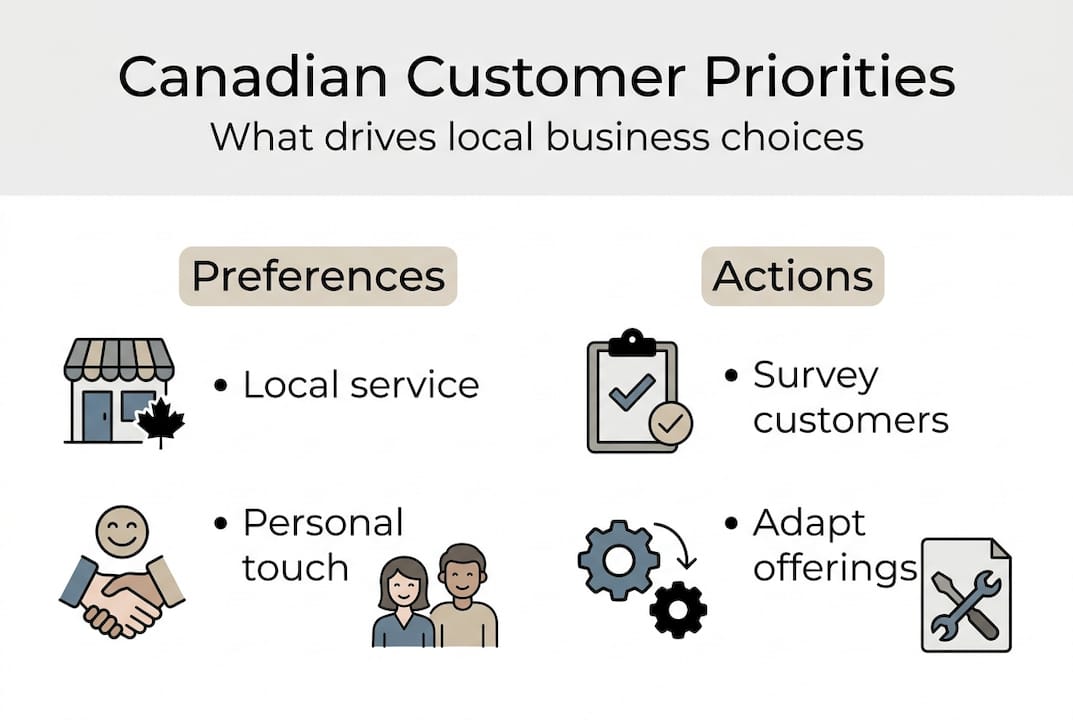
One area many business owners overlook is AI-driven discovery. More Canadians are asking tools like ChatGPT for AI customer recommendations before they ever visit a business website. Getting cited by these tools means your business appears at the top of a new class of search behaviour.
| Customer priority | Why it matters | Action for you |
|---|---|---|
| Local relevance | Customers trust nearby providers | Add city and region to all profiles |
| Review volume and recency | Signals trust and activity | Request reviews consistently |
| Bilingual content | Reaches French-speaking customers | Add French pages or translations |
| Mobile-friendly experience | Most searches happen on phones | Audit your site on mobile monthly |
Pro Tip: Survey your existing customers with one simple question: “How did you find us?” The answer will tell you more about targeting than any analytics dashboard.
Optimise your web presence for Canadian search
With a clear understanding of customer expectations, let’s move to actionable online visibility strategies. Your website and online profiles are your most powerful targeting tools. But they only work if they’re built for Canadian search behaviour.
Location-specific keywords are the foundation. Rather than targeting generic terms like “mechanic” or “plumber,” target location-specific keywords such as “mechanic Calgary” or “emergency plumber Halifax” in your page titles, headers, and content. Creating dedicated service area pages for each city or region you serve compounds this effect significantly.
“The businesses that win local search in Canada aren’t the ones with the biggest budgets. They’re the ones who’ve built their digital presence around how real customers in real cities actually search.”
A numbered optimisation playbook:
- Add location keywords to your homepage title tag, H1 heading, and first paragraph.
- Create service area pages for every city or region you actively serve.
- Implement schema markup (structured data that tells search engines what your business does and where) to improve how you appear in local results. Learn how AI schema for local SEO works.
- Claim and complete your Google Business Profile with photos, services, hours, and a local phone number.
- Add bilingual content if you serve Quebec or French-speaking communities. Use hreflang tags for French SEO to signal to search engines which version of the page to show based on language preference.
| Approach | Generic (avoid this) | Canadian-optimised (do this) |
|---|---|---|
| Keyword targeting | “Plumber services” | “Plumber Ottawa emergency repair” |
| Service pages | One general services page | Individual pages per city served |
| Language | English only | English + French for applicable regions |
| Schema | None or basic | LocalBusiness schema with service area |
Explore our local SEO insights to see examples of how other Canadian service businesses have structured their web presence for maximum regional visibility.

Pro Tip: Even if you don’t serve Quebec, adding a single French-language FAQ page for bilingual communities in your province can open up a new segment of local customers who prefer to search in French.
Leverage Canadian advertising channels
With your web presence optimised, the next step is targeting customers through smart advertising channels. Organic search is powerful, but paid advertising lets you reach the right people right now.
Google Ads with location targeting lets you show ads exclusively to people searching within your service area. Local Services Ads (LSAs) are particularly effective for home service businesses like HVAC technicians, plumbers, and electricians. LSAs appear above standard ads, display a “Google Guaranteed” badge, and charge per lead rather than per click.
Key advertising channels for Canadian local businesses:
- Google Ads: Set tight geographic boundaries around your service area. Bid on high-intent terms like “[service] near me” and city-specific queries.
- Local Services Ads: Ideal for regulated trades and home services. Build trust through the verification badge.
- Canadian business directories: YellowPages.ca, HomeStars, and Houzz all carry domain authority and local relevance that amplifies your visibility.
- Facebook and Instagram geo-targeting: Effective for awareness campaigns targeting specific postal codes or cities.
- Nextdoor Canada: A growing platform where neighbourhoods actively recommend local service providers.
Statistic callout: Personalised campaigns generate 10 to 15% more revenue for Canadian businesses. That figure is even higher when campaigns are refined using actual lead source data.
View industry-specific ad strategies to see which channels perform best for your type of service business.
The mistake most business owners make is spreading budget equally across every channel. Concentrate spend where your customers actually convert. If phone calls from Google Ads drive 80% of your bookings, double down there before experimenting elsewhere. Start with one channel, prove it, then scale. That’s the flywheel.
Pro Tip: Track every lead source, whether it’s a form submission, phone call, or directory inquiry. After 60 days, cut anything with a cost per acquisition that exceeds your average job margin. Then reinvest that budget into what’s working.
Measure and refine your targeting strategy
To ensure your efforts deliver real results, let’s discuss how to measure and continuously improve your customer targeting. Setting up campaigns is step one. Staying in the loop on what’s actually working is what separates growing businesses from stagnant ones.
A step-by-step measurement framework:
- Set clear, specific goals. Not “get more customers” but “generate 20 qualified leads per month from the Ottawa service area.”
- Install Google Analytics 4 on your website and set up conversion events for phone calls, form fills, and quote requests.
- Use UTM parameters on every paid ad link to track which campaign, channel, and keyword brought each visitor.
- Review lead source data monthly and identify which channels generate the most bookings versus just clicks.
- Benchmark against industry ROI benchmarks to know whether your results are on track for your sector.
Metrics worth tracking:
- Website visitors from your target cities or regions
- Conversion rate (visitors who contact you divided by total visitors)
- Cost per lead by channel
- Customer acquisition cost (total spend divided by new customers gained)
- Review velocity (how quickly new reviews are accumulating)
Metrics to ignore:
- Total website sessions without context
- Social media follower counts
- Impressions and reach without conversion data
| Metric | What it tells you | Improvement action |
|---|---|---|
| Conversion rate below 2% | Visitors aren’t taking action | Improve calls to action and page speed |
| High traffic, low leads | Wrong audience or weak offer | Refine keyword targeting |
| Good leads, low close rate | Sales process needs work | Improve follow-up speed and scripts |
| Rising cost per lead | Competition increasing or ads fatigued | Refresh ad creative and bidding strategy |
The Canadian business ROI data makes clear that personalised, well-measured campaigns consistently outperform generic ones. Measurement isn’t optional. It’s the engine. Track your local business visibility metrics regularly and treat every campaign as a test with a hypothesis, not a set-and-forget expense.
A fresh look: Why targeting Canadian customers isn’t ‘one-size-fits-all’
After covering actionable steps, let’s challenge a piece of conventional wisdom. Most marketing advice treats Canada as a scaled-down version of the American market. It isn’t. The regional complexity here is real. An HVAC business in Winnipeg faces completely different competitive dynamics, seasonality, and consumer trust signals than one in Victoria or Quebec City.
We’ve seen business owners copy strategies wholesale from US playbooks and wonder why results are flat. The answer is almost always that they haven’t accounted for Canadian regional nuance. French-speaking markets aren’t just “translated English” markets. Northern and rural communities don’t behave like urban centres. Indigenous and multicultural neighbourhoods have their own trust dynamics.
The businesses that win are the ones treating their local SEO experiments as ongoing learning. They test, measure, adapt, and test again. They don’t expect a single tactic to work forever. What moves the needle this quarter may plateau next quarter. Build that expectation into your strategy from the start, and you’ll outpace competitors who think targeting is a one-time setup.
Boost your local visibility with proven solutions
If you’ve made it this far, you understand the opportunity. Canadian customers are reachable. The strategies above work. But execution takes time, expertise, and consistent attention that most busy service business owners simply don’t have.
That’s where Locally Visible comes in. We offer done-for-you AI SEO onboarding designed specifically for Canadian local service businesses, including schema setup, citation building, and AI search visibility. Our clients get cited by ChatGPT within 90 days, or we keep working at no additional cost. Explore our industry SEO solutions to find the right fit for your business and start attracting the Canadian customers you’ve been missing.
Frequently asked questions
What is the best way to target Canadian customers online?
Use location-specific keywords like “mechanic Calgary” in your page titles and content, create dedicated service area pages, and run Google Ads with tight geographic targeting to reach the right customers in your region.
How important is bilingual content for targeting customers in Quebec?
Bilingual content is essential for Quebec, and using hreflang tags alongside French-language pages improves local search rankings and builds trust with French-speaking customers who prefer to search in their first language.
What advertising channels are most effective for Canadian local businesses?
Google Ads with location targeting and Local Services Ads consistently deliver strong results for Canadian home service businesses, alongside Canadian directories like HomeStars and YellowPages.ca that carry genuine local authority.
How can I measure if my targeting strategies are working?
Track website conversions, lead sources, and cost per acquisition monthly, then compare against your job margin. Personalised, measured campaigns consistently generate 10 to 15% more revenue than untargeted ones, making data review a non-negotiable habit.