Blog / Importance Of Business Signals
Boost your local search visibility with business signals

Boost your local search visibility with business signals
You could have a five-star rating, a loyal customer base, and a service area stretching across half of Ontario — and still not show up when someone nearby searches for what you do. That frustration is real, and we hear it from Canadian service business owners constantly. The missing piece is almost never more reviews. It is almost always inconsistent or incomplete business signals. Search engines and AI platforms use business signals to verify, rank, and recommend local businesses, and if those signals are muddled, even the best reputation can get buried.
Table of Contents
- What are business signals and why do they matter?
- Types of business signals that affect search visibility
- Common mistakes and how to fix business signal gaps
- How to leverage business signals for AI-powered customer engagement
- Why most experts overlook business signals and why they matter more than ever
- Unlock your visibility and customer engagement with AI-powered solutions
- Frequently asked questions
Key Takeaways
| Point | Details |
|---|---|
| Signals drive visibility | Search engines and AI platforms prioritise businesses with strong, consistent signals. |
| Consistency is critical | Uniform business details across web platforms prevent visibility losses and boost trust. |
| AI relies on signals | AI tools increasingly use business signals, not just reviews, to make local recommendations. |
| Fix mistakes quickly | Address signal gaps and mismatches to improve rankings and customer engagement. |
| Sector-tailored strategies | Plumbing, HVAC, dental, and legal businesses gain extra visibility through industry-specific signal tactics. |
What are business signals and why do they matter?
Having established the stakes, let us dive into what actually constitutes a business signal.
A business signal is any piece of structured or unstructured data that helps search engines and AI platforms confirm that your business is legitimate, accurately located, and relevant to a specific search query. Think of signals as a chorus: every data point sings the same tune, and the louder and more consistent that chorus, the more confident an algorithm becomes in recommending you.
Business signals include:
- Name, address, and phone number (NAP): The foundational trio. Every platform where your business appears must show identical details.
- Website presence and content: Does your site clearly describe what you do, where you operate, and who to call?
- Citations: Mentions of your business on third-party directories like Yelp, Yellow Pages, or Houzz.
- Reviews: Quantity, recency, and how you respond all contribute to your signal strength.
- Local schema markup: Structured data embedded in your website code that tells search engines exactly what your business is.
- Social profiles: Consistent branding and contact details across Facebook, Instagram, and LinkedIn.
Here is the part most business owners miss. Reviews capture customer sentiment, but they are only one layer of a much more complex picture. ChatGPT recommendations and Google’s local search results both rely on a wide web of signals to determine whether your business deserves a top spot. A business with 200 reviews but inconsistent NAP data can easily lose ground to a competitor with 50 reviews and rock-solid signal consistency.
“The businesses that dominate local AI results are not necessarily the most popular — they are the most verifiable.”
Research consistently shows that local discovery is driven by trust signals more than raw popularity. When AI platforms evaluate which plumber or HVAC contractor to recommend, they are essentially running a background check on every business in the database. The stronger and more consistent your signals, the more that background check works in your favour.
Types of business signals that affect search visibility
Now that we know what business signals are, let us compare and prioritise the types that matter most.
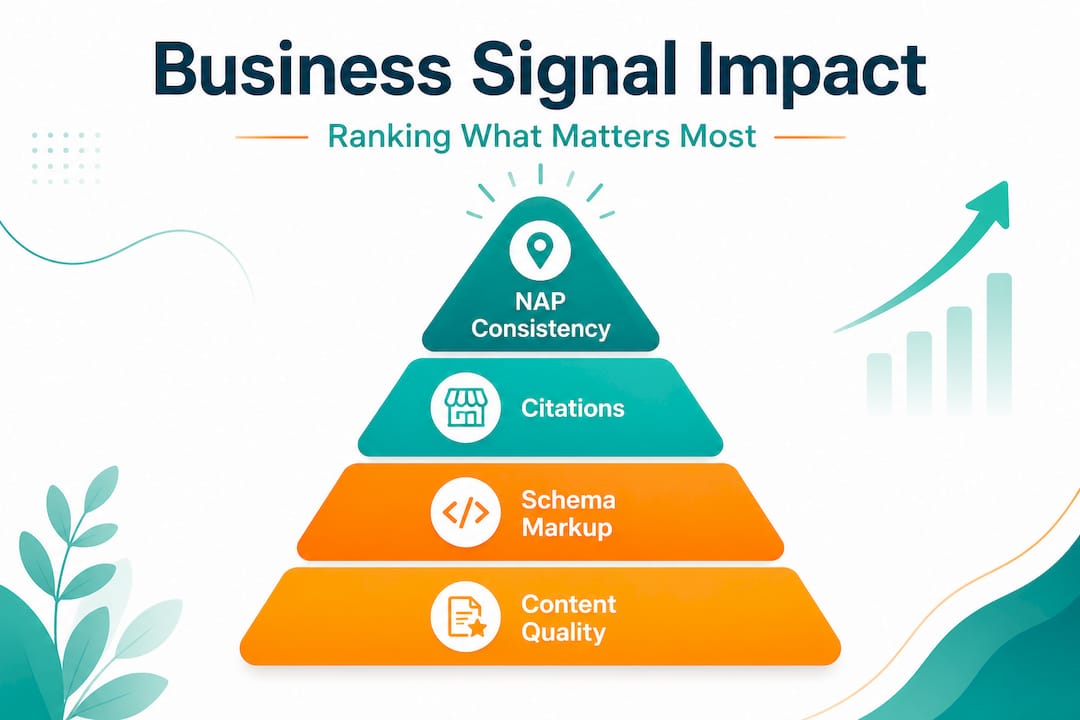
Not all business signals carry equal weight. Some are foundational — meaning that without them, everything else suffers. Others amplify what you already have. Here is a breakdown:
| Signal type | Traditional search impact | AI recommendation impact |
|---|---|---|
| NAP consistency | Very high | Very high |
| Citations (directories) | High | High |
| Reviews and responses | High | Moderate to high |
| Website content and keywords | High | Moderate |
| Local schema markup | Moderate | High |
| Social media consistency | Low to moderate | Moderate |
A few observations worth noting here. Schema markup, which is structured code that labels your business data for machines, has a disproportionately high impact on AI recommendations compared to traditional search. That makes sense when you think about it: AI tools are reading your data programmatically, so giving them clean, labelled information speeds up the trust-building process considerably.

Accurate NAP details contribute directly to positive signals for home service trades businesses. That sounds simple, but the reality is that most Canadian service providers have at least three or four variations of their contact details scattered across the internet from old listings, outdated Google profiles, or directory entries they never claimed.
Here is the order we recommend prioritising your signal work:
- Audit and correct your NAP across every platform where your business appears.
- Claim and optimise your Google Business Profile with complete service categories, photos, and hours.
- Build consistent citations on high-authority directories relevant to your trade.
- Add schema markup for citations to your website so AI tools can parse your business data accurately.
- Gather and respond to reviews with consistency, aiming for steady review velocity rather than bursts.
- Align your social profiles with the same NAP and business description used everywhere else.
Pro Tip: When you are reviewing winning business prompts in ChatGPT to see how your business is described, pay close attention to whether the AI gets your service area, specialisation, and contact method right. If it does not, your signals are not strong enough yet.
The goal is not perfection on every front simultaneously. The goal is a consistent, believable, machine-readable identity across all platforms where potential customers and AI tools might encounter your business.
Common mistakes and how to fix business signal gaps
Understanding the types of business signals, let us recognise the errors that can undermine their effectiveness and how to address them.
This is where most Canadian service businesses lose the game without even knowing they are playing. Signal gaps are rarely dramatic. They are subtle: a suite number left off in one directory, an old phone number on a chamber of commerce listing, a website that still says “serving the Greater Toronto Area” when you expanded to Hamilton two years ago.
The most common mistakes we see include:
- Mismatched contact information: Your Google Business Profile says one phone number; your website footer says another. Both are technically correct, but the discrepancy signals unreliability to algorithms.
- Unclaimed directory listings: Automated aggregators create listings for businesses all the time. If you have not claimed them, the data is often wrong.
- Outdated web content: Service pages that do not reflect your current offerings, pricing structure, or service area confuse both users and AI tools.
- Missing or incorrect schema markup: Many service business websites have no local business schema at all, leaving AI tools to guess what you do and where.
- No response strategy for reviews: Ignoring reviews, positive or negative, signals low engagement and can suppress your AI-driven ranking potential.
The good news is that signal gaps are fixable, and the improvement in visibility can be measurable within weeks.
Here is a practical before-and-after comparison to illustrate what signal fixes actually accomplish:
| Signal issue | Before fix | After fix |
|---|---|---|
| Inconsistent NAP | Confusing to AI and directories | Clean, trusted data across all platforms |
| Unclaimed listings | Wrong info, no control | Verified, accurate, brandable |
| No schema markup | AI guesses your business type | AI reads exact service and location data |
| No review responses | Signals low engagement | Signals active, trustworthy business |
| Outdated service pages | Mismatched with search intent | Aligned with what customers actually search |
Pro Tip: Use a tool like Moz Local or BrightLocal to run a citation audit. These tools scan hundreds of directories and flag every inconsistency. It is the fastest way to see where your signal gaps are hiding. Once you have the list, tackle the highest-authority directories first: Google, Yelp, Facebook, and industry-specific platforms like HomeStars for Canadian contractors.
Do not overlook improving local citations as a standalone project. Many business owners treat citations as a one-time setup task, but directories update, merge, and sometimes corrupt data over time. A quarterly review keeps your signals clean and your rankings stable.
How to leverage business signals for AI-powered customer engagement
Once signal gaps are fixed, here is how to put those improvements to work in AI-powered engagement.
Fixing your signals is the foundation. Leveraging them is where the real growth happens. When your business data is accurate, consistent, and machine-readable, AI tools can do something remarkable: they can recommend you unprompted, in direct response to a customer’s query, without you spending a cent on advertising.
Local authority in home service industries is built through the cumulative strength of your signals over time. A plumbing business in Calgary that has consistent NAP data, fifty citations, forty reviews with responses, and proper schema markup on their service pages is far more likely to appear when someone asks ChatGPT “who is a reliable plumber near me in Calgary” than a competitor with twice the reviews but half the signal consistency.
Here is a practical engagement strategy built on signal strength:
- Audit your current signals using a citation tool and a manual check of your top five directory listings. Document every inconsistency.
- Optimise your Google Business Profile by completing every field: services, attributes, business description, Q&A, and photos. This is the single most impactful platform for Canadian local search.
- Build citations on Canadian-relevant directories including YellowPages.ca, HomeStars, the Better Business Bureau, and any regional chamber of commerce listings in your service area.
- Connect your signals to AI tools by embedding structured data (schema) that matches your Google Business Profile exactly. When the data is identical across sources, AI tools confirm your identity faster.
- Maintain review velocity by asking satisfied customers for a review within 24 hours of completing a job. Steady, regular reviews outperform sporadic bursts every time.
- Monitor AI mentions by periodically querying ChatGPT and Bing Chat with prompts a customer might use. Check whether your business appears, and if so, whether the information is accurate.
A real-world example: a plumbing business that invested in signal consistency across thirty local directories, updated their schema, and maintained a monthly review cadence saw their AI citation rate increase substantially within a quarter. The lesson is straightforward: AI tools reward verifiable, consistent businesses.
“If you do one thing this month, make sure every platform that mentions your business says exactly the same thing about it.”
For sector-specific AI strategies, the approach varies slightly. HVAC companies benefit from seasonal content tied to their service pages. Dental practices need to align their schema with healthcare-specific categories. Legal professionals need consistent profile data across law society directories. The signal principles are universal; the execution is always tailored. Explore our field notes on AI SEO for industry-specific guidance on where to focus first.
Why most experts overlook business signals and why they matter more than ever
With practical advice covered, let us explore why business signals deserve more focus than most advisors admit.
Here is something we have observed after working with Canadian service businesses across multiple trades and professions: most SEO consultants and digital marketing advisors default to a content-first strategy. Publish more blogs. Get more reviews. Run Google Ads. These are not bad tactics, but they are often prescribed before the foundation is solid.
The uncomfortable truth is that AI-driven visibility is shaped largely by business signals, and most advisors underweight this because signals are unglamorous work. Fixing a citation does not make for a compelling case study. Writing a blog post does. But here is what we know from experience: a beautifully written blog on a site with inconsistent NAP data and no schema markup will underperform a basic, well-structured site with clean signals every single time in AI-driven results.
The AI era has shifted the calculus. When someone asks ChatGPT to recommend a local service provider, the AI is not crawling your blog. It is referencing structured data, citation patterns, and signal consistency across the web. The businesses that figured this out early are capturing AI recommendation real estate that their competitors are not even aware exists yet.
We are at an inflection point. Businesses that adopt a signal-first strategy now will build a compounding advantage. Think of it as a flywheel: clean signals earn AI trust, AI trust generates unprompted recommendations, recommendations drive enquiries, and enquiries generate more reviews and citations. Let that sit for a second. That is a growth engine that runs on accuracy and consistency, not ad spend.
The Canadian service businesses we have seen succeed in AI-driven search share one trait: they stopped treating business signals as an afterthought and started treating them as infrastructure. Your signals are not marketing. They are the foundation your marketing is built on.
Unlock your visibility and customer engagement with AI-powered solutions
Having explored the critical role of business signals, here is how Locally Visible can help you maximise their impact in the AI era.
We built Locally Visible specifically for Canadian local service businesses that are tired of being invisible online despite delivering excellent work. Our done-for-you approach starts with a thorough business signal audit, identifies every gap in your citations, schema, and NAP consistency, and then fixes it systematically so AI tools and search engines can find, verify, and recommend you with confidence.
If you want to understand how AI SEO works and why signals are the centrepiece of our process, that page walks you through our three-step method clearly. When you are ready to talk numbers, our AI SEO pricing is straightforward and built for service businesses with real budgets. And if you want the full picture of what we offer, Locally Visible is the place to start. We start with a free visibility check, then a website build, then the SEO and AI visibility program to keep it climbing.
Frequently asked questions
How do business signals differ from reviews?
Business signals go beyond reviews to include contact consistency, citation breadth, schema markup, and web content alignment, while reviews reflect only customer opinion and experience.
Why does inconsistent contact information hurt my SEO?
Search engines and AI tools may mistrust or ignore businesses with mismatched details, lowering their visibility. Accurate contact details are foundational to signal strength and must match across every platform where your business appears.
Should I update my business signals for each platform?
Yes, consistent updates across platforms ensure optimal visibility and customer trust. Even small discrepancies across Google, Bing, and business directories can confuse algorithms and suppress your ranking.
Can AI tools use business signals to recommend my service?
Absolutely. AI tools rely on signals to surface reliable local service recommendations when customers ask direct questions. The more consistent and complete your signals, the more likely you are to be cited unprompted.
What is the first step to improving my business signals?
Start with a business signal audit to identify inconsistencies and missing citations. A signal audit gives you a clear, prioritised list of what to fix first so your efforts move the needle immediately.