
Why SEO for small businesses: a 2026 guide
Most small business owners pour money into paid ads and wonder why the phone goes quiet the moment they stop spending. The answer is simpler than it seems: they are renting visibility instead of owning it. Understanding why SEO for small businesses matters starts with one number. Organic search drives 53% of all online traffic and contributes 44% of revenue across industries. That is not a minor channel. That is the channel. And for a local service business competing against larger brands with bigger ad budgets, organic search is often the most level playing field available.
Table of Contents
- Key takeaways
- Why SEO for small businesses delivers lasting growth
- Common challenges and how to get past them
- Key SEO strategies for small businesses and startups
- Understanding SEO timelines and what to expect
- My take: why small businesses underestimate SEO
- Ready to get found by local customers?
- FAQ
Key takeaways
| Point | Details |
|---|---|
| Organic search is dominant | Organic traffic accounts for over half of all website visits, making SEO the highest-impact digital channel for small businesses. |
| SEO costs drop over time | Unlike paid ads, SEO cost-per-lead falls 60 to 80% after the first year, compounding your return. |
| Page two is practically invisible | Moving from page two to page one can increase your share of traffic from 0.63% to 27.6%, a 44 times difference. |
| Local intent converts fast | 76% of local searches result in a store visit within 24 hours, making local SEO a direct driver of foot traffic. |
| Results take time but last | Expect initial progress in 3 to 6 months, with compounding growth that paid channels simply cannot replicate. |
Why SEO for small businesses delivers lasting growth
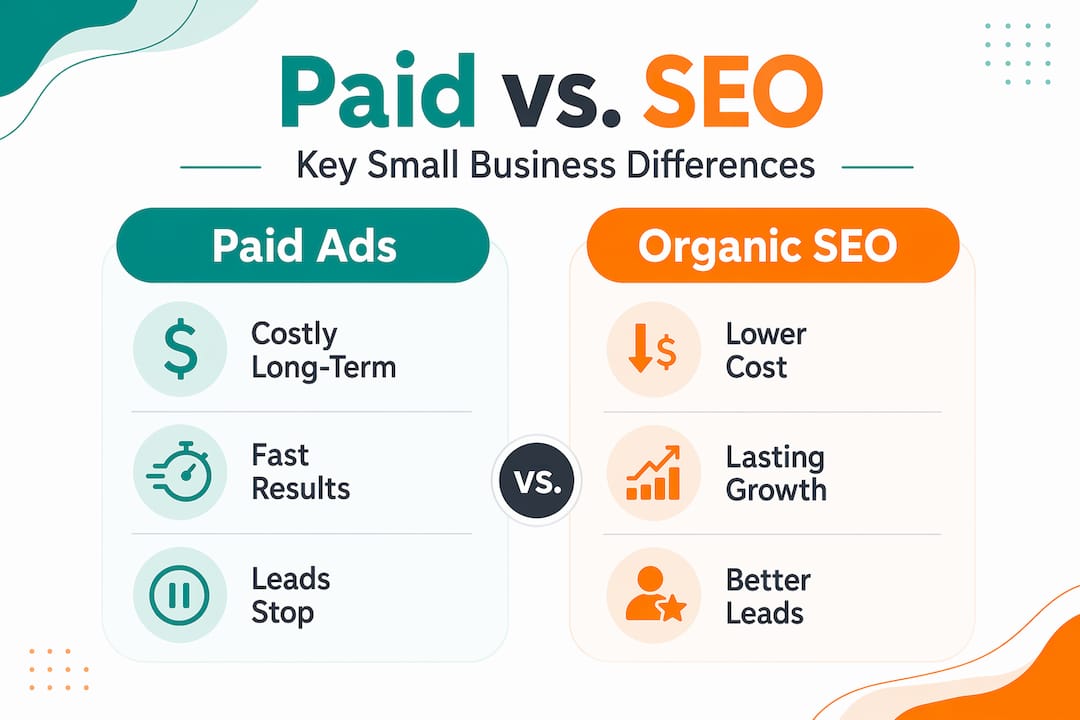
Paid advertising is a tap. Turn it on and leads flow in. Turn it off and they stop. SEO works differently. Every piece of content you publish, every backlink you earn, and every technical fix you make builds on the last. Think of it as a flywheel. Slow to start, but once it is spinning, it generates momentum you did not have to pay for that month.

The financial case is hard to ignore. SEO cost-per-lead drops 60 to 80% after the first year, while paid ad costs stay flat or rise as competition increases. For a local plumber or HVAC company running Google Ads, you might pay $80 to $150 per click in a competitive market. For the same keyword, a well-ranked organic page delivers those same clicks at near-zero marginal cost after the initial investment.
The quality of that traffic also matters. Organic search visitors convert at higher rates than social or display traffic because they arrive with commercial intent. Someone searching “emergency plumber Toronto” is not browsing. They need help now. Ranking for that term puts you in front of exactly the right person at exactly the right moment.
Paid ads vs. organic SEO: a direct comparison
| Factor | Paid ads | Organic SEO |
|---|---|---|
| Cost over time | Steady or rising | Drops significantly after year one |
| Traffic when you stop | Immediate zero | Sustained for months or years |
| Click intent | Mixed | High purchase intent |
| Trust signal to searchers | Lower (marked as ad) | Higher (perceived as earned) |
| Competitive barrier | Budget-dependent | Authority and content quality |
Pro Tip: If you are currently running paid ads with no SEO plan, you are building your competitor’s advantage. Every dollar they invest in organic rankings compounds. Yours does not.
Common challenges and how to get past them
The single biggest obstacle we see is not budget. It is mindset. Small business owners frequently treat SEO as a recurring expense rather than a capital investment. When you frame it as a cost, you look for ways to cut it. When you frame it as an asset, you look for ways to grow it. A well-ranked page is like a property. It generates returns long after the initial work is done.
Budget constraints are real, but they are not the barrier most owners assume. Free tools like Google Search Console give you direct access to what queries are bringing people to your site, which pages are underperforming, and where your fastest wins are hiding. You do not need a $500 per month SEO platform to get started.
Here are the most common mistakes small businesses make with SEO, and the smarter alternative for each:
- Chasing high-volume keywords they cannot win. A solo dental practice cannot outrank WebMD or Healthline for “tooth pain.” Instead, target “tooth pain dentist [your city]” and own that local niche.
- Ignoring page two rankings. Keywords ranking in positions 11 to 20 are your highest-ROI opportunity. A focused update to that page’s content and internal linking can move it to page one within weeks.
- Skipping technical basics. A slow, mobile-unfriendly site undercuts every other effort. Check your Core Web Vitals in Search Console and fix the obvious issues first. See our guide on mobile optimisation for local businesses for a practical starting point.
- Publishing without intent. Writing a blog post titled “Our company history” does nothing for search. Write about what your customers are actually searching for.
Pro Tip: Open Google Search Console right now. Filter for queries where your average position is between 11 and 20. Those pages are one good update away from page one traffic. Prioritise them before anything else.
Key SEO strategies for small businesses and startups
Once you understand the why, the how becomes much clearer. The importance of SEO for startups and small firms is not about doing everything at once. It is about doing the right things in the right order.
- Start with keyword research that matches your reality. Use Google Search Console and free keyword tools to find terms with clear buying intent and low-to-moderate competition. “Emergency furnace repair Winnipeg” beats “HVAC tips” every time for a local business.
- Create content that directly answers the question being asked. Building content around searcher intent is what separates pages that rank from pages that sit idle. Each piece should solve a specific problem for a specific person.
- Fix your technical foundation. Page speed, mobile responsiveness, correct meta tags, and a clean site structure are not optional. They are the floor. Everything else builds on top.
- Build backlinks through relationships, not schemes. Get listed in local directories, ask satisfied clients for links from their websites, and contribute to local media or business associations. Quality beats quantity.
- Claim and optimise your Google Business Profile. For any local service business, this is non-negotiable. Your profile drives local search visibility and business signals that influence your map pack ranking directly.
- Track what matters and adjust. Organic impressions, click-through rate, and ranking position for target keywords are your north star metrics. Review them monthly and act on what you find.
The digital marketing for small businesses landscape rewards consistency above all else. One strong month followed by three quiet ones will not compound the way a steady publishing and optimisation schedule will. Even two quality pieces of content per month, maintained over a year, builds meaningful authority.
Understanding SEO timelines and what to expect
The most common reason small businesses abandon SEO is unrealistic expectations. They invest for two months, see no dramatic results, and conclude it does not work. This misunderstands how the channel functions.
Ranking improvements typically begin within 3 to 6 months, with meaningful traffic growth accelerating in the 6 to 12-month window. Competitive keywords take longer. Local, low-competition terms can move faster. The timeline below reflects typical patterns we see with small business clients:
| Timeframe | What typically happens |
|---|---|
| Month 1 to 2 | Technical fixes applied, content published, Google Search Console data begins accumulating |
| Month 3 to 4 | Initial ranking improvements on low-competition and local terms, early impressions increase |
| Month 5 to 6 | Traffic growth becomes measurable for targeted keywords, leads begin to arrive organically |
| Month 7 to 12 | Compounding effect takes hold, domain authority builds, rankings stabilise and grow |
| Year 2 and beyond | SEO builds a durable competitive moat, making rankings difficult for competitors to displace |
Contrast this with paid ads, which deliver leads in week one but vanish entirely the moment your budget runs out. SEO rankings you earn in month six still send you traffic in month thirty-six. That is the compounding advantage no paid channel can replicate. 98% of consumers use the internet to find local services, which means the question is not whether your customers search online. It is whether they find you or your competitor when they do.
My take: why small businesses underestimate SEO
I have worked with dozens of small service businesses across Canada, and the pattern is consistent. The ones who struggle treat SEO like a marketing line item, something to cut when cash is tight. The ones who grow treat it like a rental property. You put in the work upfront, and it pays you back month after month without requiring the same input again.
What I have found actually works is relentlessly prioritising page two keywords. Most businesses have four or five pages already ranking in positions 11 to 20. Those pages have demonstrated relevance. Google is already showing them, just not prominently. A focused content update, a few internal links pointing to them, and a cleaner title tag can move them to page one in weeks. The ROI on that work is extraordinary compared to starting a brand-new piece of content from scratch.
The other thing I tell every small business owner is this: SEO builds a lasting digital asset in a way paid ads never will. When you stop paying for ads, you own nothing. When you invest in content and backlinks over two years, you own something competitors cannot simply outbid. That is not a theoretical advantage. That is a real, measurable shift in how your business functions in search.
Commit to 12 months. Track it properly. Adjust based on data. The businesses that do this consistently almost always find their way to meaningful organic growth.
— Aroon
Ready to get found by local customers?
If this article made one thing clear, it is that organic search visibility is not optional for a local service business. It is the foundation everything else builds on.
At Locallyvisible, we specialise in done-for-you AI search visibility for Canadian local service businesses, from HVAC and plumbing to dental and legal practices. Our approach is built around the strategies covered here: targeting the right keywords, fixing technical gaps, building local authority, and getting you cited by AI platforms like ChatGPT. If you are ready to stop renting attention and start owning it, explore our AI SEO by industry solutions built specifically for Canadian small businesses. We guarantee you are cited by ChatGPT within 90 days, or we work free until you are. Learn more about local visibility for Canadian businesses and take the first step toward traffic that compounds.
FAQ
What is SEO and why does it matter for small businesses?
SEO is the practice of optimising your website to appear in organic search results. It matters because organic search drives 53% of all online traffic, making it the largest source of website visitors and revenue for small businesses.
How long does it take to see SEO results?
Most small businesses see initial ranking improvements within 3 to 6 months, with significant traffic growth following in the 6 to 12-month window. Competitive keywords take longer, while local and low-competition terms often move faster.
Is SEO too expensive for a small business?
Not necessarily. Free tools like Google Search Console are powerful enough to identify your best opportunities. SEO cost-per-lead also drops 60 to 80% after the first year, making it far more cost-effective than paid advertising over time.
Why is local SEO especially important for small companies?
Local SEO targets customers in your service area who are actively looking for what you offer. With 76% of local searches resulting in a physical visit within 24 hours, local search optimisation directly converts online intent into real-world business.
What is the biggest SEO mistake small businesses make?
Targeting high-competition keywords they cannot realistically rank for. SEO success for SMBs depends on focusing on winnable terms, particularly local and long-tail keywords, rather than chasing national terms dominated by large brands.
Recommended
- Why SEO matters for service businesses: boost local visibility — Locally Visible
- Why SEO matters for service businesses: boost local visibility — Locally Visible
- Boost local business visibility with mobile optimization — Locally Visible
- Boost local business visibility with mobile optimization — Locally Visible