Blog / Mobile Optimization For Local Businesses
Boost local business visibility with mobile optimization

The short answer
Over 60% of local-business searches happen on mobile, and Google now uses mobile-first indexing — meaning the mobile version of your site is the version that ranks. Optimize for Core Web Vitals (LCP under 2.5 seconds, CLS under 0.1, INP under 200 milliseconds), add click-to-call buttons in the header, and use 16px minimum body type.
Imagine a potential customer standing on a street corner in Mississauga, searching “plumber near me” on their phone. They tap the first result. The page takes forever to load, the text is tiny, and the phone number is buried under three scrolls. They back out and call your competitor instead. That scenario plays out thousands of times a day across Canada, and it costs local service businesses real revenue. Mobile-friendly sites with locally optimised profiles are now baseline requirements for ranking in local search, not optional extras. This guide walks you through exactly what to fix and how to fix it.
Table of Contents
- Why mobile optimization matters for local businesses
- Essential elements of a mobile-optimised local business site
- Step-by-step: Optimising your site for mobile and local search
- How to measure mobile optimization success
- What most guides miss about local mobile optimization
- Take your local business mobile with expert help
- Frequently asked questions
Key Takeaways
| Point | Details |
|---|---|
| Mobile-first strategy | Optimizing for mobile is essential for local Canadian businesses to capture on-the-go customers. |
| Local search visibility | A strong mobile site and Google Business Profile boost rankings in ‘near me’ searches. |
| Ongoing measurement | Tracking performance and acting on user feedback are crucial for long-term mobile SEO success. |
| Professional help available | Specialist services can accelerate your results if you want to stay ahead in your local market. |
Why mobile optimization matters for local businesses
Let’s start with the numbers, because they tell a clear story.
More than 60% of all Google searches now happen on mobile devices. For local service queries, that figure climbs even higher. When someone needs an electrician, a cleaning service, or a roofer, they reach for their phone first. They want answers fast, and they want to act immediately. If your site isn’t built for that moment, you lose the lead before you ever knew it existed.
“Near me” searches have grown dramatically over the past five years. People aren’t just searching for categories anymore. They’re searching with intent: “emergency plumber near me open now,” “best HVAC service in Kelowna,” “affordable landscaper Brampton.” These searches signal that the customer is ready to hire. They’re not browsing. They’re deciding. That’s the opportunity mobile optimization puts you in front of.
Here’s what the data signals about Canadian mobile behaviour:
- Over 70% of Canadian smartphone users search for local services at least once per week
- “Near me” searches have more than doubled in the past three years for trades and home services
- Mobile users bounce faster: if your site loads in more than 3 seconds, more than half of visitors leave before seeing anything
- Click-to-call rates are significantly higher on mobile, meaning a well-placed phone number directly converts to a booked call
Google’s mobile-first indexing makes this even more urgent. Mobile-first indexing means Google primarily uses the mobile version of your site to determine how you rank, even for desktop users. If your mobile experience is poor, your rankings suffer across the board. Understanding how mobile search trends affect visibility is no longer optional reading for local business owners.
“Optimising your Google Business Profile alongside your mobile site is one of the most effective ways to capture local ‘near me’ searches and increase your overall visibility.” — BDC.ca
The businesses winning in local search right now are the ones that treat mobile experience as a core part of their marketing, not an afterthought. We see this consistently in our AI SEO field notes: the businesses growing fastest in local search are those who’ve made their mobile presence airtight. Everything else, reviews, citations, schema, builds on that foundation.
Essential elements of a mobile-optimised local business site
Knowing you need mobile optimization is one thing. Knowing exactly what to implement is another. Here’s what a properly built mobile site for a Canadian local service business actually looks like.
Responsive design is the non-negotiable starting point. Your site must automatically reformat for any screen size, from a small smartphone to a tablet. Text needs to be legible without zooming, buttons need to be large enough to tap without frustration, and navigation needs to be simple. A hamburger menu (the three-line icon) is standard and expected on mobile.

Tap-to-call functionality is one of the highest-value features you can add. A single button at the top of every page that dials your number when tapped removes all friction between a motivated customer and your phone ringing. Don’t make people copy a number and switch to their dialer. One tap should do it.
Maps integration matters enormously for service area businesses. Embedding a Google Map on your contact page, or better yet your homepage, gives mobile users an instant visual confirmation that you serve their area. It also reinforces local signals to search engines.
Prominent business hours need to be visible without scrolling. If someone is searching for you at 7 pm on a Tuesday, they need to know in two seconds whether you’re open. Buried hours create friction and push customers to competitors who make this obvious.
Visible reviews and social proof close the loop. A mobile user who finds your site through a “near me” search is already interested. A few five-star reviews shown prominently on the landing page convert that interest into action. Integrating schema markup for local SEO lets search engines display your star ratings directly in results, before users even click.
Here’s a quick reference checklist in table format:
| Feature | Why it matters | Priority |
|---|---|---|
| Responsive design | Ensures readability on all screens | Critical |
| Tap-to-call button | Direct conversion path for mobile users | Critical |
| Page load under 3 seconds | Prevents bounce before content loads | Critical |
| Integrated Google Map | Confirms service area visually | High |
| Visible business hours | Reduces friction for ready-to-hire customers | High |
| Schema markup | Enables rich results in search | High |
| Easy-access reviews | Builds trust at the moment of decision | Medium |
| Accessible font sizes | Readable without zooming | Medium |
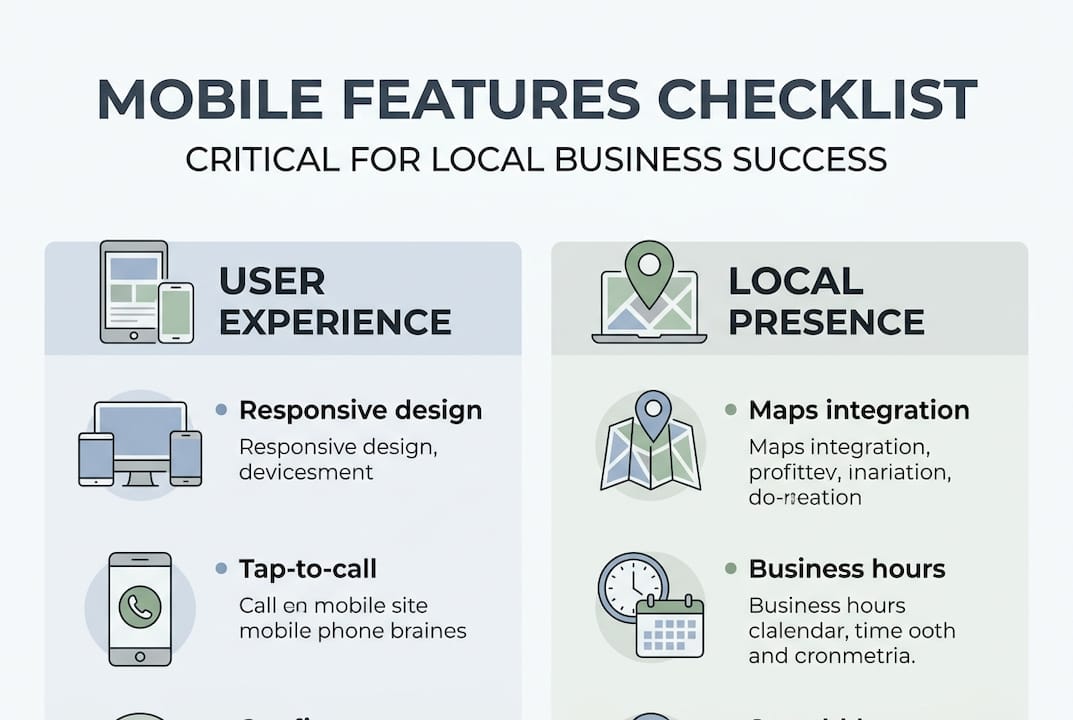
A mobile-friendly and locally optimised profile and website work together. The profile (your Google Business Profile) drives discovery. The website closes the deal. Both need to be excellent.
Pro Tip: Test your site on a real phone, not just a browser’s device simulation. Simulators miss real-world friction like slow load times on cellular data and clumsy touch targets that only become obvious when you’re actually tapping them with your thumb.
Step-by-step: Optimising your site for mobile and local search
Here’s a practical process you can follow today, whether you’re doing this yourself or directing someone who manages your site.
-
Run a speed test. Use Google PageSpeed Insights (free) and enter your homepage URL. You’ll get a score from 0 to 100 for mobile specifically, along with a list of specific issues to fix. Common culprits include unoptimised images, excessive scripts, and slow hosting. Aim for a score above 70 on mobile.
-
Test mobile usability in Search Console. If you have Google Search Console set up (and you should), navigate to the “Mobile Usability” report. It will flag pages with issues like text too small to read, clickable elements too close together, and content wider than the screen.
-
Update your Google Business Profile (GBP). Your GBP is often the first thing a mobile user sees, before they even visit your site. Make sure your hours, address, service area, phone number, and categories are all current and accurate. Add photos regularly. Respond to every review. These signals feed directly into local ranking. Optimising your GBP for near me on-the-go searches is one of the highest-return actions you can take.
-
Implement local schema markup. Schema is structured data code that tells search engines exactly what your business is, where it’s located, what it offers, and how to contact you. LocalBusiness schema, Service schema, and Review schema are the three most valuable for local service businesses.
-
Audit your NAP consistency. NAP stands for Name, Address, Phone number. These must match exactly across your website, GBP, and every directory listing you appear in. Inconsistencies confuse search engines and erode local ranking signals.
-
Simplify your navigation. Mobile menus should have five items or fewer. Every page should have a clear next action, whether that’s calling, requesting a quote, or viewing your services.
Here’s a quick comparison to help you decide how to approach this:
| Approach | Best for | Typical timeline | Cost range |
|---|---|---|---|
| DIY audit and fixes | Owners comfortable with web platforms | 2 to 4 weeks | Low (time investment) |
| Freelance developer | Specific technical issues | 1 to 2 weeks | Moderate |
| Full-service SEO partner | Ongoing visibility and ranking growth | Ongoing | Higher, but ROI-driven |
We’ve seen sector-specific optimization tips make a real difference for trades businesses in particular. A roofing company in Calgary and a cleaning service in Halifax have different competitive landscapes, and the optimization approach should reflect that. If you want to understand the full picture of what moves the needle for your specific service category, exploring Canada local SEO visibility strategies tailored to your industry is worth the time.
Pro Tip: After making changes, submit your updated sitemap in Google Search Console and request indexing for your most important pages. This speeds up how quickly Google sees and rewards your improvements.
How to measure mobile optimization success
Making changes is step one. Knowing whether they’re working is step two. Here’s how to track the metrics that actually matter.
Mobile traffic share is your starting baseline. In Google Analytics 4, navigate to Reports, then Demographics and Tech, then select “Device Category.” You want to see what percentage of your visitors are on mobile. For most local service businesses, this should be between 60% and 80%. If it’s much lower, that tells you something about who’s finding you and how.
Call clicks are gold. In Google Search Console and GBP Insights, you can see how many users clicked your phone number directly from search results. This is a direct conversion metric. Track it weekly. If it’s flat after optimization, revisit your tap-to-call placement and GBP accuracy.
Direction requests in GBP Insights tell you how many people asked Google Maps to route them to your location or service area after finding your profile. This is a strong local intent signal and a leading indicator of foot traffic and service calls.
Form fills and quote requests are the downstream result of everything working together. Track these in Google Analytics by setting up conversion goals for your contact or booking form.
Key metrics to monitor monthly:
- Mobile bounce rate (lower is better; aim below 50%)
- Average session duration on mobile (longer means engaged users)
- Mobile conversion rate (calls, forms, bookings)
- GBP views and actions (calls, directions, website clicks)
- Position in local pack for key service terms
Ranking higher in mobile search translates directly to more local traffic and more customer acquisition. Businesses that move from page two to the local three-pack (the top three map results) regularly see call volume double or more.
Pro Tip: Set a monthly 30-minute calendar reminder to review your GBP Insights and Google Analytics mobile report side by side. Patterns emerge over time that single snapshots miss. This habit alone will put you ahead of most local competitors.
Understanding the connection between mobile search and ChatGPT recommendations is also worth your attention. AI assistants are increasingly citing local businesses in their responses, and that visibility channel is growing rapidly alongside traditional search.
What most guides miss about local mobile optimization
Here’s the uncomfortable truth we’ve learned working with Canadian SMBs: most business owners treat mobile optimization as a one-time project. They fix the obvious things, check a few boxes, and move on. But local mobile SEO is a living system, not a checkbox.
The businesses we see stagnate are the ones who went “mobile-friendly” two years ago and assumed that was done. The businesses we see grow are the ones building real, ongoing signals. Fresh photos on their GBP every month. Responding to every review within 24 hours. Adding new service pages that match exactly how customers in their neighbourhood actually search.
Hyper-local signals matter far more than most guides acknowledge. Mentioning specific neighbourhoods, local landmarks, and service-area communities throughout your site content creates relevance that a generic “serving the Greater Toronto Area” statement never will. Google is looking for specificity. So are customers.
Quick fixes tend to backfire. We’ve seen businesses install a “mobile theme” over a broken site structure and wonder why rankings dropped. Sustainable results come from building the right foundation and maintaining it consistently. The AI SEO lessons we share come directly from watching what works and what doesn’t across real Canadian local service businesses. The patterns are clear: consistency and genuine local engagement outperform technical shortcuts every time.
Take your local business mobile with expert help
Mobile optimization is one of the highest-leverage investments a Canadian local service business can make right now. But getting it right across your site, your GBP, your schema, and your ongoing content takes time and expertise that most business owners simply don’t have to spare.
That’s exactly what we do at Locally Visible. Our done-for-you AI SEO process is built specifically for Canadian local service businesses who want to be found in search and cited by AI tools like ChatGPT. We handle the technical setup, the local signals, the ongoing optimization, and the reporting so you can focus on running your business. Explore our AI SEO pricing or visit Locally Visible to see how we help businesses like yours grow through smarter search visibility.
Frequently asked questions
What is mobile optimization and why does it matter for my local business?
Mobile optimization ensures your website functions well on smartphones, making it faster and easier for customers to find and contact you. Mobile-friendly and locally optimised profiles directly improve your SEO and lead generation.
How can I check if my website is mobile-friendly?
Google’s Mobile-Friendly Test and the Mobile Usability report in Google Search Console will quickly identify any issues preventing your site from performing well on phones and tablets.
Which mobile site features should every Canadian local business include?
Every local service site needs responsive design, tap-to-call buttons, integrated maps, clearly visible hours, and customer reviews. BDC.ca recommends a mobile-friendly site with strong local focus as a core SEO requirement for small businesses.
Does optimising for ‘near me’ really attract more customers in Canada?
Absolutely. “Near me” searches represent high-intent buyers who are ready to hire immediately, and optimising your GBP and mobile site for these queries puts your business in front of them at exactly the right moment.
When should I get expert help for mobile optimization?
If your rankings aren’t improving after making changes, or if the technical side feels overwhelming, a professional partner can accelerate results and prevent costly mistakes that slow down your progress.