
What AI means for digital marketing success in Canada
Canadian small and medium-sized businesses are no longer sitting on the sidelines when it comes to artificial intelligence. 71% of Canadian SMBs are already using AI tools to drive efficiency and growth, and local service businesses are very much part of that shift. If you run a plumbing company in Calgary, a landscaping operation in Mississauga, or a cleaning service in Halifax, AI is no longer a luxury reserved for tech giants. This guide breaks down exactly what AI means in practical digital marketing terms, where it makes the biggest difference, and how you can start using it to win more local customers without losing control of your brand.
Table of Contents
- Defining AI in digital marketing for local Canadian businesses
- How AI drives results across the digital marketing lifecycle
- Agentic AI: Autonomous support that puts you in control
- Practical tips to adopt and succeed with AI in your marketing
- A practical perspective: Why AI alone won’t win the race for local service marketing
- Ready to amplify your marketing? AI solutions for local services
- Frequently asked questions
Key Takeaways
| Point | Details |
|---|---|
| AI adoption is rising | Most Canadian local businesses now use AI to boost marketing efficiency and results. |
| Human oversight is crucial | AI enhances campaigns but your expertise and review remain essential for success. |
| Agentic AI needs guidance | Advanced AI can act on your behalf, but always requires your approval before making changes. |
| Start small, build ROI | Layer AI tools into your marketing efforts gradually and measure the impact to scale up effectively. |
Defining AI in digital marketing for local Canadian businesses
Let’s start with the basics. Artificial intelligence (AI) refers to software that can analyse data, learn patterns, and make decisions or recommendations without needing a human to program every step. In digital marketing, this shows up in three main forms: machine learning (algorithms that improve with more data), automation (tools that handle repetitive tasks like sending emails or adjusting ad bids), and agentic AI (more advanced systems that can reason through multiple steps and take actions on your behalf, more on that in the next section).
For a local service business owner, AI content creation tools can write a first draft of your Google Business Profile description in seconds, while automation tools can send a follow-up SMS to a lead who filled out your contact form. These aren’t futuristic concepts. They’re available right now, often built into tools you may already be paying for.
Here’s a quick look at where AI sits across the marketing task spectrum:
| Marketing task | Simple AI/automation | Advanced agentic AI |
|---|---|---|
| Email marketing | Auto-send follow-ups based on triggers | Personalise content and send timing for each contact |
| Google Ads | Schedule ads by time of day | Suggest and apply bid changes, generate ad copy variants |
| Social media | Auto-post at optimal times | Analyse engagement and recommend new content angles |
| Reporting | Pull basic performance data | Synthesise insights and suggest strategic pivots |
| Lead follow-up | Send templated responses | Qualify leads and route them based on intent signals |
Notice the pattern: simple AI handles the mechanical tasks, while advanced agentic AI starts doing the thinking. The key principle here, and this is critical, is that AI is positioned as a tool to scale personalisation and automation while keeping human oversight firmly in place.
Think of it like having a very capable junior employee. You’d review their work before it goes out. The same logic applies to AI. We refer to this balance as the “co-pilot” model: AI does the heavy lifting, you provide the direction, context, and final approval. Your visibility strategies still need a human hand steering them.
How AI drives results across the digital marketing lifecycle
Understanding what AI is gives you the foundation. Now let’s look at how it actually moves the needle across the four key stages of local digital marketing: content creation, ad targeting, lead conversion, and reporting and measurement.
Each stage has traditionally required either expensive agency help or a significant time investment from business owners. AI changes that equation considerably.
Comparing traditional vs. AI-powered approaches:
| Marketing stage | Traditional approach | AI-powered approach |
|---|---|---|
| Content creation | Write from scratch or hire a copywriter | Draft content in minutes, then refine for your brand voice |
| Ad targeting | Manual audience setup, slow iteration | Automation examples like smart bidding and real-time audience adjustments |
| Lead conversion | Leads sit in a spreadsheet until follow-up | Instant qualification and automated nurture sequences |
| Reporting | Pull data manually from multiple platforms | AI synthesises data and flags what actually matters |
Here’s a numbered look at how a typical AI-enhanced marketing workflow might run for a local HVAC company:
- Identify your target audience using AI tools that analyse your past customers and suggest lookalike segments in your city or region.
- Generate content for your Google Business Profile, local landing pages, and social media using AI writing tools calibrated to your service area and tone.
- Launch Google Ads with AI-powered smart bidding that adjusts your bids in real time based on the likelihood of conversion for each search.
- Qualify inbound leads automatically using a chatbot or AI-driven form that sorts urgent calls from general inquiries and triggers the right follow-up sequence.
- Review performance with an AI reporting dashboard that highlights which ads, keywords, and pages are generating booked jobs rather than just clicks.
- Refine and repeat based on the patterns AI surfaces, while your experienced judgment shapes the strategy going forward.
AI affects all stages of a local marketing programme, from creative and targeting through to conversion and measurement, and the businesses seeing the best results are those treating AI as a system, not a single tool.
“The businesses winning with AI aren’t replacing their marketing instincts. They’re amplifying them.”
This is exactly what AI for lead generation looks like in practise: faster, more consistent follow-up with less manual effort. Keep in mind that AI content detection is increasingly used by search engines and readers alike, so your AI-generated content must still sound authentically like your business.
Pro Tip: Treat every AI output as a first draft. Review tone, accuracy, and local relevance before anything goes live. A plumber in Winnipeg and one in Victoria serve different markets, even if an AI doesn’t automatically know the difference.
Agentic AI: Autonomous support that puts you in control
Here’s where things get genuinely exciting, and where business owners most need to pay attention. Agentic AI goes beyond simple automation. It reasons through problems, takes multi-step actions, and can even implement changes on your behalf. But the crucial word is “can.” Whether it does depends entirely on the permissions you grant.

Google’s Ads Adviser, currently in beta, is a practical example most local service businesses will eventually encounter. Ads Adviser takes multi-step actions and provides campaign insights, but requires your review and explicit approval before any changes go live. This is not a small detail. It’s the entire architecture that makes agentic AI safe for businesses that can’t afford a botched ad campaign.
Here’s what agentic AI can realistically do for your local digital marketing right now:
- Suggest and implement ad copy changes based on performance data, with your approval at each step
- Auto-generate performance reports that go beyond raw numbers and explain what drove results week over week
- Identify underperforming keywords in your Google Ads account and recommend replacements aligned with local search intent
- Draft responses to customer reviews that match your brand’s tone, ready for you to review and post
- Optimise landing pages by testing different headlines or calls to action, then escalating the winner automatically
- Flag budget inefficiencies across campaigns and suggest reallocation before you’ve even noticed the problem
For an introduction to how this fits the broader search landscape, our AI-powered search guide covers the full picture. On the operational side, service optimisation tips show how AI thinking extends well beyond just marketing.
The exciting element of agentic AI is the time it saves. For a business owner who is also managing crews, quoting jobs, and handling customer calls, the ability to hand off repetitive campaign management tasks to an AI agent is genuinely transformative. The caution is this: you are still responsible for every output. An AI agent won’t apologise to your client if the wrong ad runs. You will.
Pro Tip: Never enable full automation without setting up a review step first. A simple rule of thumb: if an AI action would cost you money or reach customers publicly, it needs a human sign-off every single time.
Practical tips to adopt and succeed with AI in your marketing
Understanding AI is one thing. Deploying it successfully in a local service business is another. Here’s a clear, step-by-step approach we recommend to clients across Canada.
- Choose one specific problem to solve first. Don’t try to automate everything at once. Start with the task that costs you the most time, whether that’s following up with leads, writing Google Business Profile posts, or generating monthly reports.
- Set measurable goals before you launch anything. “Use AI more” is not a goal. “Reduce lead response time from 24 hours to under 2 hours” is a goal. Clear benchmarks let you evaluate what’s working.
- Select tools that integrate with what you already use. If you’re on HubSpot, explore its native AI features before subscribing to a separate tool. Fragmented tech stacks create more problems than they solve.
- Train yourself and your team before you go live. Even a 30-minute walkthrough of how a new AI tool makes decisions will prevent costly mistakes and build the confidence to use it consistently.
- Run a pilot campaign before full deployment. Test AI-generated content or automated follow-up sequences on a small segment of your audience. Measure the results honestly before scaling.
- Review and refine monthly. Canadian SMBs report efficiency gains with AI, but consistently attribute those gains to ongoing human refinement, not set-and-forget automation.
Common pitfalls to avoid:
- Ignoring quality control. AI can produce confident-sounding content that’s factually wrong or tonally off-brand. Always review before publishing.
- Over-trusting automation. An ad campaign running unchecked for two weeks can burn through your budget fast. Schedule regular check-ins.
- Not tracking results properly. If you don’t know your baseline metrics before adopting AI, you won’t know whether it’s actually helping.
- Using generic AI outputs without localising them. AI doesn’t inherently know that your customers in Saskatoon have different seasonal needs than those in Kelowna. You do.
For practical AI content for local businesses, the best results come from combining AI efficiency with locally informed context. Think of AI as the engine and your local expertise as the steering wheel.
A practical perspective: Why AI alone won’t win the race for local service marketing
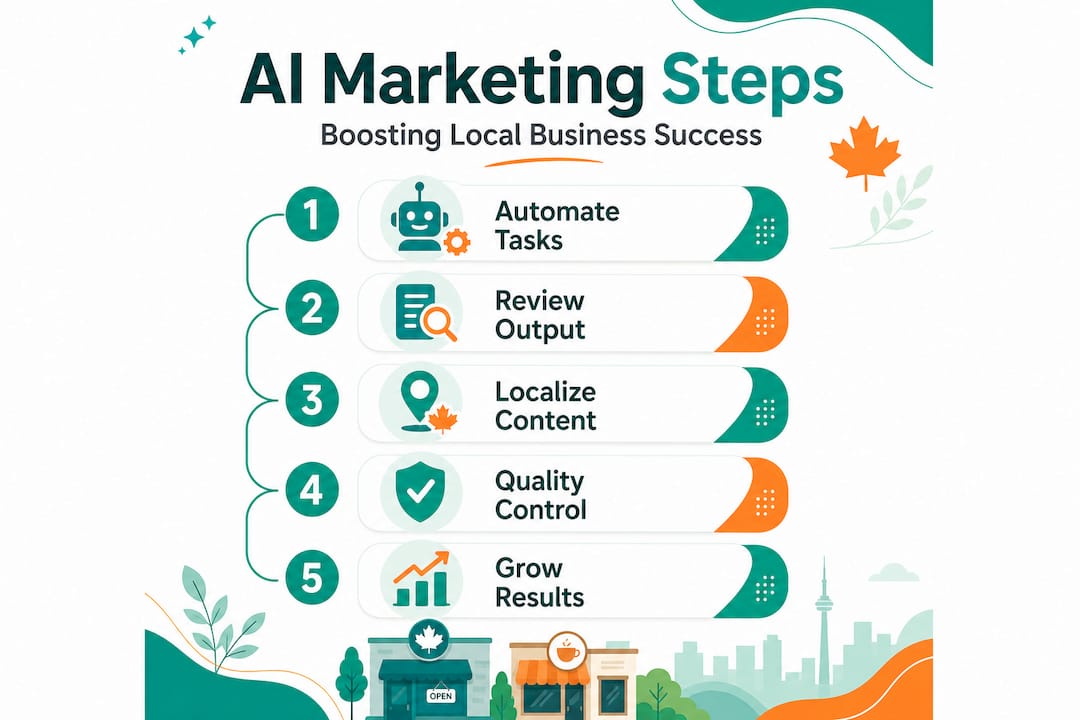
We’ll be direct here: AI is one of the most powerful tools local service businesses have ever had access to. And it’s also one of the most overhyped solutions we see being sold right now.
Here’s the uncomfortable truth. Most of the businesses seeing genuine, lasting results from AI in their local marketing aren’t the ones who handed everything over to a tool and walked away. They’re the ones who used AI to free up time and then invested that time in the things AI genuinely cannot do: deepening customer relationships, developing local reputation, and making nuanced decisions about their brand’s direction.
AI cannot replicate the trust a long-time customer has in you personally. It cannot read the room when a community event changes what your neighbourhood cares about that month. It cannot replace the judgment call you make when a client’s situation doesn’t fit neatly into a campaign template.
Google is explicit about this. Users must always check and approve AI outputs before they go live. That requirement isn’t just a legal disclaimer. It reflects a genuine truth: the final layer of accountability in your marketing is always you.
We’ve seen businesses invest in AI tools, see an initial efficiency bump, and then plateau because they stopped engaging critically with the outputs. The flywheel only keeps spinning when a human keeps feeding it real-world context. Your reviews, your seasonality, your local partnerships, your customer language: all of that needs to flow back into your AI strategy regularly, or the outputs start to drift from what actually converts.
Good AI quality control practises are what separate businesses that grow with AI from those that just experiment with it. The smartest approach is to treat AI as a high-output colleague who needs briefing, feedback, and oversight, not a vending machine you deposit tasks into.
Ready to amplify your marketing? AI solutions for local services
If this guide has made one thing clear, it’s that AI in digital marketing isn’t complicated in principle. The complexity is in the execution: choosing the right tools, configuring them for your specific market, and keeping human judgment at the centre.
At Locally Visible, we’ve built our entire service around making that execution easy for Canadian local service businesses. Whether you run a roofing company in Edmonton or a wellness clinic in Ottawa, our done-for-you AI search visibility solutions are designed for your industry and your market. Explore our AI SEO by industry pages to see exactly how we approach businesses like yours. We’re so confident in the results that we back our work with a clear AI marketing guarantee: get cited by ChatGPT within 90 days, or we work free until you are. Book a discovery call and let’s talk about what AI-powered visibility can actually look like for your business.
Frequently asked questions
What is the simplest way to start using AI in digital marketing for my local business?
Begin with AI tools that automate content creation, customer interactions, or basic ad targeting to save time and resources. Starting points like AI-driven content and lead capture are among the most accessible entry points for local service owners with limited marketing budgets.
Will AI replace the need for human marketers in local Canadian service businesses?
No, AI is a support tool, and final decisions, relationship-building, and brand judgement always require knowledgeable human oversight. Google’s Ads Adviser stresses that users remain responsible for all AI-generated changes, which reinforces that humans must stay in the loop.
How does agentic AI differ from basic marketing automation?
Agentic AI reasons through multiple steps, proactively suggesting and implementing actions, while basic automation simply executes pre-set rules. Agentic AI takes multi-step actions with your approval at each stage, making it far more dynamic than a standard email trigger or ad scheduler.
Does using AI guarantee more leads and sales?
AI can improve targeting efficiency and reduce response time, but effective results depend on ongoing testing, clear strategy, and active human input. Canadian SMBs report efficiency gains with AI, while also acknowledging that human oversight remains essential for sustainable growth.
Recommended
- AI content detection: boost your local business visibility — Locally Visible
- What is AI-powered search? Guide for Canadian service businesses — Locally Visible
- What is AI-powered search? Guide for Canadian service businesses — Locally Visible
- How AI transforms content for Canadian local businesses — Locally Visible