
Why update business listings: a local service owner’s guide
Two-thirds of consumers have visited a business only to find the information online was wrong, and a significant portion never returned. For Canadian plumbers, electricians, landscapers, and other local service providers, that is not an abstract statistic — it is a lost booking, a lost review, and a lost referral. Understanding why update business listings matters is not about ticking a box on your digital marketing checklist. It is about protecting the revenue your business depends on, every single day.
Table of Contents
- How inaccurate business listings hurt your local service
- What consistency means and why it matters for your business listings
- How often should you update your business listings and why timing matters
- Steps to maintain accurate business listings and prevent costly errors
- Why accurate listings matter more than ever in the age of AI-driven search
- The uncomfortable truth about business listings most owners overlook
- How Locally Visible helps Canadian service businesses master their listings
- Frequently asked questions
Key Takeaways
| Point | Details |
|---|---|
| Incorrect listings cause lost customers | Two-thirds of consumers encounter wrong info online, deterring visits and trust. |
| NAP consistency boosts local SEO | Exact matches of name, address, and phone across platforms improve rankings. |
| Update frequency depends on changes | Immediate updates plus quarterly or monthly reviews prevent data drift. |
| AI search increases listing importance | AI tools amplify errors, so accuracy is crucial for modern local discovery. |
| Ongoing monitoring is essential | Continuous audits and fixes protect against errors and lost revenue. |
How inaccurate business listings hurt your local service
The consequences of outdated listings are more severe than most owners expect. When a potential customer in your neighbourhood searches for your service, finds your number, calls it, and gets a disconnected tone — that customer does not wait. They move on to your competitor within seconds. The damage is immediate and silent; you never even know it happened.
Trust takes years to build and seconds to lose online. 80% of consumers lose trust in a local business the moment they encounter incorrect contact details. Think about that from a customer’s perspective: if your address is wrong, they wonder what else you got wrong. It signals carelessness, and in service industries where you are entering someone’s home or property, carelessness is disqualifying.
The impact does not stop at customer perception. Search engines actively compare your listing data across the web. When they find conflicting information — your phone number listed differently on three separate directories — they treat those as separate, unverified entities. This inconsistency can drop your local search visibility by 30%, pushing you further down the results page while competitors with cleaner data rise above you.
Here is what inaccurate listings actually cost you:
- Lost calls from customers who dial a wrong number and assume you are out of business
- Missed visits from customers who show up at a former address
- Suppressed rankings because search engines cannot confidently verify your location
- Eroded trust that takes months of good reviews to partially rebuild
- Wasted ad spend if paid campaigns drive traffic to listings with wrong information
“A business that invests in excellent service but neglects its listing data is like a shop with great products but a locked front door. The quality is real — but customers cannot find their way in.”
Understanding why SEO matters for service businesses is the first step. Accurate listings are the foundation that SEO is built on.
What consistency means and why it matters for your business listings
NAP consistency refers to having your business Name, Address, and Phone number match exactly across every directory, platform, and website where your business appears. Exactly means exactly. Not “Smith Plumbing Ltd.” on one platform and “Smith Plumbing” on another. Not “123 Main St.” versus “123 Main Street.” Those differences look minor to a human reader, but they create confusion for search engines.

Google treats even minor variations in your business name, address, or phone number as different entities. Each discrepancy dilutes the authority signals that would otherwise push you up the local rankings. You are essentially splitting your credibility across multiple phantom versions of your business.
Search engines and AI platforms rely on consistent NAP data from trusted sources to build confidence about your business. The more consistently your information appears across quality platforms, the more confidently a search engine will recommend you.
Here is a quick comparison that illustrates what consistency looks like in practice:
| Listing element | Consistent (correct) | Inconsistent (problematic) |
|---|---|---|
| Business name | Oakwood Electrical Services | Oakwood Electrical / Oakwood Elec. Services |
| Address | 45 Rideau Avenue, Ottawa, ON | 45 Rideau Ave, Ottawa / 45 Rideau, Ottawa ON |
| Phone number | (613) 555-0192 | 613-555-0192 / +16135550192 |
| Hours | Mon–Fri 8am–6pm | Mon–Fri / 8:00–18:00 / varies |
| Website URL | https://oakwoodelectrical.ca | oakwoodelectrical.ca / www.oakwoodelectrical.ca |
The tier of the platform matters too. Tier-1 platforms, meaning Google Business Profile, Yelp, Bing Places, and Facebook, carry the heaviest weight. Getting those right first is the priority. Tier-2 platforms like Yellow Pages Canada and industry-specific directories follow. Each correct citation reinforces the others.
Pro Tip: Create a single canonical NAP document — a locked reference file — that lists the exact spelling, punctuation, and formatting of your business name, address, phone number, and website URL. Every person who updates your listings uses this document. No exceptions. This one habit prevents most consistency problems before they start.
To boost local service visibility across Canada, NAP consistency is not optional — it is the baseline.
How often should you update your business listings and why timing matters
Keeping listings current is not a one-time project. It is an ongoing responsibility, and the right frequency depends on how often your business changes. The importance of accurate business listings is directly tied to how quickly your updates follow real-world changes.
The optimal update frequency depends on your business dynamics. Stable businesses with consistent hours and contact details do well with quarterly audits. Businesses with seasonal services, changing staff, new locations, or frequent phone number updates need monthly reviews at minimum.
Here is a clear schedule to follow:
- Immediately: Update listings the moment you change your phone number, address, email, or business name. Every hour of delay is potential lost business.
- Within 48 hours: Reflect any change in operating hours, especially around holidays. A customer who shows up on Boxing Day expecting you to be open will not be forgiving.
- Monthly: Review your Google Business Profile posts, service descriptions, and photos if your offerings change regularly.
- Quarterly: Audit all major directories for accuracy, check for new duplicate listings, and confirm your website URL and contact form are functioning.
- Annually: Conduct a full citation audit across all platforms, including tier-2 and industry-specific directories, to catch any data drift introduced by third-party aggregators.
The reasons to keep listings current go beyond SEO rankings. A roofing company that updates its seasonal services in January, before the spring rush, will capture searches from customers planning ahead. A pest control business that adds “wasp nest removal” to its listings in July will appear in local searches that competitors miss entirely.
Pro Tip: Set a recurring calendar reminder for your quarterly audit. Treat it like a utility bill — not something you skip. Thirty minutes every three months will protect you from the kind of listing errors that cost you calls without your ever knowing it.
If you want to generate local service leads reliably, regular listing maintenance is the most underrated lever available to you.
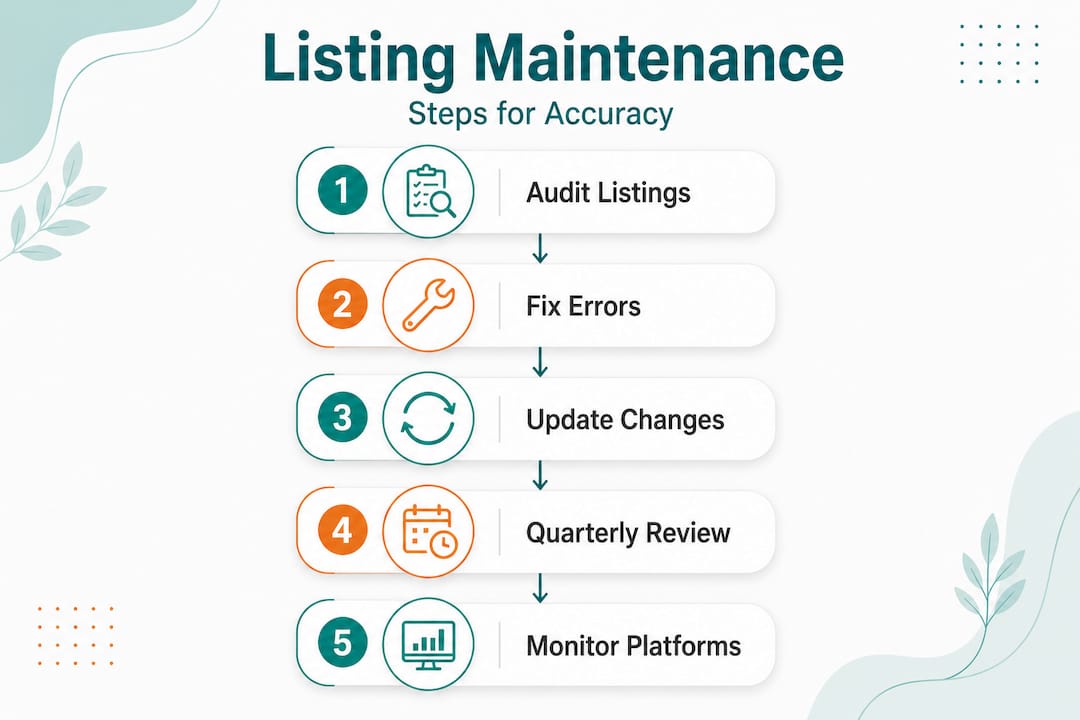
Steps to maintain accurate business listings and prevent costly errors
Knowing you need accurate listings is one thing. Having a repeatable process to maintain them is another. Here is how to build that process.
Businesses that fix inconsistencies across 40-plus quality citations rank 53% higher in local results — that is not a marginal lift. It is the difference between page one and page two. And duplicate listings reduce local search visibility by up to 30%, compounding the problem if left unaddressed.
Step-by-step listing maintenance:
- Run a citation audit using a tool like BrightLocal or Moz Local to identify where your business is listed and flag inconsistencies.
- Fix tier-1 platforms first: Google Business Profile, Yelp, Bing Places, Facebook, and Apple Maps.
- Address tier-2 platforms next: Yellow Pages Canada, Foursquare, and regional directories.
- Search for and claim duplicate listings, then request removal or merge them where the platform allows.
- Update your service descriptions and category selections to reflect exactly what you offer today, not what you offered two years ago.
- Add recent photos. Listings with photos receive significantly more clicks and calls than those without.
| Common listing error | Impact | Fix |
|---|---|---|
| Wrong phone number | Lost calls, distrust | Update all platforms immediately using canonical NAP doc |
| Old address | Wasted visits, negative reviews | Priority fix on tier-1 platforms within 24 hours |
| Duplicate listings | 30% visibility drop | Claim and remove duplicates via each platform |
| Missing hours | Customer frustration | Add full hours including statutory holidays |
| Inconsistent business name | Diluted local rankings | Standardise to exact canonical name across all listings |
| No photos | Lower engagement | Add 5-10 current, high-quality images |
Ongoing monitoring tips:
- Set up Google Alerts for your business name to catch new inaccurate mentions early
- Check your Google Business Profile insights monthly to spot traffic drops tied to listing changes
- Monitor your Google Business Profile visibility for sudden ranking shifts that may signal a data conflict
- Ask your team to flag any customer calls mentioning wrong addresses or hours — that is real-time feedback
- Use a spreadsheet or citation management tool to track which platforms have been updated and when
For broader local SEO for service businesses, listing maintenance is the most controllable factor you have. Algorithm changes are unpredictable. Your own data accuracy is not.
Why accurate listings matter more than ever in the age of AI-driven search
Search behaviour in Canada is shifting fast. Nearly half of consumers now use AI tools weekly or daily for local searches. They are asking ChatGPT, Gemini, and Perplexity questions like “Who is the best electrician near me in Mississauga?” and trusting the answers. If your listing data is inconsistent across sources, AI tools will either surface the wrong information or, worse, skip your business entirely in favour of one with cleaner data.
This is where the impact of listing updates on SEO gets amplified. Traditional search engines rank pages. AI models synthesise information from many sources simultaneously. AI tools aggregate data from multiple platforms at once, meaning any inconsistency is not just one ranking signal gone wrong — it is a conflict that causes the AI to lower its confidence in recommending your business.
Here is what this means practically for your business:
- Visibility: AI-driven results favour businesses with clear, consistent, multi-platform data over those with conflicting signals
- Trust signals: An AI tool that finds three different phone numbers for your business will not recommend you confidently to a user
- Consumer behaviour: Customers who use AI to vet businesses before calling expect the details to match — if they do not, the call never happens
- Competitive edge: Most of your local competitors have not adapted to AI-driven search yet; accurate listings right now is a real advantage
“AI-powered search doesn’t just read your website. It cross-references every platform that mentions your business and looks for coherence. Inconsistencies don’t get ignored — they get penalised.”
Understanding how AI transforms local search for Canadian businesses is no longer a future concern. It is a present-day competitive reality for every local service owner in Canada.
The uncomfortable truth about business listings most owners overlook
Here is something we see repeatedly: a business owner spends an afternoon fixing all their listings, feels confident the job is done, and then does nothing for 18 months. Within six months of that fix, data has drifted again. Not because they changed anything — because someone else did.
Third-party data aggregators like Acxiom and Neustar gather business information from dozens of sources and distribute it to hundreds of directories. If their records contain your old address from three years ago, they will push that outdated information out to platforms that pull from them, quietly overwriting the corrections you made. You never receive a notification. You never see it happen. Your listing just silently reverts to wrong.
This is why treating listing accuracy as a one-time project is a costly mistake. The businesses we see winning in local search treat their listing data as infrastructure — the same way they treat their vehicles, their insurance, or their tools. It needs regular maintenance because the environment around it keeps changing, independent of what you do.
The owners who get this right share a few habits. They have a canonical NAP document and it never changes without a deliberate decision. They have someone assigned to listing audits on a schedule. They use a monitoring tool or a service that flags changes automatically. And they understand that being visible to local customers in 2026 requires treating digital infrastructure with the same discipline they apply to their physical operations.
The gap between a business that manages this well and one that ignores it is growing wider every year as AI search increases the weight placed on data consistency. Should you update your business information? Yes. Immediately, and then again next quarter.
How Locally Visible helps Canadian service businesses master their listings
If reading this has made it clear that listing management is more involved than a one-time fix, you are right. And you do not have to manage it alone.
Locally Visible is built specifically for Canadian local service businesses that want accurate, AI-ready citation data without spending hours maintaining it themselves. Our AI-driven approach by industry means your citations are tuned to how search engines and AI tools evaluate businesses in your specific trade. Automated scans detect inconsistencies before they cost you customers. Ongoing monitoring prevents data drift from third-party aggregators silently undoing your work. And our 90-day citation guarantee means you are cited by ChatGPT within 90 days — or we keep working until you are, at no extra charge. For Canadian service businesses that compete on trust and local reputation, that is a meaningful promise.
Frequently asked questions
Why does updating my business listings regularly matter?
Regular updates keep your contact details accurate across all platforms, preventing customer confusion and supporting stronger local search rankings. 66% of consumers have encountered wrong business information online, resulting in lost trust and missed visits.
How often should I check and update my business information?
Update immediately after any change to your contact details or hours, then perform quarterly audits for stable businesses or monthly reviews if your services, hours, or staff change frequently.
What is NAP consistency and why is it important?
NAP consistency means your business name, address, and phone number match exactly across every listing online. Google treats small variations in NAP as separate entities, which harms your local SEO performance.
Can duplicate listings affect my business visibility?
Yes. Duplicate listings confuse both customers and search engines, and duplicate listings reduce local search visibility by up to 30%, while also diluting your reviews and credibility.
How does AI-driven search influence the need for accurate listings?
AI tools pull data from multiple sources simultaneously, so inconsistencies are amplified rather than averaged out. AI-powered search amplifies data conflicts, making accurate and consistent listings essential for discovery and consumer trust.