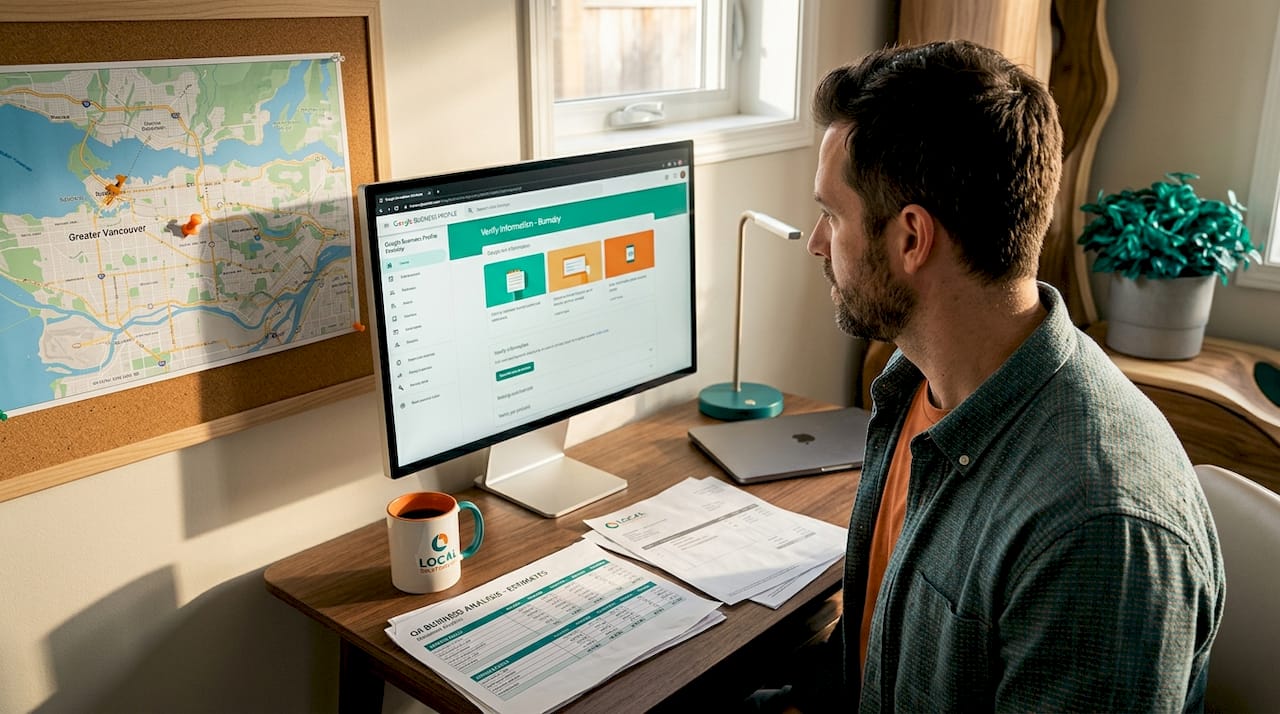
Service area businesses explained: Local growth strategies
If you run a plumbing, cleaning, landscaping, or mobile mechanic business in Canada, there’s a strong chance you already operate as a service area business (SAB) without fully understanding what that means for your Google presence, compliance obligations, or marketing strategy. The distinction matters more than most owners realise. Getting your business model classified correctly shapes how you appear in local search, whether your Google Business Profile gets suspended, and how efficiently you attract paying customers across your territory. This guide cuts through the confusion and gives you clear, actionable direction.
Table of Contents
- What defines a service area business in Canada?
- Google Business Profile: Service area rules and best practices
- Local marketing and Google Local Services Ads: Opportunities and requirements
- Service area business models and growth trends in Canada
- A fresh perspective: Avoiding common mistakes and unlocking SAB advantages
- Optimise your service area and local reach
- Frequently asked questions
Key Takeaways
| Point | Details |
|---|---|
| Clear SAB definition | Service area businesses deliver or visit customers and do not serve at a public address. |
| GBP compliance rules | Set up to 20 realistic service areas in Google, keeping your address private to stay compliant. |
| Marketing advantages | Local Services Ads and Google Verified boosts visibility and lead generation for Canadian SABs. |
| Economic impact | SABs drive growth in Canada’s service sector and meet the needs of a changing population. |
| Avoiding pitfalls | Overclaiming service areas risks suspension; use territory mapping to optimise reach and customer satisfaction. |
What defines a service area business in Canada?
Not all local businesses work the same way, and Google does not treat them the same way either. Understanding where your operation fits is the first step toward smarter local marketing.
According to Google Business Profile Help, a service area business is a type of business that visits or delivers directly to customers but does not serve them at its own business address. Classic Canadian examples include plumbers, cleaners, mobile mechanics, HVAC technicians, dog groomers who travel to homes, electricians, and pest control companies. These businesses go to the customer rather than the reverse.
There are three distinct business model types you need to know:
- Service area business (SAB): Travels to customers, has no public-facing location, and should hide its address on Google.
- Storefront business: Serves customers at a fixed, publicly accessible location (a retail shop, a clinic, a restaurant). Address is always shown.
- Hybrid business: As noted by Google Business Profile Help, hybrid businesses serve customers both at their address (which must have visible signage) and via service areas. The address is shown publicly alongside defined service zones.
Understanding your model affects your marketing, your compliance, and your customer reach. A plumber who runs a van-based operation from a home address is a textbook SAB. A plumbing company that runs a showroom where customers select fixtures is a hybrid. The rules for each are different.
Why does this matter? Misclassifying your business as a storefront when you are truly an SAB can trigger a Google suspension. Showing a home address publicly when you should be hiding it also creates privacy and safety risks for the business owner.
Correct classification also affects how you implement schema markup for service area businesses, the structured data that tells search engines and AI tools exactly what your business does and where. Get the classification right first, and every downstream decision becomes cleaner.
Google Business Profile: Service area rules and best practices
With the business definitions clarified, let’s explore the digital rules and practical steps for service area businesses on Google.
Your Google Business Profile (GBP) is your most important free marketing asset as an SAB. But there are specific rules you must follow or risk losing visibility entirely.
Here is how to set up and maintain a compliant GBP as a Canadian SAB:
- Verify your address privately. You must use a legitimate address (your home, warehouse, or registered office) for verification purposes. Google sends a postcard or uses other verification methods. The address itself is never shown to the public.
- Hide your address from the profile. Once verified, go into your GBP settings and remove the public address. Leaving it visible when you do not serve customers there violates Google’s guidelines and risks suspension.
- Define your service areas using cities, regions, or postal codes. According to Google’s guidelines, SABs can define up to 20 service areas and should stay within approximately two hours’ driving time from their base. Do not use a radius setting as your primary boundary.
- Keep service areas realistic. If you are based in Mississauga, claiming Hamilton, Guelph, and Oshawa is reasonable. Claiming Ottawa or Kingston is not realistic within two hours and will signal over-claiming to Google.
- Update areas as your business grows. Your GBP service areas are not permanent. Revisit them quarterly, especially if you hire new team members or expand your fleet.
Here is a quick comparison of how the three business models handle Google Business Profile settings:
| Setting | SAB | Storefront | Hybrid |
|---|---|---|---|
| Address shown publicly | No | Yes | Yes |
| Service areas defined | Yes (up to 20) | No | Yes |
| Physical signage required | No | Yes | Yes |
| Verification address needed | Yes (private) | Yes (public) | Yes (public) |
Pro Tip: Use a free territory mapping tool like Smappen or BatchGeo to visualise your realistic drive-time zones before selecting your GBP service areas. This prevents the temptation to over-claim and keeps your profile clean.
Risks of over-claiming are real. If you list service areas you cannot realistically serve within a reasonable drive time, you invite negative reviews from frustrated customers who waited too long, and Google’s algorithms can flag or suspend your listing. For schema markup compliance and overall trust signals, precision matters far more than coverage.
Businesses like mobile mechanics and residential cleaners that use a disciplined plumber compliance strategy approach, where service areas match operational capacity, consistently outperform those that chase territory they cannot serve well.
Local marketing and Google Local Services Ads: Opportunities and requirements
Once compliant with Google profiles, businesses can attract more customers using Local Services Ads. Here is how to get started and what to know.
Google Local Services Ads (LSA) are a powerful, pay-per-lead advertising format designed specifically for service businesses. Unlike traditional pay-per-click ads, you only pay when a verified lead contacts you. For Canadian SABs, this is a significant opportunity.
According to Google Local Services Ads Canada, LSAs are available for mechanics, plumbers, and many other home service categories across Canada. The model requires licence and insurance verification, and qualified businesses earn the Google Verified badge, which appears prominently in search results.
Here is what the Google Verified badge delivers:
- Increased trust: Customers see that Google has screened your business.
- Top placement: Verified LSA listings appear above standard paid search ads.
- Higher lead conversion: The badge signals credibility, which reduces friction for first-time customers.
- Dispute protection: Google offers a lead credit system if you receive invalid leads.
| Feature | Traditional Google Ads | Local Services Ads |
|---|---|---|
| Cost model | Pay per click | Pay per lead |
| Verification required | No | Yes (licence/insurance) |
| Google badge displayed | No | Yes (if verified) |
| Placement position | Below LSAs | Top of search results |
| Lead quality control | None built-in | Dispute and credit system |
The verification process requires you to submit proof of valid business licences and current insurance coverage. This varies by province and trade. An HVAC technician in Ontario will need different documentation than a cleaning company in British Columbia. Start by confirming the licence requirements in your specific province before applying.
For home service businesses looking to build a reliable pipeline, SEO for home services combined with LSAs creates a powerful one-two approach: organic search builds long-term visibility while LSAs generate immediate, qualified leads. You can explore detailed lead generation tactics that complement your LSA investment and keep your calendar full year-round.
Quick tip on budgeting: LSA costs vary by trade and region. Plumbing leads in Toronto may cost more than cleaning leads in a mid-sized city like Kelowna. Set a monthly cap, track your cost per acquired customer carefully, and adjust by season. Winter plumbing demand spikes in most Canadian markets, so increase budgets accordingly.
Service area business models and growth trends in Canada
Marketing strategies are only effective when matched to industry trends and local demand. Let us review how SABs are shaping Canada’s service economy.
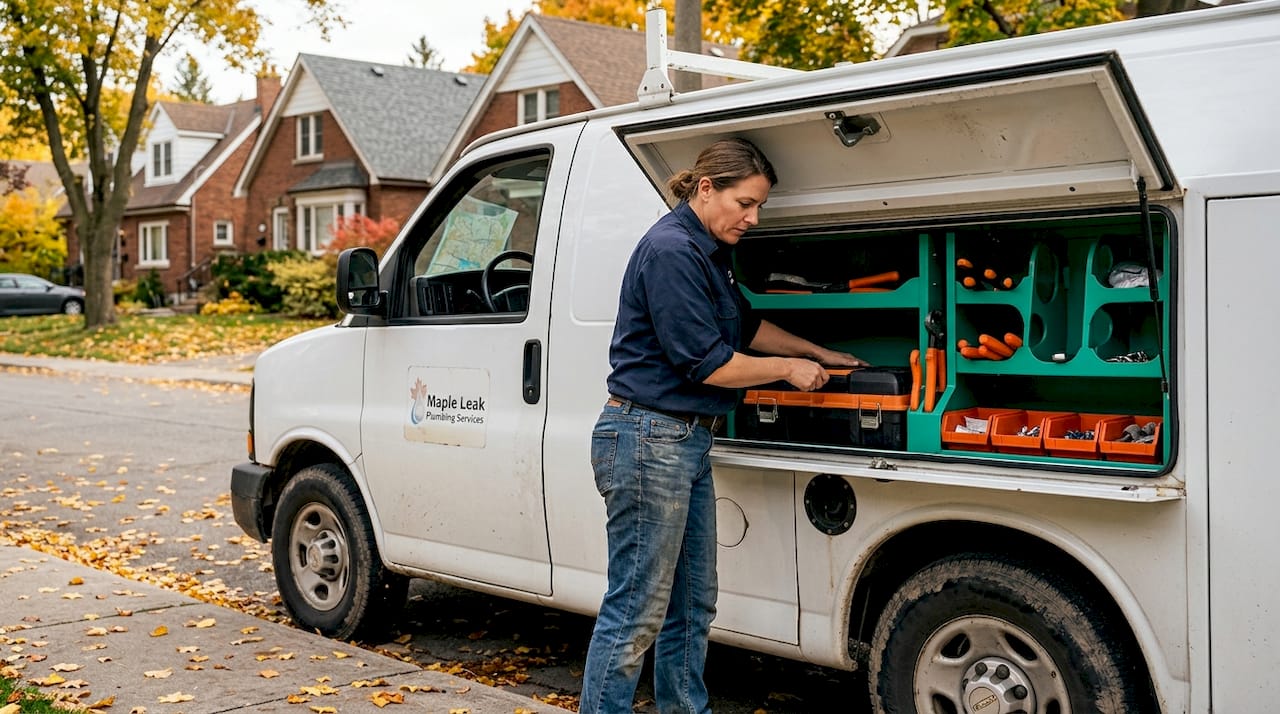
Canada’s service sector is not just growing. It is accelerating. Franchising alone contributes $120B to GDP and employs 2M Canadians, and an ageing population is expected to push seniors to 25% of Canada’s population by 2035, driving massive demand for home-based and mobile services. Think home health aides, snow removal, meal delivery, appliance repair, and accessibility renovation.
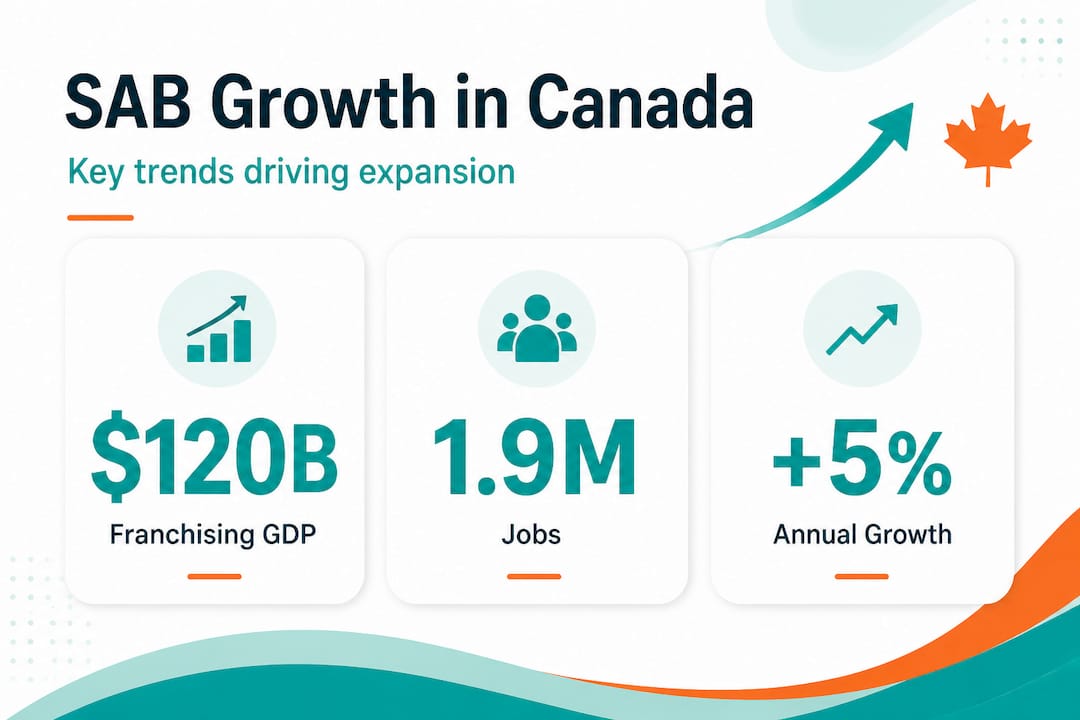
This demographic shift is not a distant trend. It is already reshaping which SABs thrive in suburban and rural markets. Services that help older Canadians stay in their homes longer are seeing consistent double-digit demand growth.
Here is a snapshot of sectors experiencing the strongest SAB growth in Canada:
| Service category | Growth driver | Key markets |
|---|---|---|
| Home health and personal care | Ageing population | Ontario, British Columbia, Alberta |
| HVAC and plumbing | Infrastructure age, climate | All major cities |
| Residential cleaning | Dual-income households | Toronto, Vancouver, Calgary |
| Mobile auto repair | Convenience demand | Suburban and rural markets |
| Landscaping and snow removal | Seasonal, year-round cycle | Prairie provinces, Ontario |
Several additional trends are reshaping the SAB landscape across Canada:
- Franchising as a growth vehicle: Many independent SABs are converting to franchise models to access established branding, territory protection, and marketing support.
- Technology-enabled dispatch: Routing and job management software is making it easier for smaller SABs to compete with larger operators by reducing wasted drive time.
- On-demand customer expectations: Customers increasingly expect same-day or next-day service. SABs that can meet this expectation improve profitability in field services by reducing scheduling gaps and no-shows.
- Niche specialisation: Broad “handyman” services are losing ground to specialists. Businesses that dominate one service category in a defined territory outperform generalists on both search visibility and customer retention.
Understanding the service business types available in Canada gives you a clearer picture of where your business fits and which growth paths are most aligned with your current capacity and local market.
A fresh perspective: Avoiding common mistakes and unlocking SAB advantages
We have worked with enough Canadian home service businesses to spot a clear pattern: the businesses that struggle most are not the ones with the least talent or the smallest territory. They are the ones who over-claim on Google and under-deliver in practice.
Overclaiming service areas is the single most damaging mistake an SAB can make. It feels like smart marketing to list every city within 300 kilometres of your base. In reality, you are setting yourself up for late arrivals, stretched crews, poor reviews, and ultimately a Google profile suspension. Realistic drive-time zones using territory mapping consistently outperform inflated service areas on every metric that matters: customer satisfaction, repeat bookings, and review velocity.
Here is what we find often gets overlooked. Territory mapping is not just a compliance exercise. It is a profitability tool. When you know exactly which postal codes fall within a 45-minute drive from your base during peak hours, you can route jobs more efficiently, reduce fuel costs, and schedule more appointments per day. That efficiency directly translates to better margins without adding a single new employee.
The second overlooked advantage is licensing and insurance documentation. Many Canadian SABs treat this as a bureaucratic hurdle. We treat it as a marketing asset. When you are Google Verified, when your LSA profile shows valid credentials, and when your location compliance tips are built into your GBP from day one, you project authority that competitors who cut corners simply cannot match.
The businesses growing fastest in Canada’s service sector right now are doing three things consistently: keeping their territory honest, keeping their credentials current, and investing in search visibility that compounds over time. The rest are fighting over the same overcrowded, low-quality leads. The choice is clear.
Optimise your service area and local reach
Understanding your SAB classification is just the beginning. Putting that knowledge to work in search, in Google Business Profile, and in Local Services Ads is where real growth happens.
At Locally Visible, we specialise in done-for-you AI search visibility for Canadian local service businesses. We handle the technical setup, compliance, territory strategy, and content that gets you cited by ChatGPT and ranked in Google. Our work spans SEO for Canadian service industries including plumbing, cleaning, HVAC, landscaping, and beyond. Whether you are starting from scratch or cleaning up a profile that has stalled, our industry-specific SEO services are built for exactly the kind of business you run. We are so confident in what we do that if you are not cited by ChatGPT within 90 days, we work free until you are.
Frequently asked questions
How do I set service areas in Google Business Profile?
Service area businesses can select up to 20 areas using cities, postal codes, or regions, staying within roughly two hours’ drive from their base. Choose realistic areas that reflect where you can consistently deliver quality service.
What happens if I overclaim my service area?
Overclaiming service areas risks Google profile suspensions and negative customer reviews from unmet expectations. Use territory mapping tools to define only the zones you can reliably serve within a reasonable drive time.
Can a business be both a storefront and service area business?
Yes. Hybrid businesses serve customers at a physical address with visible signage and also define service areas on Google. The business address is shown publicly, unlike a pure SAB.
What verification is required for Local Services Ads in Canada?
To participate in Local Services Ads in Canada, businesses must verify their licences and insurance, which earns the Google Verified badge and boosts visibility in search results above standard paid ads.
Why are service area businesses important in Canada’s economy?
SABs are central to Canada’s growing service sector, with franchising contributing $120B to GDP and an ageing population driving sharply rising demand for home-based and mobile service delivery across every province.
Recommended
- Business visibility strategies for Canadian local services — Locally Visible
- Business visibility strategies for Canadian local services — Locally Visible
- Proven strategies to generate leads for local services — Locally Visible
- Reach Canadian customers: proven strategies for local growth — Locally Visible
- Effective ways to promote your business locally in the UK
- Field service optimisation tips: 5 strategies for efficiency