
Proven strategies to generate leads for local services
Most local service businesses in Canada rely too heavily on word-of-mouth referrals, and that’s a fragile foundation. When a neighbour stops recommending you, or a slow season hits, the phone goes quiet. The good news: there’s a clear, repeatable system for generating quality digital leads that works specifically in Canadian cities and towns. This article walks you through everything from assessing your local market to executing high-impact tactics and winning against tough urban competition. Whether you’re a plumber in Calgary or a cleaner in Toronto, these strategies will help you build a lead pipeline you can actually count on.
Table of Contents
- Understanding your local market and lead sources
- Essential setup: tools and profiles you need
- Step-by-step guide to digital lead generation tactics
- Advanced strategies: winning in urban and competitive markets
- What most lead generation guides get wrong for Canadian services
- Take your local lead generation to the next level
- Frequently asked questions
Key Takeaways
| Point | Details |
|---|---|
| Know your market | Researching your local area and competitors is the foundation for successful lead generation. |
| Use trusted digital tools | Setting up LSAs, Google Business Profile, and industry citations builds credibility and discoverability. |
| Optimise for mobile and local | Mobile-ready and hyper-local digital tactics work best for Canadian services seeking new leads. |
| Test and adapt in cities | Refine your approach with hyper-local pages and citation strategies to win in competitive urban markets. |
Understanding your local market and lead sources
Let’s start by taking a holistic look at where your future leads can actually come from and what every Canadian business owner should analyse first.
Before you spend a dollar on ads or an hour building profiles, you need to understand your local landscape. Your city’s competitive density matters enormously. A painting contractor in a mid-sized city like London, Ontario operates in a very different environment than one in Vancouver, where dozens of firms are competing for the same searches every day.
Where your leads actually come from
Most local service leads originate from a handful of sources. Knowing which channels drive the most volume in your specific trade helps you focus your energy where it counts:
- Google Search and Maps: The dominant discovery tool for urgent local services like plumbing, electrical, and HVAC
- Online directories: Platforms like HomeStars, Houzz, and Yelp Canada carry significant weight for trades and home services
- Local Services Ads (LSAs): A pay-per-lead programme from Google specifically designed for service businesses, with pay-per-lead costs ranging from $20 to $150 CAD and conversion rates between 20 and 40%
- Social referrals: Facebook community groups and Nextdoor remain strong for neighbourhood-level trust
- Direct referrals: Still valuable, but inconsistent when relied upon alone
Understanding the types of service businesses that thrive in your area helps you benchmark what a realistic lead volume looks like and which tactics your competitors are using.
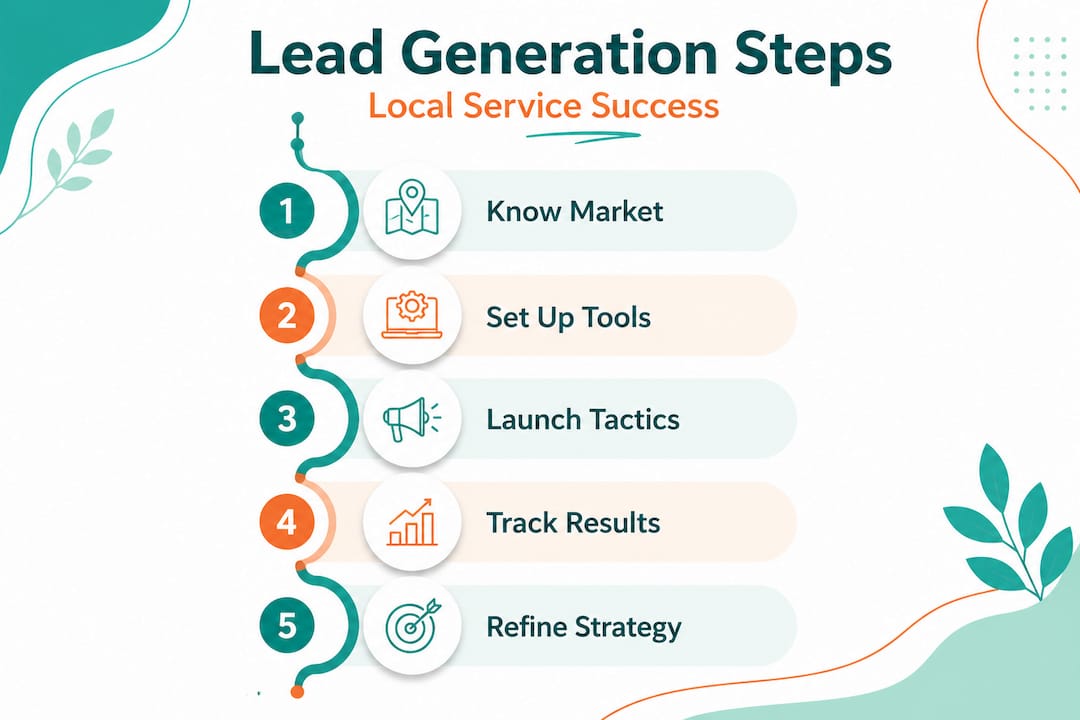
Mapping your competitive landscape
Search your top service keywords in an incognito browser window in your city. Who appears in the top three Google Map results? Do your competitors have Google Guaranteed badges? How many reviews do they have, and how recent are those reviews? This quick audit reveals exactly which channels you’re competing on and where you have an opening.
| Lead source | Average cost per lead | Conversion rate | Best suited for |
|---|---|---|---|
| Local Services Ads (LSA) | $20 to $150 CAD | 20 to 40% | Trades, cleaning, HVAC |
| Google Ads (Search) | $15 to $80 CAD | 5 to 15% | Competitive urban markets |
| HomeStars / Houzz | $30 to $100 CAD | 8 to 18% | Contractors, renovators |
| Organic local SEO | Low ongoing cost | 10 to 25% | Long-term visibility |
| Social media ads | $5 to $40 CAD | 3 to 10% | Brand awareness, retargeting |
This kind of comparison grounds your budgeting decisions in reality. And once you understand AI-powered search basics, you’ll also see why AI-driven discovery tools are increasingly influencing which businesses get found first.
Essential setup: tools and profiles you need
Now that you know your options, let’s make sure you have the right digital foundation in place, because missing just one key tool can limit your results significantly.
Think of your digital presence as a house. Your Google Business Profile is the front door. Your citations are the street address. Your LSA account is the trust signal that says you’ve been vetted. You need all three to compete in 2026.
Your setup checklist
- Claim and verify your Google Business Profile. Add accurate hours, services, service areas, photos, and a business description using natural language your customers would actually search. Consistency here feeds directly into local SEO rankings.
- Apply for Local Services Ads. LSA categories in Canada include plumbers, electricians, HVAC technicians, cleaners, locksmiths, and several other trades. The Google Guaranteed badge earned through LSA approval adds visible credibility right at the top of search results.
- Claim your industry directories. HomeStars, Yelp Canada, Houzz, and Yellow Pages Canada are non-negotiable starting points. Consistent name, address, and phone number (NAP) data across all directories strengthens your local SEO signal.
- Set up a review request process. After every completed job, send a follow-up text or email with a direct link to your Google review page. Review velocity, the pace at which you accumulate new reviews, is one of the strongest ranking signals in local search.
- Install basic website tracking. Google Analytics and Google Search Console take less than 30 minutes to set up and give you real data on what’s driving traffic.
Comparing your key platforms
| Platform | Cost structure | Approval required | Badge/trust signal | Best for |
|---|---|---|---|---|
| Google Business Profile | Free | Yes (postcard/phone) | Local Pack ranking | All local services |
| Local Services Ads | Pay per lead | Yes (background check) | Google Guaranteed | High-urgency trades |
| HomeStars | Free + paid tiers | Yes (reviews verified) | Best of HomeStars | Contractors, renovators |
| Yelp Canada | Free + paid ads | No | Yelp rating badge | Restaurants, services |
Pro Tip: Don’t apply for LSA until your Google Business Profile is fully optimised with at least 10 reviews. Google’s approval algorithm favours profiles with strong social proof already in place, and it can speed up the vetting process considerably.
Good reputation management practices are the connective tissue between all of these platforms. A business with 80 five-star reviews and a Google Guaranteed badge will outperform one with better services and no digital proof, every single time.
Step-by-step guide to digital lead generation tactics
With your setup complete, you’re ready to put proven digital tactics into practice that actually drive leads.
Here’s the thing: most business owners try everything at once and measure nothing. The businesses that win are the ones that execute a small number of tactics well and track what’s moving the needle.
Your lead generation playbook
- Activate LSAs and set your weekly budget. Start conservatively, around $200 to $300 CAD per week, to test lead quality before scaling. LSAs show conversion rates up to 40% for eligible Canadian service businesses, which makes them one of the highest-ROI tools available.
- Optimise your Google Business Profile weekly. Post updates, add new photos, respond to every review (positive and negative), and update your service list seasonally. An active profile signals relevance to Google’s algorithm.
- Build location-specific service pages on your website. If you serve five neighbourhoods, create a distinct page for each one with locally relevant content. This is how AI SEO for plumbing and other trades gains traction in competitive markets.
- Run targeted Google Search Ads with location extensions. Use exact-match and phrase-match keywords around your highest-margin services. Exclude irrelevant search terms (called negative keywords) to stop burning budget on people who aren’t ready to hire.
- Implement a structured follow-up sequence. Speed-to-response is critical in local services. Studies consistently show that responding to a lead within five minutes dramatically increases your chances of closing the job. Use an automated text response when you can’t pick up the phone.
High-impact mobile and local optimisation
Mobile visibility is not optional. Over 70% of local service searches happen on mobile devices, and most users make contact decisions within seconds of landing on a page. Your website must load in under three seconds, display your phone number prominently, and have a one-tap call button above the fold.
- Make sure your site uses HTTPS (secure connection)
- Compress all images to under 200KB
- Use schema markup (structured data) so search engines understand your business category, service areas, and hours
- Test your site on three different phones before launching any ad campaign
Tracking what actually matters
Set up conversion tracking in Google Ads for phone calls and contact form submissions. Review your LSA dashboard weekly to assess lead quality and dispute any leads that don’t match your services. If you’re using AI-powered equipment tracking for field operations, integrate that data with your lead tracking to understand job profitability by lead source.
Statistic callout: LSAs deliver conversion rates between 20 and 40% for eligible Canadian service categories, compared to 5 to 15% for standard Google Search Ads. For high-urgency services, that gap in performance directly translates to more booked jobs per dollar spent.
Advanced strategies: winning in urban and competitive markets
When you’re up against tough competition in the city, you’ll need to think beyond the basics. Here’s how the best local firms do it.

Urban Canadian markets like Toronto, Vancouver, Montreal, and Calgary are genuinely difficult. Dozens of businesses are bidding on the same keywords, chasing the same directory placements, and requesting reviews from the same pool of customers. You need differentiation that goes beyond having a nice logo.
Hyper-local content and pages
For services in Canadian cities, testing hyper-local pages and trusted local citations is one of the clearest competitive advantages available. A hyper-local page isn’t just swapping the city name into a template. It includes neighbourhood-specific offers, local landmarks as reference points, mentions of local events or seasonal conditions (think ice storm pipe bursts in Ottawa or spring flooding in Abbotsford), and genuine customer stories from that area.
Here are the key elements that make a hyper-local page rank and convert:
- A unique headline referencing the specific neighbourhood (e.g., “Emergency plumber serving Leslieville and the Beach in Toronto”)
- A locally relevant introductory paragraph that reads naturally, not like keyword stuffing
- At least one verified customer review from a client in that specific area
- A Google Map embed showing your service radius
- Local schema markup indicating your service area boundaries
Citations and strategic partnerships
Local citations mean having your business listed consistently across dozens of relevant directories. But in urban markets, quantity alone isn’t enough. Quality and relevance matter more. Getting listed on a trusted local business association site or a neighbourhood improvement district directory carries far more authority than appearing on a generic national listing site.
Partnerships with complementary businesses are an underused strategy. A plumber who has a referral agreement with a local property management company gets warm leads with built-in trust. A landscaper who partners with a real estate agent taps into a consistent stream of clients preparing homes for sale. Knowing how to present your services well as part of that curb appeal preparation process can be a genuine differentiator when positioning yourself to realtor networks.
“In urban Canadian markets, the businesses that win aren’t necessarily the best at the job. They’re the best at being found, trusted, and remembered when the need arises.”
Explore AI SEO by industry to find tactics specific to your trade. What works for a residential cleaner in Burnaby differs meaningfully from what works for an electrical contractor in downtown Calgary.
What most lead generation guides get wrong for Canadian services
Now that we’ve covered proven strategies, let’s get real about what actually works and why most online advice misses the mark for Canadian business owners.
Here’s our honest assessment after working with dozens of local service businesses across Canada: the vast majority of lead generation content online is written for the American market. It references tools, directories, and search behaviours that don’t map cleanly onto Canadian realities.
Take LSAs as one example. The categories available, the approval process, and the trust signals that resonate with Canadian consumers are meaningfully different from what you’d find in a US market guide. Canadian searchers tend to place a higher premium on verified badges and strong review histories before making contact. That makes reputation management and citation consistency not just supporting tactics, but foundational ones.
We’ve also seen too many Canadian service businesses chase quick wins through tactics like purchased reviews or low-quality link schemes. These approaches don’t just fail. They actively damage the trust signals that Google and AI search tools use to rank your business. Let that sit for a second: a shortcut today can cost you years of organic visibility.
What actually works is consistent, local-specific investment in your digital presence. The businesses we see generating the most qualified leads aren’t running the flashiest ad campaigns. They’re maintaining accurate profiles, earning steady reviews, publishing useful local content, and showing up reliably across every touchpoint a customer might encounter. That flywheel, once spinning, generates compounding returns.
Visibility strategies in Canada need to account for regional search behaviour, bilingual considerations in Quebec and parts of Ontario, seasonal demand patterns, and the specific competitive density of your trade in your city. Generic playbooks skip all of that. Build yours with local context baked in from the start.
Take your local lead generation to the next level
If you’re ready to see real, measurable lead growth tailored to your unique Canadian market, here’s how Locally Visible can help.
We built Locally Visible specifically for Canadian service businesses that are tired of generic SEO advice and ready for results that actually show up in their booking calendar. Our done-for-you approach covers how AI SEO works in practice, from citation building and schema implementation to LSA optimisation and AI search visibility. You get a system designed around your trade, your city, and your growth goals.
We cover industry-specific SEO for trades, cleaners, landscapers, contractors, and more, with strategies built for Canadian markets rather than borrowed from American playbooks. Our guarantee is straightforward: you get cited by ChatGPT and other AI search tools within 90 days, or we keep working at no additional charge. If you’re serious about building a lead generation system that compounds over time, Locally Visible is where that journey starts.
Frequently asked questions
What is the average cost per lead for Local Services Ads in Canada?
Local Services Ads typically charge between $20 and $150 CAD per lead, depending on the industry and city. Trades like plumbing and electrical tend to sit at the higher end due to competitive demand.
Do all service types qualify for Google Local Services Ads in Canada?
LSA eligibility in Canada is limited to select categories including plumbing, electrical, HVAC, cleaning, and locksmith services. If your trade isn’t listed, focus on optimising your Google Business Profile and organic local SEO instead.
How can I increase my conversion rate from digital leads?
Verified trust signals like the Google Guaranteed badge and a strong recent review history raise customer confidence and push conversion rates to between 20 and 40% for LSA leads. Responding to inquiries within five minutes also has a significant impact on close rates.
Which strategy is best for competing in a big city?
Hyper-local service pages and accurate, high-quality local citations give you a measurable edge in urban Canadian markets. Pair those with consistent review velocity and LSA activation for the strongest combined effect.
Recommended
- Why SEO matters for service businesses: boost local visibility — Locally Visible
- Boost local business visibility with mobile optimization — Locally Visible
- Business visibility strategies for Canadian local services — Locally Visible
- How ChatGPT picks who to recommend — Locally Visible
- Top property marketing strategies for Cape Coral rentals