
Email marketing strategies for Canadian local service businesses
Most Canadian local service businesses send emails that disappear into inboxes without a click, a reply, or a booking. The problem is rarely effort. It is strategy. Inconsistent messaging, missing compliance steps, and one-size-fits-all campaigns drain marketing budgets and frustrate owners who expected better results. The good news is that service business types across Canada, from plumbers to personal trainers, are seeing strong returns when they apply targeted, compliant email strategies built for their specific niche. This guide walks you through exactly how to build, launch, and optimise campaigns that retain clients and grow revenue.
Table of Contents
- Understanding email marketing compliance in Canada
- Setting up your email marketing system: tools and essentials
- Crafting campaigns: what content works for local services
- Automation and frequency for maximum retention
- What most guides miss about email marketing for Canadian local services
- Take your local email marketing further with Locally Visible
- Frequently asked questions
Key Takeaways
| Point | Details |
|---|---|
| Follow CASL rules | Gain customer trust and avoid severe penalties by meeting Canadian Anti-Spam Legislation requirements. |
| Engage through automation | Build retention and sales by sending relevant automated email sequences rather than random blasts. |
| Prioritise segmentation | Small, well-segmented email lists achieve higher click rates and revenue per campaign. |
| Optimise frequency | Industry-specific benchmarks help you find the right balance of sending often enough without overwhelming subscribers. |
| Leverage story-driven content | Emotional, locally relevant content drives customer action—illustrated by Canadian and global success examples. |
Understanding email marketing compliance in Canada
Now that we have established email marketing’s potential, it is critical to understand compliance obligations before sending your first campaign. Canada’s Anti-Spam Legislation, known as CASL, is one of the strictest email marketing laws in the world. Getting it wrong is not just embarrassing. It is expensive.
CASL requires express or implied consent before sending commercial electronic messages (CEMs) to Canadians, along with clear sender identification, an unsubscribe link honoured within 10 business days, and records kept for 3 years. Penalties reach up to $10 million per violation, and the law applies to any business sending to Canadian recipients, even if you operate outside Canada.
Understanding the difference between express and implied consent is essential:
- Express consent means someone explicitly opted in, for example by ticking a checkbox on your website that says “I agree to receive marketing emails from XYZ Plumbing.”
- Implied consent arises from an existing business relationship, such as a customer who hired you in the past two years, or a person who made an inquiry within the last six months. Implied consent has an expiry date, so you must track it carefully.
Once implied consent expires, you cannot continue sending marketing emails unless the recipient gives express consent. This is where many small businesses slip up. They assume that because someone hired them three years ago, they can keep emailing forever. CASL says otherwise.
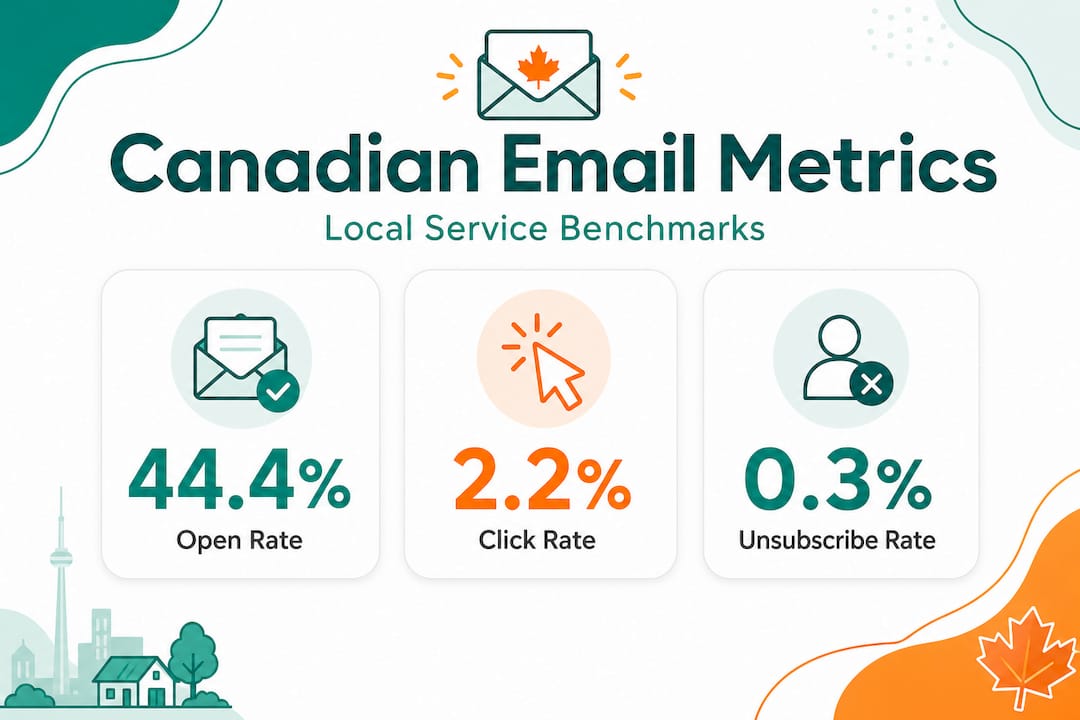
Canadian email benchmarks to know:
| Metric | Canadian average |
|---|---|
| Open rate | 44.43% |
| Click-through rate | 2.24% |
| Unsubscribe rate | 0.34% |
| Hard bounce rate | 0.27% |
| Emails sent per year | ~34 |
These figures come from 12,000+ Canadian organisations, meaning they reflect real local market conditions rather than global averages heavily skewed by large US brands. Government, education, and healthcare sectors tend to outperform on open rates because their messages are perceived as highly relevant, which is a strong hint for service businesses: relevance drives opens far more than send volume.
Pro Tip: Build a simple spreadsheet or CRM tag system to track consent type, consent date, and expiry for every contact. Automate a reminder to re-engage expiring implied consent contacts at least 30 days before the deadline.
Setting up your email marketing system: tools and essentials
With compliance in hand, your next step is assembling the right email system and processes tailored for local services. The platform you choose shapes everything from how easily you segment your list to whether your signup forms collect proper CASL-compliant consent language.
When evaluating tools, prioritise these features:
- Automation workflows for welcome sequences and follow-ups
- Segmentation to separate new leads from repeat clients and cold contacts
- CASL-compliant consent fields built into signup forms
- Deliverability reporting so you catch bounce issues early
- Integration with your booking software or CRM
Here is a quick comparison of common platforms suited for small Canadian service businesses:
| Platform | Best for | CASL support | Starting cost (CAD) |
|---|---|---|---|
| Mailchimp | General small business | Manual setup | Free to ~$20/month |
| Cyberimpact | Canadian-first compliance | Built-in | ~$25/month |
| Klaviyo | E-commerce and service hybrid | Manual setup | Free to ~$30/month |
| ActiveCampaign | Automation-heavy services | Manual setup | ~$29/month |
Cyberimpact stands out for Canadian businesses because it was built with CASL compliance in mind and stores data on Canadian servers, which also satisfies PIPEDA and Quebec’s Law 25 requirements. That matters if you serve clients in Quebec, where privacy regulations are stricter.
The Canadian Marketing Association’s 2025 data reinforces something that gets overlooked: smaller lists with deeper segmentation outperform large, undifferentiated lists. Canadian marketers are shifting focus from open rates to click rates and revenue per email, which tells you that the quality of your list matters more than its size.
Your signup flow deserves as much attention as your campaign content. Place consent checkboxes on your website contact form, booking page, and any paper sign-in sheets you use on-site. The checkbox must be unchecked by default and the consent language must clearly state what type of emails the person will receive. Vague language like “join our newsletter” leaves you exposed under CASL.
Pro Tip: Review your signup UX at least once per quarter. Check for pre-ticked boxes, unclear consent language, or broken forms. One friction point can quietly shrink your list growth for months.
For broader proven local growth strategies that complement email, integrating your list-building efforts with your search visibility work creates a compounding effect where new visitors from Google or AI tools become email subscribers who then book repeat services.
Crafting campaigns: what content works for local services
Once you have the infrastructure ready, it is time to focus on campaign content and strategies that resonate with local clients. Most service business owners default to promotional blasts, “10% off this week only” sent to everyone. That approach exhausts your list and trains subscribers to ignore you.
Here are the five email types that consistently work for Canadian local service businesses:
- Welcome sequence (3 emails over 2 weeks): Introduce your business, share a client success story, and invite a first booking or consultation.
- Seasonal offers: Tie promotions to Canadian seasons. An HVAC company emailing about furnace tune-ups in September, before the cold hits, will outperform a generic discount email every time.
- Educational newsletters: A landscaper sharing lawn care tips for Canadian winters builds authority and keeps the business top of mind without a hard sell.
- Re-engagement campaigns: Target contacts who have not opened or clicked in 90 days with a single, direct subject line like “Still interested in help with your plumbing?”
- Post-service follow-ups: Automated emails 3 to 5 days after a job is completed, asking for a review or offering a maintenance reminder, are some of the highest-converting emails you can send.
Prioritising automation over one-off campaigns is a principle that applies directly here. A welcome sequence running on autopilot 24 hours a day outperforms a manually sent newsletter every month. A/B test subject lines on your automated sequences, particularly the welcome email, because that is the message every new subscriber sees.
Story-driven content is another underused asset for local service owners. A case study about how your team helped a family in Mississauga deal with a flooded basement during last spring’s storms creates emotional resonance that a generic promo never will.
“Bakery businesses using story-driven email campaigns saw a 45% lift in sales, while beauticians who sent consistent newsletters reported repeat bookings and increased product sales. The underlying principle transfers directly to any local service.”
Mobile adaptation is non-negotiable. Over 60% of emails are opened on smartphones, and a subject line that gets cut off at 40 characters or a call-to-action button that is too small to tap will kill your results before anyone reads your content. Keep subject lines under 45 characters, use single-column layouts, and make your booking link a large, tappable button.
You can explore specific lead generation tactics to feed your email list consistently, because a great campaign system is only as strong as the flow of new, compliant subscribers entering it.
Automation and frequency for maximum retention
Armed with winning campaign content, focus next on how often and how automatically you engage clients for best retention and response. Frequency is one of the most debated topics in email marketing, and the answer is genuinely industry-specific.
| Industry | Recommended frequency | Primary email type |
|---|---|---|
| Professional services (legal, accounting) | 3 to 4 per month | Thought leadership |
| Restaurants and food services | 1 per week | Weekly specials |
| Home services (plumbing, HVAC, cleaning) | 2 to 3 per month | Seasonal offers, tips |
| Health and wellness (physiotherapy, massage) | 2 per month | Education, promotions |
Industry frequency benchmarks for small businesses show average open rates ranging from 17% to 28% and click-through rates between 2% and 5%, with conversion rates in the same range. If your numbers fall below these benchmarks, the issue is usually relevance, not frequency.
Automation sequences reduce the burden on you while keeping engagement consistent. Here is a practical retention sequence for a home service business:
- Day 0: Welcome email with service overview and booking link
- Day 7: Educational tip relevant to the service (“How to check if your furnace filter needs replacing”)
- Day 21: Soft offer or seasonal promotion
- Day 60: Check-in email asking how things are going
- Day 90: Re-engagement prompt if no booking or click has occurred
This kind of sequence runs in the background and does real retention work without requiring 20 minutes of manual effort per send.
The cost comparison between email and direct mail is worth understanding. Direct mail achieves a 4.4% response rate versus email’s 0.12%, which looks dramatically in favour of direct mail at first glance. However, email costs $1 to $5 per thousand contacts (CPM) compared to $500 to $800 for direct mail. The overall ROI for local services lands in a similar range of 150% to 300% for both channels, but email wins decisively when you have an owned, opted-in list.
For trade businesses, it is worth noting that the same strategic thinking applies to AI SEO for HVAC and AI SEO for plumbing businesses, where email retention supports the broader local visibility flywheel.
Pro Tip: Segment your automation sequences by service type and geography. A client in a rural area has different seasonal needs than one in downtown Toronto. Relevant segmentation, even just two or three audience groups, can lift click rates significantly.
What most guides miss about email marketing for Canadian local services
Most email marketing guides focus relentlessly on growth. More subscribers, more sends, more opens. We think this misses the point for local service businesses, and here is why.
Your goal is not to build a media company. It is to retain good clients, generate repeat bookings, and earn referrals. A local cleaning company with 400 highly engaged, well-segmented email subscribers will outperform a competitor with 4,000 cold contacts every single time. The economics of local services reward depth of relationship, not breadth of reach.
We see this play out constantly. Business owners obsess over list size, then wonder why their campaigns produce flat results. The answer is almost always segmentation. Are you treating a client who has hired you six times the same way you treat someone who made one inquiry 18 months ago? If your email platform has one list and one campaign, you are leaving real money on the table.
CASL compliance is another area where the conventional framing misses the mark. Most guides treat it as a legal burden, a checklist of things to do to avoid fines. We see it differently. A business that rigorously collects express consent, keeps clean records, and honours unsubscribes promptly is building a list of people who genuinely want to hear from them. That changes your open rates, your click rates, and ultimately your bookings. Compliance is not a hurdle. It is a quality filter.
The businesses that expand their offerings successfully, as we explore in our guide on service business expansion, are almost always the ones who already have strong client communication habits. Email is the thread that keeps relationships intact between service appointments and allows you to introduce new services without it feeling like a cold pitch.
Our honest advice: spend less time worrying about your list size and more time making your existing list feel like they are hearing from a business that knows them. Personalise by service history. Acknowledge their local area. Mention the season they are actually experiencing. That depth of engagement is the real competitive advantage.
Take your local email marketing further with Locally Visible
Email marketing is one piece of a broader local visibility strategy, and it works best when paired with strong search presence that keeps your contact list growing with qualified, local leads.
At Locally Visible, we build done-for-you AI search visibility for Canadian local service businesses, making sure you get cited by ChatGPT and found by the clients who need you most in 90 days or we work free until you are. Our services are built specifically for Canadian local industries, from HVAC and plumbing to cleaning, landscaping, and beyond. When your search visibility feeds a well-run, CASL-compliant email strategy, the two channels reinforce each other. New visitors become subscribers, subscribers become repeat clients, and repeat clients become your best source of referrals.
Frequently asked questions
How often should my local service business send marketing emails?
Most professional services send 3 to 4 emails per month focused on thought leadership, while restaurants typically send one per week highlighting weekly specials and promotions.
What consent is needed to send marketing emails in Canada?
You need express or implied consent under CASL; implied consent expires after 2 years from a business relationship or 6 months following an inquiry, after which you must obtain express consent.
What email marketing metrics matter most for Canadian service businesses?
Focus on click rates and revenue per email rather than open rates alone; smaller, segmented lists consistently deliver higher engagement than large, undifferentiated contact databases.
How does email marketing compare to traditional direct mail for local services?
Direct mail achieves higher response rates, but email’s ROI matches direct mail at 150% to 300% for local services while costing a fraction of the price per thousand contacts.
What penalties can local businesses face for violating CASL?
Non-compliance with CASL can result in penalties up to $10 million per violation, and the legislation applies to any business sending commercial electronic messages to Canadian recipients.
Recommended
- Reach Canadian customers: proven strategies for local growth — Locally Visible
- Proven strategies to generate leads for local services — Locally Visible
- What is AI SEO? Boost local visibility for Canadian businesses — Locally Visible
- Business visibility strategies for Canadian local services — Locally Visible